Department of Infection Control Science, Juntendo University Faculty of Medicine, 2-1-1 Hongo, Bunkyo-ku, Tokyo, 113-8421, Japan,
J Infect Chemother. 2013 Oct;19(5):871-5. doi: 10.1007/s10156-013-0584-y. Epub 2013 Apr 5.
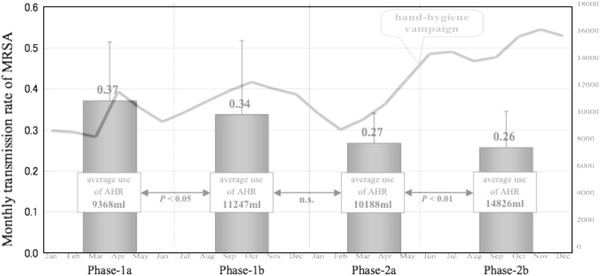
Hospital-wide active surveillance for methicillin-resistant Staphylococcus aureus (MRSA) targeted to adult patients with a history of MRSA carriage within the past 5 years was performed in Juntendo University Hospital (JUH) over a 2-year period. In the first year, MRSA screening culture was ordered by physicians in charge. In the second year, infection-control practitioners (ICPs) took samples for active surveillance culture. The average monthly transmission rate of MRSA in JUH was 0.35 per 1,000 bed-days in the first year and decreased significantly to 0.26 per 1,000 bed-days in the second year (P < 0.05). In the second year, more active commitment of ICPs to MRSA screening was effective in improving the performance rate of screening, shortening turn-around time of screening results, and decreasing transmission rate. Increasing compliance with active MRSA surveillance by involvement of ICPs, targeting patients with a previous history of MRSA carriage in the previous 5 years, was effective to control nosocomial MRSA transmission.
在过去的两年中,顺天堂大学医院(JUH)针对过去 5 年内有 MRSA 携带史的成年患者,对耐甲氧西林金黄色葡萄球菌(MRSA)进行了全院主动监测。在第一年,主治医生下达了 MRSA 筛查培养的医嘱。第二年,感染控制从业人员(ICPs)采集样本进行主动监测培养。在第一年,JUH 中每千个住院日的 MRSA 平均传播率为 0.35,第二年显著下降至 0.26(P<0.05)。第二年,ICPs 更积极地参与 MRSA 筛查,提高了筛查的执行率,缩短了筛查结果的周转时间,降低了传播率。通过 ICPs 的参与,针对过去 5 年内有 MRSA 携带史的患者,提高主动监测 MRSA 的依从性,有效控制了医院内 MRSA 的传播。