Das Kajal, Mittal Bhagwant R, Vasistha Rakesh K, Singh Paramjit, Mathuriya Suresh N
Department of Neurosurgery, Post Graduate Institute of Medical Education and Research, Chandigarh, India.
Indian J Nucl Med. 2011 Oct;26(4):171-6. doi: 10.4103/0972-3919.106698.
To determine whether F-18-fluorodeoxyglucose positron emission tomography (F-18-FDG PET) can be used to differentiate among common enhancing brain tumors such as gliomas, metastatic brain tumors, and lymphoma.
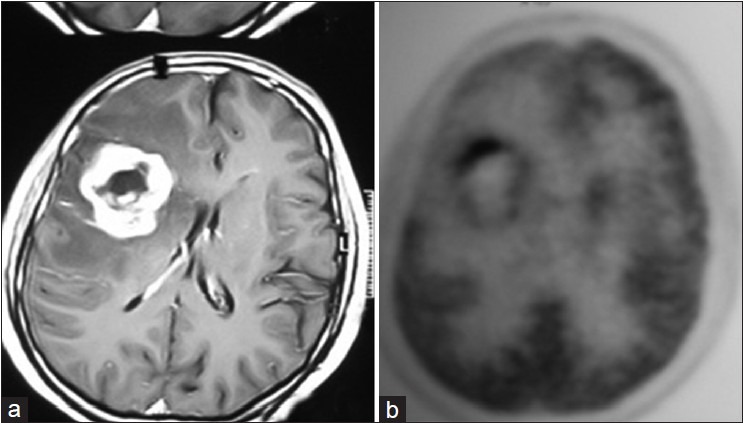
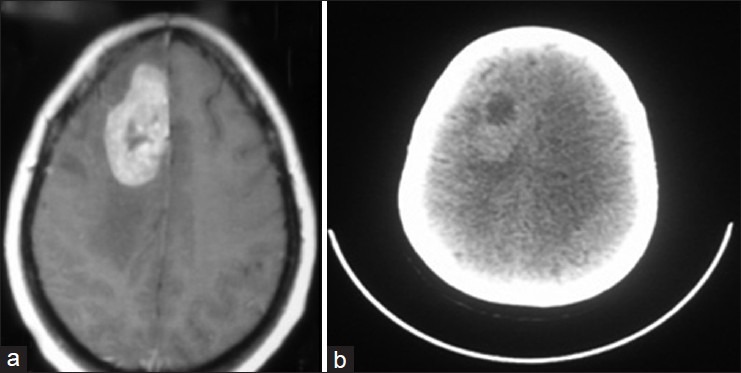
We evaluated 20 patients with an enhancing brain tumor on magnetic resonance imaging (MRI). FDG PET scan was done in all patients pre operatively. For PET image analysis, regions of interest were placed over the tumor (T), contralateral cortex (C), and white matter (WM). Average and maximum pixel values were determined at each site. On the basis of these measurements, average and maximum standard uptake values (SUV avg and SUV max ) were calculated, and comparisons among lesions were then made.
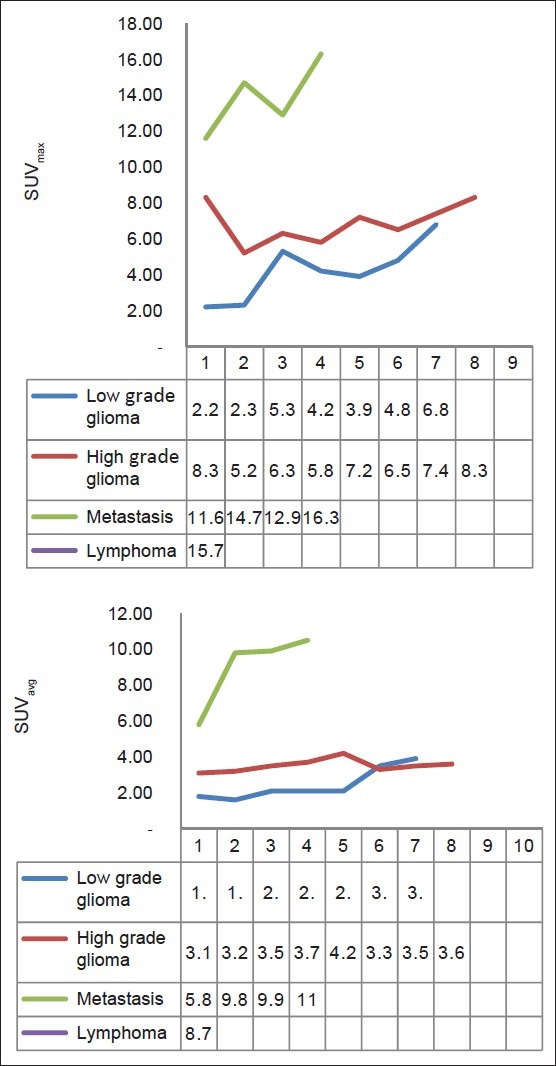
SUVavg and SUVmax are significantly higher for central nervous system (CNS) lymphoma than for other tumors (P < 0.01). High-grade gliomas showed significantly higher SUVavg and SUVmax than the low grade gliomas (P < 0.05) and metastatic tumor showed higher SUVavg and SUVmax than all gliomas, both low and high grade (P < 0.05). When the lowest values of CNS lymphoma parameter were used as cutoff levels to distinguish CNS lymphomas from other tumors (i.e. 100% sensitivity), SUVmax was the most accurate parameter. Using a SUVmax of 15.0 as a cutoff for diagnosing CNS lymphoma, only one case of metastasis (SUV max , 16.3) was found to be false positive in this study.
FDG PET appears to provide additional information for differentiating common enhancing malignant brain tumors, namely lymphoma versus high grade glioma and metastatic tumor, particularly when differential diagnoses are difficult to narrow using MRI alone.
确定F-18-氟脱氧葡萄糖正电子发射断层扫描(F-18-FDG PET)是否可用于区分常见的强化脑肿瘤,如胶质瘤、脑转移瘤和淋巴瘤。
我们评估了20例磁共振成像(MRI)显示有强化脑肿瘤的患者。所有患者术前均进行了FDG PET扫描。对于PET图像分析,在肿瘤(T)、对侧皮质(C)和白质(WM)上放置感兴趣区。在每个部位确定平均像素值和最大像素值。基于这些测量结果,计算平均标准摄取值(SUV avg)和最大标准摄取值(SUV max),然后对病变进行比较。
中枢神经系统(CNS)淋巴瘤的SUVavg和SUVmax显著高于其他肿瘤(P < 0.01)。高级别胶质瘤的SUVavg和SUVmax显著高于低级别胶质瘤(P < 0.05),转移瘤的SUVavg和SUVmax高于所有低级别和高级别胶质瘤(P < 0.05)。当将CNS淋巴瘤参数的最低值用作区分CNS淋巴瘤与其他肿瘤的临界值水平时(即100%敏感性),SUVmax是最准确的参数。在本研究中,以SUVmax为15.0作为诊断CNS淋巴瘤的临界值时,仅发现1例转移瘤(SUV max为16.3)为假阳性。
FDG PET似乎为区分常见的强化恶性脑肿瘤,即淋巴瘤与高级别胶质瘤和转移瘤,提供了额外信息,特别是在仅使用MRI难以缩小鉴别诊断范围时。