Frontotemporal Degeneration Center, Department of Neurology, Perelman School of Medicine, University of Pennsylvania Philadelphia, PA, USA.
Front Psychol. 2013 Apr 2;4:153. doi: 10.3389/fpsyg.2013.00153. eCollection 2013.
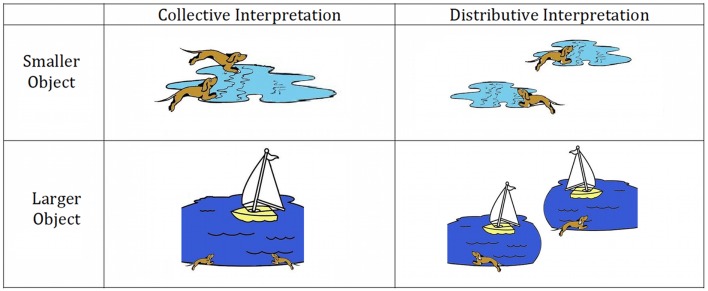
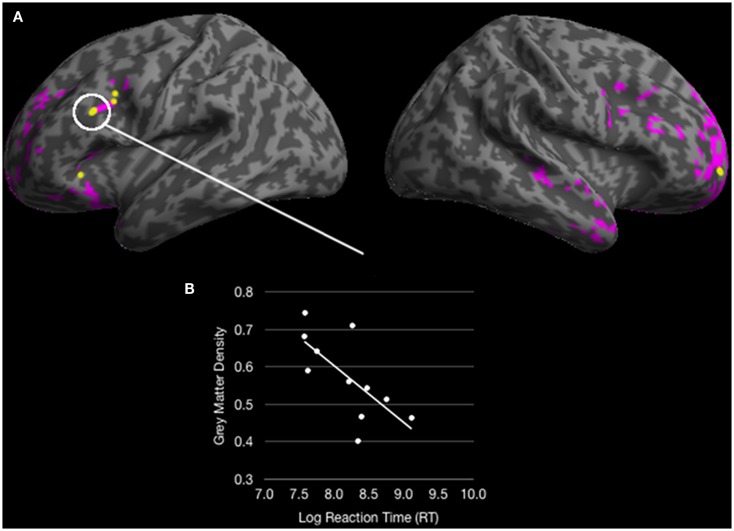
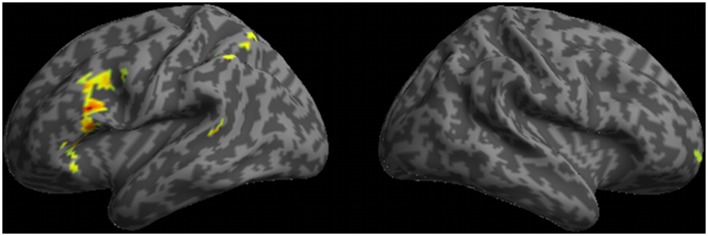
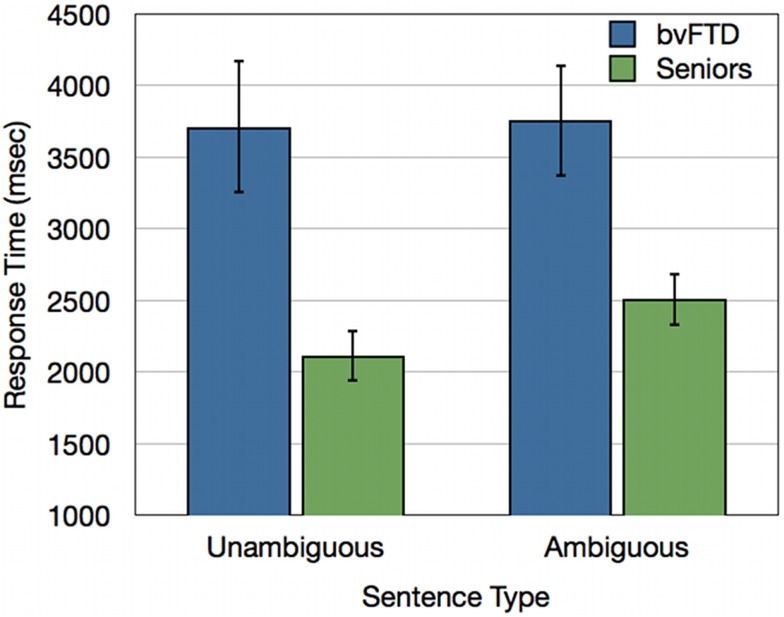
Traditional neuroanatomic models of language comprehension have emphasized a core language network situated in peri-Sylvian cortex. More recent evidence appears to extend the neuroanatomic network beyond peri-Sylvian cortex to encompass other aspects of sentence processing. In this study, we evaluate the neuroanatomic basis for processing the ambiguity in doubly-quantified sentences. For example, a sentence like "All the dogs jumped in a lake" can be interpreted with a collective interpretation (e.g., several dogs jumping into a single lake) or a distributive interpretation (e.g., several dogs each jumping into a different lake). In Experiment 1, we used BOLD fMRI to investigate neuroanatomic recruitment by young adults during the interpretation of ambiguous doubly-quantified sentences in a sentence-picture verification task. We observed that young adults exhibited a processing cost associated with interpreting ambiguous sentences and this was related to frontal and parietal cortex recruitment. In Experiment 2, we investigate ambiguous sentence processing with the identical materials in non-aphasic patients with behavioral variant frontotemporal dementia (bvFTD) who have frontal cortex disease and executive and decision-making limitations. bvFTD patients are insensitive to ambiguity associated with doubly-quantified sentences, and this is related to the magnitude of their frontal cortex disease. These studies provide converging evidence that cortical regions that extend beyond peri-Sylvian cortex help support the processing costs associated with the interpretation of ambiguous doubly-quantified sentences.
传统的语言理解神经解剖学模型强调位于侧裂周围皮层的核心语言网络。最近的证据似乎将神经解剖学网络扩展到侧裂周围皮层之外,以包含句子处理的其他方面。在这项研究中,我们评估了处理双重量化句子歧义的神经解剖学基础。例如,像“所有的狗都跳进了湖里”这样的句子可以用集体解释(例如,几只狗跳进一个湖里)或分配解释(例如,几只狗各自跳进一个不同的湖里)。在实验 1 中,我们使用 BOLD fMRI 来研究年轻人在句子-图片验证任务中解释歧义双重量化句子时的神经解剖学招募情况。我们观察到,年轻人在解释歧义句子时表现出与处理成本相关的大脑活动,这与额叶和顶叶皮层的招募有关。在实验 2 中,我们使用相同的材料,在没有失语症的行为变异额颞叶痴呆(bvFTD)患者中研究了歧义句子的处理,这些患者的额叶皮层疾病和执行和决策能力有限。bvFTD 患者对双重量化句子的歧义不敏感,这与他们额叶皮层疾病的严重程度有关。这些研究提供了一致的证据,表明扩展到侧裂周围皮层之外的皮层区域有助于支持解释歧义双重量化句子的处理成本。