Department of Bio-Industrial Mechatronics Engineering, National Taiwan University, Taipei, Taiwan.
PLoS One. 2013;8(4):e59135. doi: 10.1371/journal.pone.0059135. Epub 2013 Apr 2.
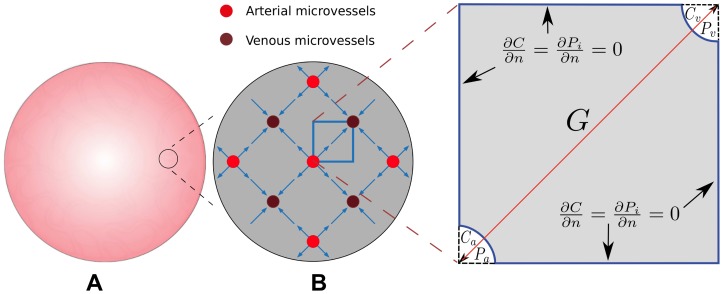
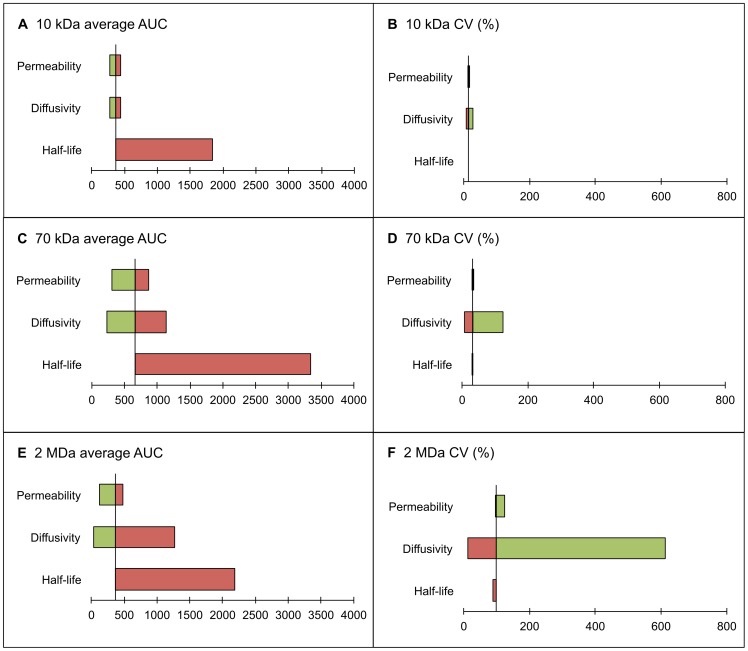
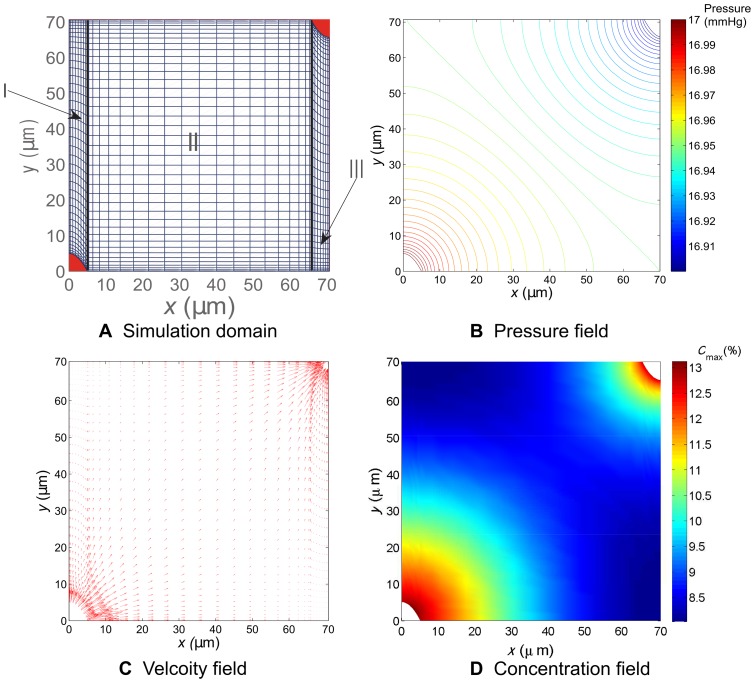
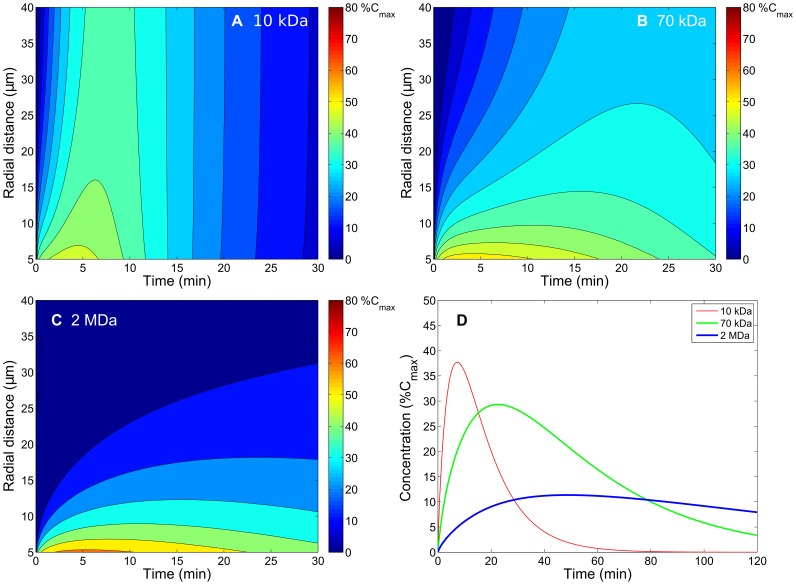
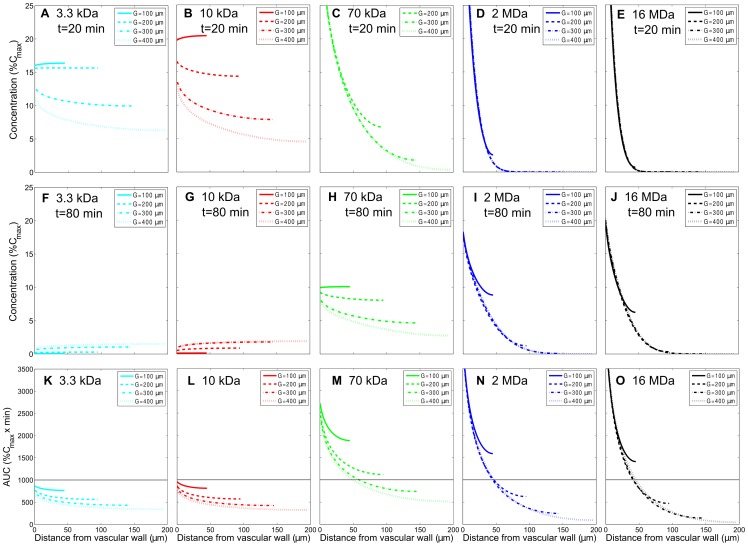
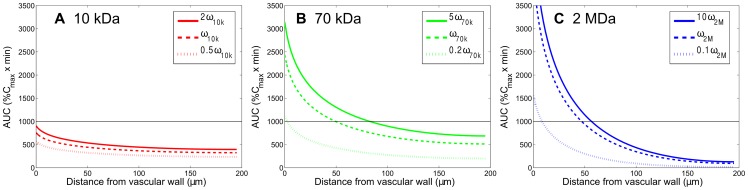
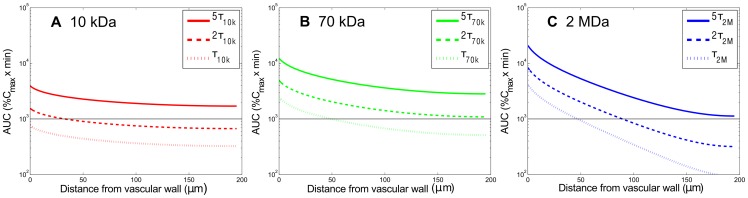
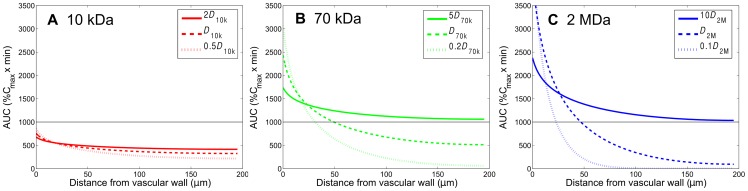
The transport and accumulation of anticancer nanodrugs in tumor tissues are affected by many factors including particle properties, vascular density and leakiness, and interstitial diffusivity. It is important to understand the effects of these factors on the detailed drug distribution in the entire tumor for an effective treatment. In this study, we developed a small-scale mathematical model to systematically study the spatiotemporal responses and accumulative exposures of macromolecular carriers in localized tumor tissues. We chose various dextrans as model carriers and studied the effects of vascular density, permeability, diffusivity, and half-life of dextrans on their spatiotemporal concentration responses and accumulative exposure distribution to tumor cells. The relevant biological parameters were obtained from experimental results previously reported by the Dreher group. The area under concentration-time response curve (AUC) quantified the extent of tissue exposure to a drug and therefore was considered more reliable in assessing the extent of the overall drug exposure than individual concentrations. The results showed that 1) a small macromolecule can penetrate deep into the tumor interstitium and produce a uniform but low spatial distribution of AUC; 2) large macromolecules produce high AUC in the perivascular region, but low AUC in the distal region away from vessels; 3) medium-sized macromolecules produce a relatively uniform and high AUC in the tumor interstitium between two vessels; 4) enhancement of permeability can elevate the level of AUC, but have little effect on its uniformity while enhancement of diffusivity is able to raise the level of AUC and improve its uniformity; 5) a longer half-life can produce a deeper penetration and a higher level of AUC distribution. The numerical results indicate that a long half-life carrier in plasma and a high interstitial diffusivity are the key factors to produce a high and relatively uniform spatial AUC distribution in the interstitium.
抗癌纳米药物在肿瘤组织中的转运和积累受到许多因素的影响,包括颗粒特性、血管密度和通透性、间质扩散性。了解这些因素对整个肿瘤中药物分布的详细影响对于有效治疗非常重要。在这项研究中,我们开发了一个小规模的数学模型,系统地研究了局部肿瘤组织中大分子载体的时空响应和累积暴露。我们选择了各种葡聚糖作为模型载体,并研究了血管密度、通透性、扩散系数和葡聚糖半衰期对其在肿瘤细胞中的时空浓度响应和累积暴露分布的影响。相关的生物学参数是从 Dreher 小组先前报道的实验结果中获得的。浓度-时间响应曲线下面积(AUC)量化了组织暴露于药物的程度,因此在评估整体药物暴露程度方面比个别浓度更可靠。结果表明:1)小分子可以穿透肿瘤间质深处,产生均匀但低空间分布的 AUC;2)大分子在血管周围区域产生高 AUC,但在远离血管的远端区域产生低 AUC;3)中分子在两血管之间的肿瘤间质中产生相对均匀且高的 AUC;4)通透性的增强可以提高 AUC 水平,但对其均匀性影响不大,而扩散性的增强能够提高 AUC 水平并改善其均匀性;5)半衰期的延长可以产生更深的穿透和更高的 AUC 分布水平。数值结果表明,血浆中半衰期长的载体和间质中高扩散性是在间质中产生高且相对均匀的空间 AUC 分布的关键因素。