Huang Yu, Gu Boram, Liu Cong, Stebbing Justin, Gedroyc Wladyslaw, Thanou Maya, Xu Xiao Yun
Department of Chemical Engineering, Imperial College London, London SW7 2AZ, UK.
Department of Surgery and Cancer, Imperial College London, London W12 0NN, UK.
Pharmaceutics. 2019 Nov 29;11(12):637. doi: 10.3390/pharmaceutics11120637.
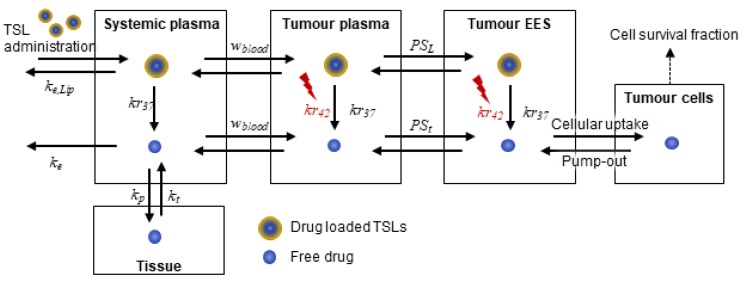
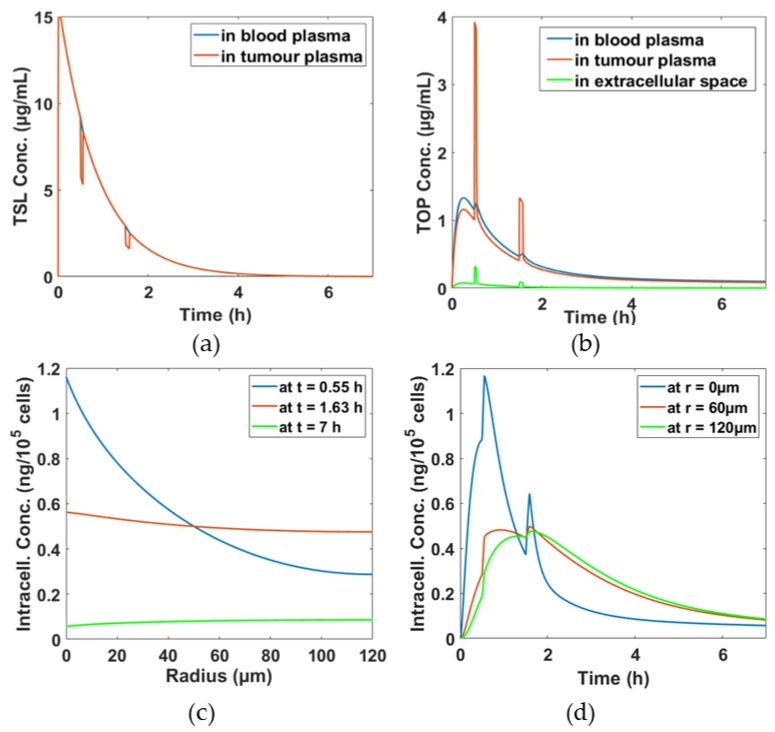
Thermosensitive liposome-mediated drug delivery has shown promising results in terms of improved therapeutic efficacy and reduced side effects compared to conventional chemotherapeutics. In order to facilitate our understanding of the transport mechanisms and their complex interplays in the drug delivery process, computational models have been developed to simulate the multiple steps involved in liposomal drug delivery to solid tumours. In this study we employ a multicompartmental model for drug-loaded thermosensitive liposomes, with an aim to identify the key transport parameters in determining therapeutic dosing and outcomes. The computational model allows us to not only examine the temporal and spatial variations of drug concentrations in the different compartments by utilising the tumour cord concept, but also assess the therapeutic efficacy and toxicity. In addition, the influences of key factors on systemic plasma concentration and intracellular concentration of the active drug are investigated; these include different chemotherapy drugs, release rate constants and heating duration. Our results show complex relationships between these factors and the predicted therapeutic outcome, making it difficult to identify the "best" parameter set. To overcome this challenge, a model-based optimisation method is proposed in an attempt to find a set of release rate constants and heating duration that can maximise intracellular drug concentration while minimising systemic drug concentration. Optimisation results reveal that under the operating conditions and ranges examined, the best outcome would be achieved with a low drug release rate at physiological temperature, combined with a moderate to high release rate at mild hyperthermia and 1 h heating after injection.
与传统化疗相比,热敏脂质体介导的药物递送在提高治疗效果和减少副作用方面已显示出有前景的结果。为了便于我们理解药物递送过程中的转运机制及其复杂的相互作用,已开发出计算模型来模拟脂质体药物递送至实体瘤所涉及的多个步骤。在本研究中,我们采用了一种用于载药热敏脂质体的多隔室模型,旨在确定决定治疗剂量和结果的关键转运参数。该计算模型不仅使我们能够利用肿瘤索概念来检查不同隔室中药物浓度的时空变化,还能评估治疗效果和毒性。此外,研究了关键因素对活性药物的全身血浆浓度和细胞内浓度的影响;这些因素包括不同的化疗药物、释放速率常数和加热持续时间。我们的结果表明这些因素与预测的治疗结果之间存在复杂的关系,使得难以确定“最佳”参数集。为了克服这一挑战,提出了一种基于模型的优化方法,试图找到一组能使细胞内药物浓度最大化同时使全身药物浓度最小化的释放速率常数和加热持续时间。优化结果表明,在所研究的操作条件和范围内,在生理温度下低药物释放速率,结合在轻度热疗时中等至高释放速率以及注射后1小时加热,将能实现最佳结果。