Departmen of Neurophysiology of Vision and Neuroophtalmology, G,B, Bietti Foundation IRCCS, Via Livenza 3-00198, Rome, Italy.
J Headache Pain. 2013 Feb 28;14(1):20. doi: 10.1186/1129-2377-14-20.
The interictal deficit of habituation to repetitive visual stimuli in migraine patients could be due to deficient intracortical inhibition and/or to low cortical pre-activation levels. Which of these abnormalities contributes more to the habituation deficit cannot be determined with the common methods used to record transient visual responses.We investigated lateral inhibition in the visual cortex during the migraine cycle and in healthy subjects by using differential temporal modulations of radial windmill-dartboard (WD) or partial-windmill (PW) visual patterns.
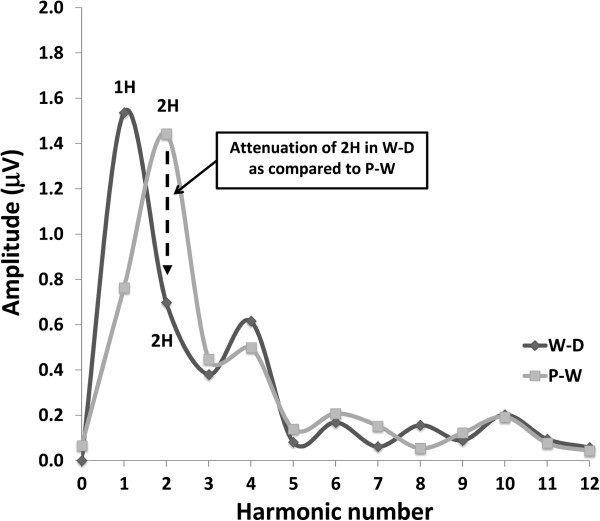
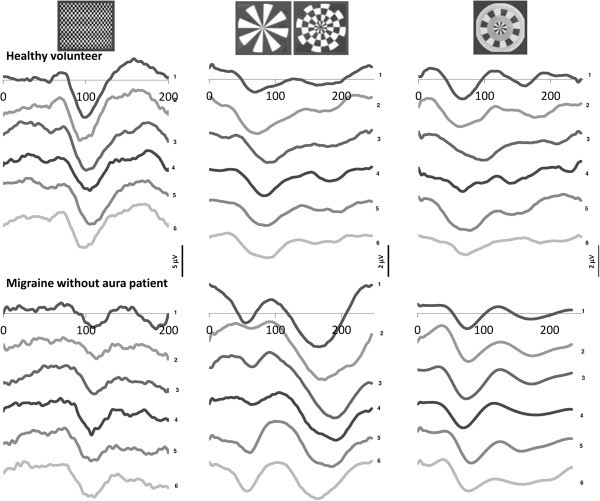
Transient (TR-VEP) and steady-state visual-evoked potentials (SS-VEP) were recorded in 65 migraine patients (21 without and 22 with aura between attacks; 22 patients during an attack) and in 21 healthy volunteers (HV). Three stimulations were used in each subject: classic checkerboard pattern (contrast-reversion 3.1 Hz), WD and PW (contrast-reversion ~4 Hz). For each randomly presented stimulation protocol, 600 sweeps were acquired and off-line partitioned in 6 blocks of 100. Fourier analysis allowed data to extract in SS-VEP the fundamental (1H) and the second harmonic (2H) components that reflect respectively short-(WD) and long- range lateral inhibition (attenuation of 2H in WD compared to PW).
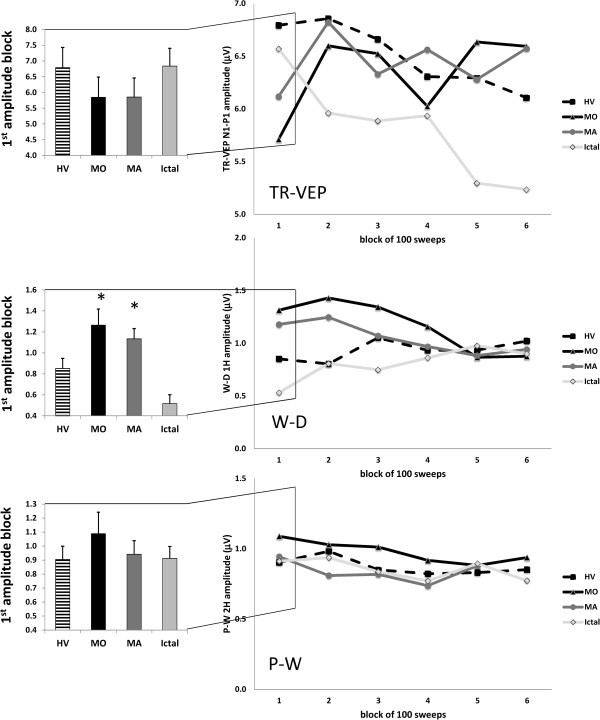
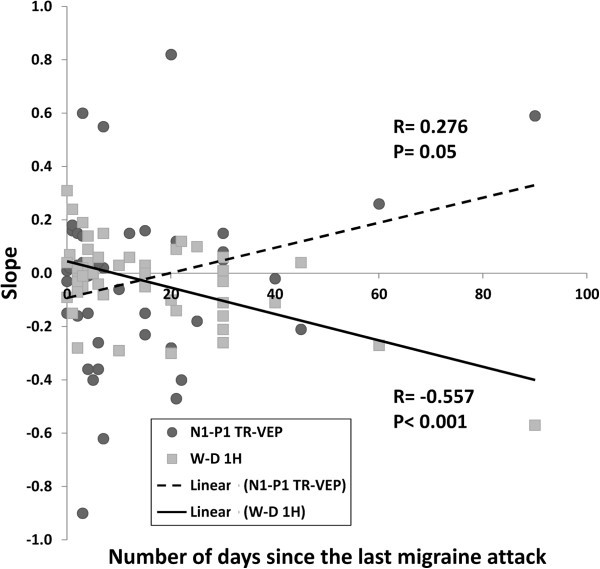
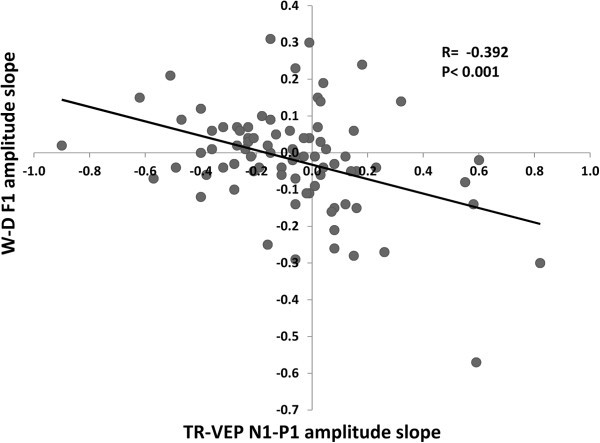
Compared to HV, migraineurs recorded interictally had significantly less habituation of the N1-P1 TR-VEP component over subsequent blocks and they tended to have a smaller 1st block amplitude. 1H amplitude in the 1st block of WD SS-VEP was significantly greater than in HV and habituated in successive blocks, contrasting with an amplitude increase in HV. Both the interictal TR-VEP and SS-VEP abnormalities normalized during an attack. There was no significant between group difference in the PW 2H amplitude and its attenuation. When data of HV and migraine patients were combined, the habituation slope of WD-VEP 1H was negatively correlated with that of TR-VEP N1-P1 and with number of days since the last migraine attack.
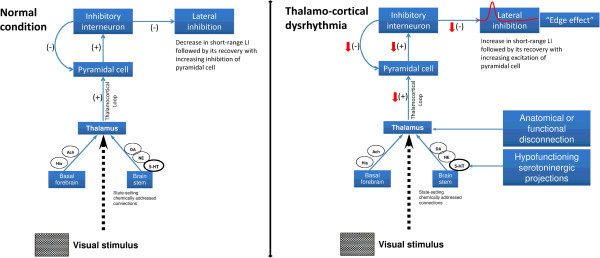
These results are in favour of a migraine cycle-dependent imbalance between excitation and inhibition in the visual cortex. We hypothesize that an interictal hypoactivity of monaminergic pathways may cause a functional disconnection of the thalamus in migraine leading to an abnormal intracortical short-range lateral inhibition that could contribute to the habituation deficit observed during stimulus repetition.
偏头痛患者在发作间期对重复视觉刺激的适应不足可能是由于皮质内抑制不足和/或皮质预激活水平较低。但是,无法通过记录瞬态视觉反应的常用方法来确定这些异常中哪一个对适应不足的贡献更大。
我们通过使用不同的时间调制方法来研究偏头痛发作周期和健康受试者的视觉皮层中的侧向抑制作用,使用径向风车靶(WD)或部分风车靶(PW)视觉图案。
与 HV 相比,发作间期的偏头痛患者在随后的块中 N1-P1 TR-VEP 成分的适应明显减少,并且他们的第 1 块振幅趋于减小。 WD SS-VEP 的第 1 块 1H 振幅明显大于 HV,并在连续块中适应,与 HV 中的振幅增加形成对比。发作间期的 TR-VEP 和 SS-VEP 异常均在发作期间正常化。 PW 2H 振幅及其衰减在组间无显着差异。当将 HV 和偏头痛患者的数据合并时,WD-VEP 1H 的适应斜率与 TR-VEP N1-P1 的适应斜率以及距上次偏头痛发作的天数呈负相关。
这些结果有利于偏头痛周期中视觉皮层兴奋与抑制之间的不平衡。我们假设,发作间期单胺能途径的低活性可能导致偏头痛中的丘脑功能分离,从而导致异常的皮质内短程侧向抑制,这可能导致在刺激重复期间观察到的适应不足。