Department of Medicine I, Center for Oncology, Haematology and Palliative Care, Wilhelminenspital, Vienna.
Department of Medicine I, Center for Oncology, Haematology and Palliative Care, Wilhelminenspital, Vienna.
Ann Oncol. 2013 Jul;24(7):1886-1892. doi: 10.1093/annonc/mdt118. Epub 2013 Apr 7.
Only limited data on the prevalence of iron deficiency (ID) and its correlation with clinical parameters are available in cancer. ID frequently contributes to the pathogenesis of anemia in patients with cancer and may lead to several symptoms such as impaired physical function, weakness and fatigue.
Parameters of iron status and clinical parameters were evaluated in 1528 patients with cancer who presented consecutively within a four-month period at our center. One thousand fifty-three patients had solid tumors and 475 hematological malignancies.
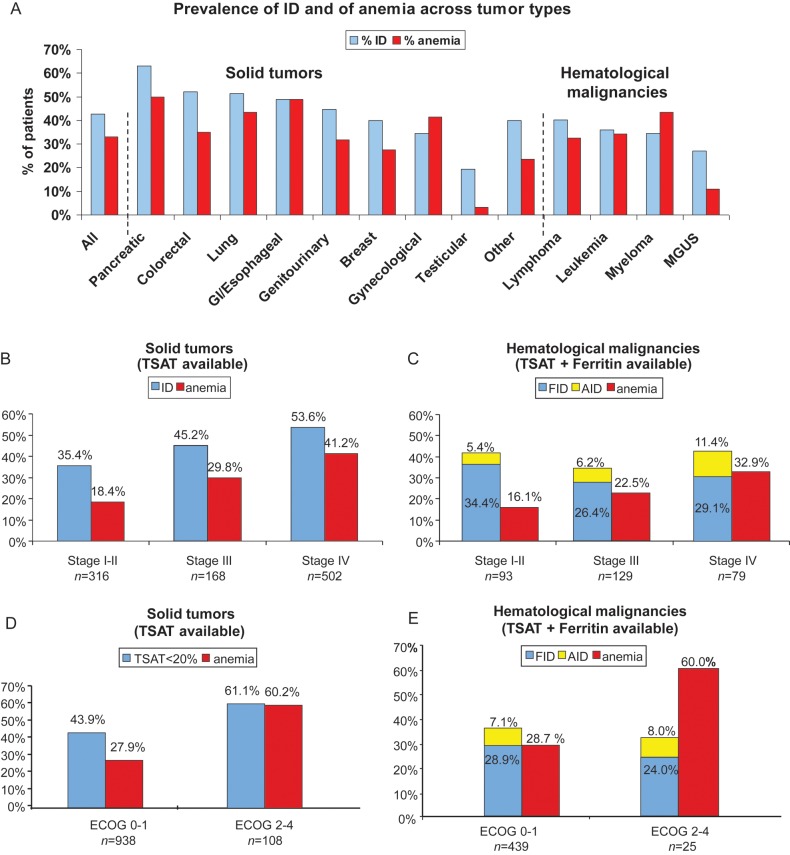
ID [transferrin saturation (TSAT) < 20%] was noted in 645 (42.6%) of the 1513 patients with TSAT tests available and 500 (33.0%) were anemic. ID rates were highest in pancreatic (63.2%), colorectal (51.9%) and lung cancers (50.7%). Of the 409 iron-deficient patients in whom serum ferritin levels were available additionally to TSAT, 335 (81.9%) presented with functional ID (FID) (TSAT < 20%, serum ferritin ≥30 ng/ml) and 74 (18.1%) with absolute ID. In patients with solid tumors, prevalence of ID correlated with cancer stage at diagnosis (P = 0.001), disease status (P = 0.001) and ECOG performance status (P = 0.005).
ID was frequently noted in cancer and was associated with advanced disease, close proximity to cancer therapy, and poor performance status in patients with solid tumors.
目前仅有有限的数据表明癌症患者缺铁(ID)的患病率及其与临床参数的相关性。ID 常导致癌症患者贫血的发病机制,并可能导致多种症状,如身体机能受损、虚弱和疲劳。
在我们中心的四个月内连续就诊的 1528 例癌症患者中,评估了铁状态和临床参数。其中 1053 例为实体瘤,475 例为血液恶性肿瘤。
在 1513 例可进行转铁蛋白饱和度(TSAT)检测的患者中,有 645 例(42.6%)存在 ID[TSAT<20%],其中 500 例(33.0%)存在贫血。胰腺癌(63.2%)、结直肠癌(51.9%)和肺癌(50.7%)的 ID 发生率最高。在另外还进行了血清铁蛋白检测的 409 例缺铁患者中,335 例(81.9%)为功能性缺铁(FID)(TSAT<20%,血清铁蛋白≥30ng/ml),74 例(18.1%)为绝对缺铁。在实体瘤患者中,ID 的患病率与诊断时的癌症分期(P=0.001)、疾病状态(P=0.001)和 ECOG 表现状态(P=0.005)相关。
癌症患者中经常出现 ID,并且与晚期疾病、接近癌症治疗以及实体瘤患者的表现状态较差相关。