Kadin M E, Agnarsson B A, Ellingsworth L R, Newcom S R
Department of Pathology, Beth Israel Hospital, Boston, Massachusetts 02215.
Am J Pathol. 1990 Jun;136(6):1209-14.
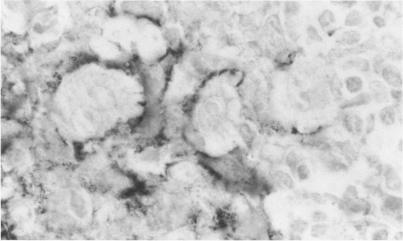
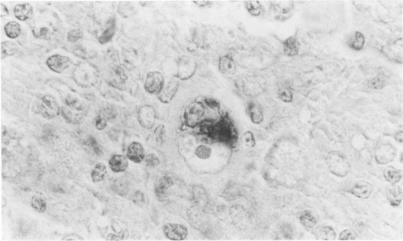
Transforming growth factor beta (TFG-beta) is a multifunctional growth factor that promotes the growth of fibroblasts, collagen synthesis and angiogenesis, and stimulates monocyte migration and activation, but suppresses the growth and differentiation of immune lymphocytes and killer cells. Previously we demonstrated biologic activity for TGF-beta in supernatants of fresh Hodgkin's disease (HD) cell cultures and the cell line L428 derived from nodular sclerosing HD. This study was undertaken to find evidence of TGF-beta activity directly in tissues affected by HD. Formalin-fixed tissue from 14 patients with HD, including 8 nodular sclerosis, 4 mixed cellularity, 1 lymphocyte predominance, and 1 lymphocyte depletion type were studied by immunoperoxidase technique with antibody CC (1-30) raised against a synthetic polypeptide with the same N-terminal amino acid sequence as TGF-beta 1. Transforming growth factor beta activity was demonstrated in six cases of nodular sclerosis but not in other histologic types of HD. Staining for TGF-beta was found in the cytoplasm of Reed-Sternberg (RS) cells in one case and on the surface of RS cells and their lacunar variants in five cases. Transforming growth factor beta activity associated with the extracellular matrix was localized mainly around blood vessels, zones of necrosis, at the margins of bands of collagen sclerosis, and in areas containing syncytia of RS cells. In two cases TGF-beta was associated with collections of epithelioid histiocytes or granulomas. Small lymphocytes, granulocytes, and germinal center cells were unreactive. These results suggest that TGF-beta is a growth factor of biologic importance in HD and may be responsible for many of the histologic features, such as nodular sclerosis and granulomas, that may have prognostic significance.
转化生长因子β(TGF-β)是一种多功能生长因子,可促进成纤维细胞生长、胶原蛋白合成和血管生成,刺激单核细胞迁移和活化,但会抑制免疫淋巴细胞和杀伤细胞的生长与分化。此前我们已证明新鲜霍奇金淋巴瘤(HD)细胞培养上清液及源自结节硬化型HD的L428细胞系中存在TGF-β的生物活性。本研究旨在直接在受HD影响的组织中寻找TGF-β活性的证据。采用免疫过氧化物酶技术,使用针对与TGF-β1具有相同N端氨基酸序列的合成多肽产生的抗体CC(1-30),对14例HD患者的福尔马林固定组织进行研究,其中包括8例结节硬化型、4例混合细胞型、1例淋巴细胞为主型和1例淋巴细胞消减型。在6例结节硬化型病例中检测到转化生长因子β活性,而在其他组织学类型的HD中未检测到。在1例病例的里德-斯腾伯格(RS)细胞胞质中发现TGF-β染色,在5例病例的RS细胞及其陷窝变体表面发现TGF-β染色。与细胞外基质相关的转化生长因子β活性主要定位于血管周围、坏死区域、胶原硬化带边缘以及含有RS细胞合体的区域。在2例病例中,TGF-β与上皮样组织细胞或肉芽肿聚集有关。小淋巴细胞、粒细胞和生发中心细胞无反应。这些结果表明,TGF-β是HD中具有生物学重要性的生长因子,可能是许多具有预后意义的组织学特征(如结节硬化和肉芽肿)的原因。