Follicle Biology Laboratory, UZ Brussel, Belgium.
PLoS One. 2013;8(4):e54226. doi: 10.1371/journal.pone.0054226. Epub 2013 Apr 3.
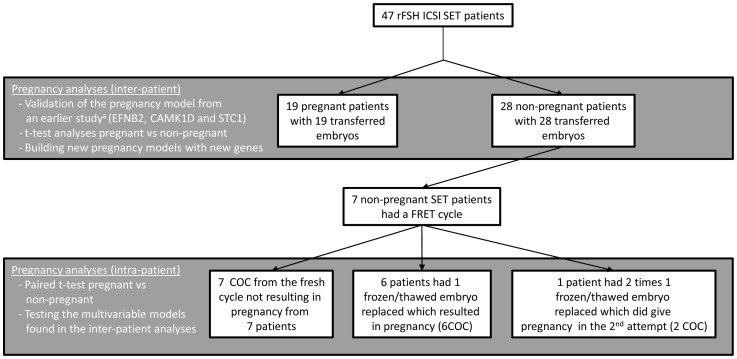
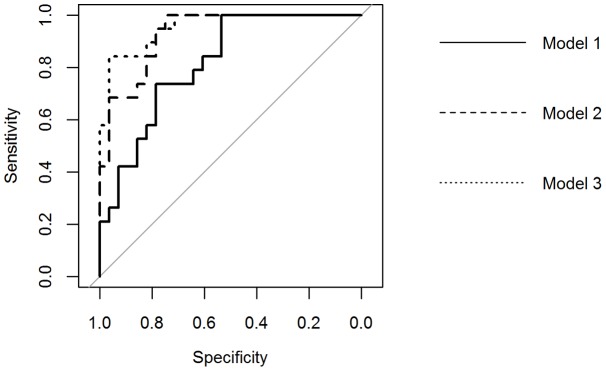
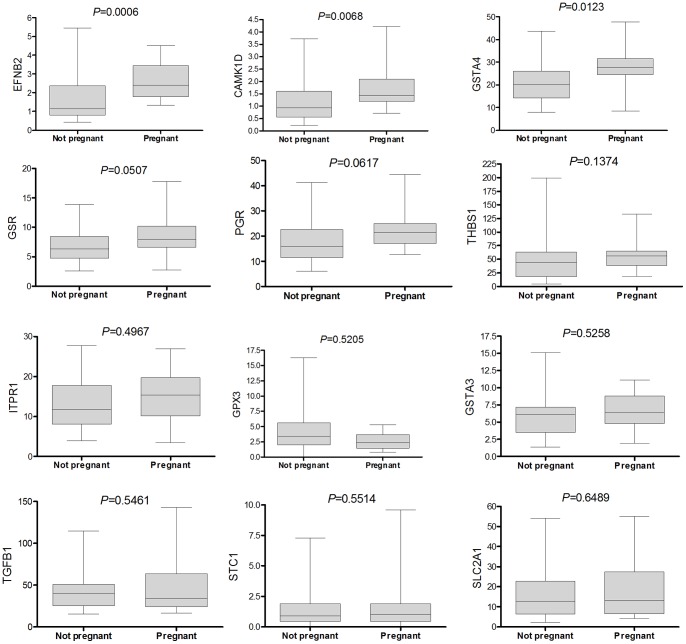
Cumulus cell (CC) gene expression is being explored as an additional method to morphological scoring to choose the embryo with the highest chance to pregnancy. In 47 ICSI patients with single embryo transfer (SET), from which individual CC samples had been stored, 12 genes using QPCR were retrospectively analyzed. The CC samples were at the same occasion also used to validate a previously obtained pregnancy prediction model comprising three genes (ephrin-B2 (EFNB2), calcium/calmodulin-dependent protein kinase ID, stanniocalcin 1). Latter validation yielded a correct pregnant/non-pregnant classification in 72% of the samples. Subsequently, 9 new genes were analyzed on the same samples and new prediction models were built. Out of the 12 genes analyzed a combination of the best predictive genes was obtained by stepwise multiple regression. One model retained EFNB2 in combination with glutathione S-transferase alpha 3 and 4, progesterone receptor and glutathione peroxidase 3, resulting in 93% correct predictions when 3 patient and treatment cycle characteristics were included into the model. This large patient group allowed to do an intra-patient analysis for 7 patients, an analysis mimicking the methodology that would ultimately be used in clinical routine. CC related to a SET that did not give pregnancy and CC related to their subsequent frozen/thawed embryos which ended in pregnancy were analyzed. The models obtained in the between-patient analysis were used to rank the oocytes within-patients for their chance to pregnancy and resulted in 86% of correct predictions. In conclusion, prediction models built on selected quantified transcripts in CC might help in the decision making process which is currently only based on subjective embryo morphology scoring. The validity of our current models for routine application still need prospective assessment in a larger and more diverse patient population allowing intra-patient analysis.
卵丘细胞 (CC) 的基因表达正被探索作为一种额外的方法,以形态评分来选择具有最高怀孕机会的胚胎。在 47 名接受单个胚胎移植 (SET) 的 ICSI 患者中,回顾性分析了使用 QPCR 的 12 个基因。同时,这些 CC 样本也被用于验证之前获得的包含三个基因(ephrin-B2 (EFNB2)、钙/钙调蛋白依赖性蛋白激酶 ID、stanniocalcin 1)的妊娠预测模型。后者的验证在 72%的样本中正确地预测了妊娠/非妊娠。随后,在相同的样本上分析了 9 个新基因,并建立了新的预测模型。在分析的 12 个基因中,通过逐步多元回归获得了最佳预测基因的组合。一个模型保留了 EFNB2 与谷胱甘肽 S-转移酶 alpha 3 和 4、孕激素受体和谷胱甘肽过氧化物酶 3 的组合,当将 3 个患者和治疗周期特征纳入模型时,正确预测率达到 93%。这个大的患者群体允许对 7 名患者进行患者内分析,该分析模拟了最终将在临床常规中使用的方法。分析了与 SET 相关的未怀孕的 CC 和与随后的冷冻/解冻胚胎相关的怀孕的 CC,这些胚胎最终怀孕。在患者间分析中获得的模型用于对患者内的卵子进行妊娠机会的排名,正确预测率达到 86%。总之,基于 CC 中定量转录本构建的预测模型可能有助于目前仅基于胚胎形态学评分的决策过程。我们当前模型的有效性仍需要在更大、更多样化的患者群体中进行前瞻性评估,以允许进行患者内分析。