Population Studies and Training Center, Brown University, Providence, Rhode Island, United States of America.
PLoS One. 2013;8(4):e58595. doi: 10.1371/journal.pone.0058595. Epub 2013 Apr 3.
Antiretroviral treatment (ART) has been introduced in Ethiopia a decade ago and continues to be scaled up. However, there is dearth of literature on the impact of ART on changes in CD4 lymphocyte count and weight among patients on treatment.
To determine the predictors of change in CD4 lymphocyte count and weight among HIV/AIDS infected patients taking antiretroviral treatment in eastern Ethiopia.
A retrospective cohort study was conducted among HIV/AIDS patients taking ART from 2005 to 2010. A sample of 1540 HIV infected adult patients who started antiretroviral therapy in hospitals located in eastern Ethiopia were included in the study. The primary outcomes of interest were changes in CD4 count and weight. Descriptive statistics and multivariable regression analyses were performed to examine the outcomes among the cohort.
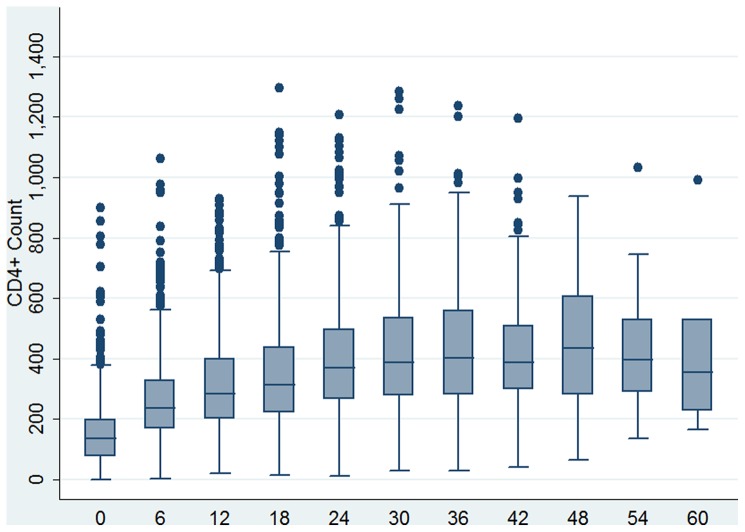
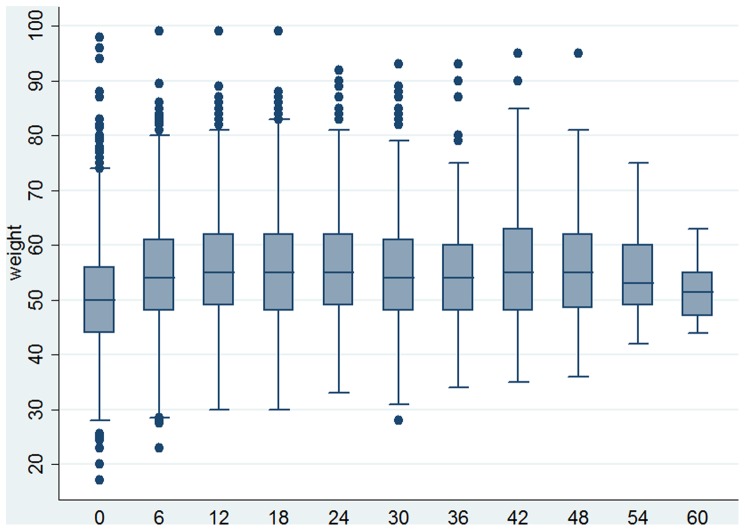
Both the median CD4 lymphocyte counts and weight showed improvements in the follow up periods. The multivariate analysis shows that the duration of ART was an important predictor of improvements in CD4 lymphocyte count (beta 7.91; 95% CI 7.48-8.34; p 0.000) and weight (beta 0.15; 95% CI 0.13-0.18; p 0.000). Advanced WHO clinical stage, lower baseline CD4 cell count, and baseline hemoglobin levels were factors associated with decline in weight. Actively working patients had higher CD4 lymphocyte count and weight compared to those that were ambulatory (p<0.05).
We detected a substantial increment in weight and CD4 lymphocyte count among the patients who were taking ART in eastern Ethiopia. Patients who are of older age, with low initial CD4 lymphocyte count, late stage of the WHO clinical stages and lower hemoglobin level may need special attention. The reasons for the improved findings on CD4 count and weight throughout the five years of follow up merit further investigation.
抗逆转录病毒治疗(ART)在十年前在埃塞俄比亚推出,并持续扩大规模。然而,关于 ART 对治疗中患者的 CD4 淋巴细胞计数和体重变化的影响的文献很少。
确定在接受抗逆转录病毒治疗的艾滋病毒/艾滋病感染者中,CD4 淋巴细胞计数和体重变化的预测因素。
对 2005 年至 2010 年期间在埃塞俄比亚东部接受 ART 的艾滋病毒/艾滋病患者进行了回顾性队列研究。本研究纳入了在位于埃塞俄比亚东部的医院接受抗逆转录病毒治疗的 1540 名感染艾滋病毒的成年患者。主要观察指标为 CD4 计数和体重的变化。对队列中的结果进行了描述性统计和多变量回归分析。
CD4 淋巴细胞计数和体重中位数在随访期间均有所改善。多变量分析显示,ART 的持续时间是 CD4 淋巴细胞计数改善的重要预测因素(β7.91;95%CI7.48-8.34;p0.000)和体重(β0.15;95%CI0.13-0.18;p0.000)。较高的世界卫生组织临床分期、较低的基线 CD4 细胞计数和基线血红蛋白水平是体重下降的相关因素。与行动不便的患者相比,有工作的患者具有更高的 CD4 淋巴细胞计数和体重(p<0.05)。
我们在接受埃塞俄比亚东部 ART 治疗的患者中发现体重和 CD4 淋巴细胞计数有显著增加。年龄较大、初始 CD4 淋巴细胞计数较低、世界卫生组织临床分期晚期和较低的血红蛋白水平的患者可能需要特别关注。在五年的随访期间,CD4 计数和体重改善的原因值得进一步调查。