Baraki Adhanom Gebreegziabher, Gezie Lemma Derseh, Zeleke Ejigu Gebeye, Awoke Tadesse, Tsegaye Adino Tesfahun
Epidemiology and Biostatistics, Institute of Public Health, College of Medicine and Health Sciences, University of Gondar, Gondar, Ethiopia
Epidemiology and Biostatistics, Institute of Public Health, College of Medicine and Health Sciences, University of Gondar, Gondar, Ethiopia.
BMJ Open. 2019 Sep 24;9(9):e033393. doi: 10.1136/bmjopen-2019-033393.
This study aimed to assess the evolution of body mass index (BMI) of HIV-positive adults on second-line antiretroviral therapy (ART) over time and factors affecting it in north-west Ethiopia.
An institution-based retrospective follow-up study was conducted using data extracted from 1016 patient cards from February 2008 to February 2016.
Eight referral hospitals from Amhara region, Ethiopia were included.
HIV patients who started second-line ART.
Change in BMI since starting second-line ART.
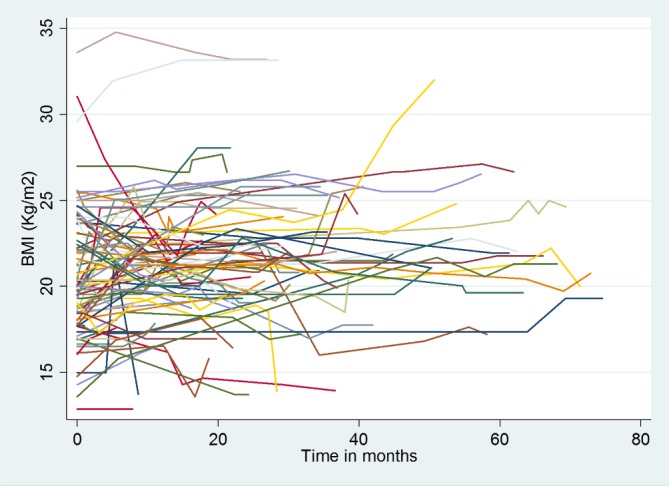
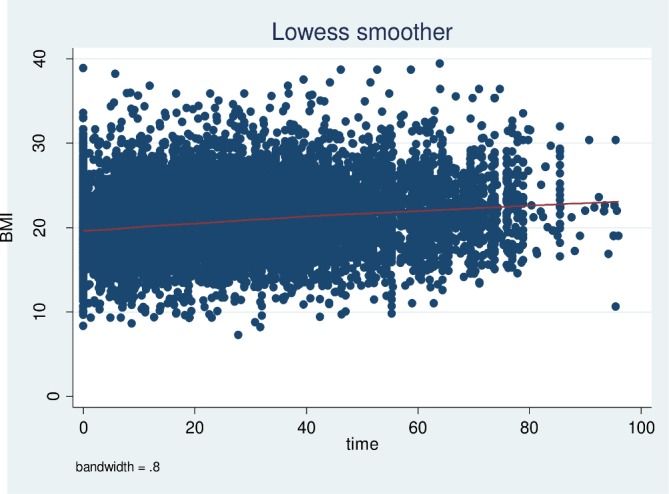
Five hundred and thirty-eight (52.95%) participants were males and the median age of the participants was 33 years (IQR: 28; 39). The median follow-up time was 18 months (IQR: 5.2; 32.2). The average change of BMI showed linear increase over time. The amount of BMI increment or decrement according to each variable was shown as β coefficients. Treatment duration (β=0.013, 95% CI 0.004 to 0.022), isoniazid prophylaxis (β=0.87, 95% CI 0.32 to 1.42), cotrimoxazole prophylaxis (β=0.63, 95% CI 0.08 to 1.19), ambulatory functional status (β=-1.16, 95% CI -1.95 to 1.31), bedridden functional status (β=-1.83, 95% CI -2.47 to 1.21), WHO stage III (β=-0.42, 95% CI -0.65 to 0.20), WHO stage IV (β=-0.62, 95% CI -1.02 to 0.22), CD4 count (β=0.001, 95% CI 0.0008 to 0.0015), and time interaction of variables like tertiary educational status (β=0.02, 95% CI 0.01 to 0.04), ambulatory functional status (β=0.03, 95% CI 0.01 to 0.05) and WHO stages III (β=0.01, 95% CI 0.007 to 0.02) were found to be significant predictors.
The BMI of patients has shown linear increment over the treatment time. Factors affecting it have been identified but its effect on cardiovascular disease needs further study.
本研究旨在评估埃塞俄比亚西北部接受二线抗逆转录病毒治疗(ART)的HIV阳性成年人的体重指数(BMI)随时间的变化情况及其影响因素。
采用基于机构的回顾性随访研究,数据取自2008年2月至2016年2月期间的1016份患者病历。
纳入了埃塞俄比亚阿姆哈拉地区的八家转诊医院。
开始接受二线ART治疗的HIV患者。
自开始二线ART治疗以来BMI的变化。
538名(52.95%)参与者为男性,参与者的中位年龄为33岁(四分位间距:28;39)。中位随访时间为18个月(四分位间距:5.2;32.2)。BMI的平均变化随时间呈线性增加。根据每个变量得出的BMI增减量以β系数表示。治疗持续时间(β=0.013,95%置信区间0.004至0.022)、异烟肼预防用药(β=0.87,95%置信区间0.32至1.42)、复方新诺明预防用药(β=0.63,95%置信区间0.08至1.19)、非卧床功能状态(β=-1.16,95%置信区间-1.95至1.31)、卧床功能状态(β=-1.83,95%置信区间-2.47至1.21)、世界卫生组织(WHO)III期(β=-0.42,95%置信区间-0.65至0.20)、WHO IV期(β=-0.62,95%置信区间-1.02至0.22)、CD4细胞计数(β=0.001,95%置信区间0.0008至0.0015)以及诸如高等教育状态(β=0.02,95%置信区间0.01至0.04)、非卧床功能状态(β=0.03,95%置信区间0.01至0.05)和WHO III期(β=0.01,95%置信区间0.007至0.02)等变量的时间交互作用被发现是显著的预测因素。
患者的BMI在治疗期间呈线性增加。已确定了影响BMI的因素,但其对心血管疾病的影响需要进一步研究。