Food Safety Research Group, Centre for Food and Waterborne Diseases, International Centre for Diarrhoeal Disease Research, Bangladesh, Mohakhali, Dhaka, Bangladesh.
PLoS One. 2013;8(4):e61090. doi: 10.1371/journal.pone.0061090. Epub 2013 Apr 3.
Unsafe water supplies continue to raise public health concerns, especially in urban areas in low resource countries. To understand the extent of public health risk attributed to supply water in Dhaka city, Bangladesh, Escherichia coli isolated from tap water samples collected from different locations of the city were characterized for their antibiotic resistance, pathogenic properties and genetic diversity.
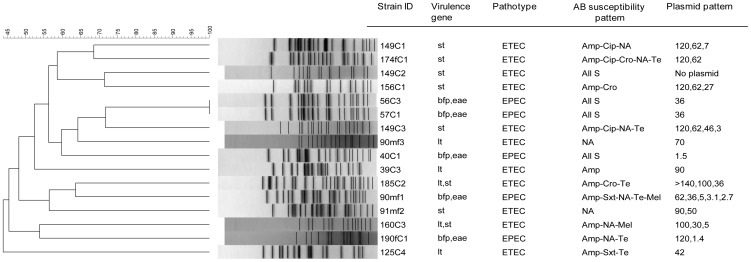
METHODOLOGY/PRINCIPAL FINDINGS: A total of 233 E. coli isolates obtained from 175 tap water samples were analysed for susceptibility to 16 different antibiotics and for the presence of genes associated with virulence and antibiotic resistance. Nearly 36% (n = 84) of the isolates were multi-drug(≥ 3 classes of antibiotics) resistant (MDR) and 26% (n = 22) of these were positive for extended spectrum β-lactamase (ESBL). Of the 22 ESBL-producers, 20 were positive for bla CTX-M-15, 7 for bla OXA-1-group (all had bla OXA-47) and 2 for bla CMY-2. Quinolone resistance genes, qnrS and qnrB were detected in 6 and 2 isolates, respectively. Around 7% (n = 16) of the isolates carried virulence gene(s) characteristic of pathogenic E. coli; 11 of these contained lt and/or st and thus belonged to enterotoxigenic E. coli and 5 contained bfp and eae and thus belonged to enteropathogenic E. coli. All MDR isolates carried multiple plasmids (2 to 8) of varying sizes ranging from 1.2 to >120 MDa. Ampicillin and ceftriaxone resistance were co-transferred in conjugative plasmids of 70 to 100 MDa in size, while ampicillin, trimethoprim-sulfamethoxazole and tetracycline resistance were co-transferred in conjugative plasmids of 50 to 90 MDa. Pulsed-field gel electrophoresis analysis revealed diverse genetic fingerprints of pathogenic isolates.
Multi-drug resistant E. coli are wide spread in public water supply in Dhaka city, Bangladesh. Transmission of resistant bacteria and plasmids through supply water pose serious threats to public health in urban areas.
不安全的供水继续引起公众健康关注,特别是在资源匮乏的低等国家的城市地区。为了了解孟加拉国达卡市供水所带来的公共卫生风险程度,从该市不同地点采集的自来水样本中分离出大肠杆菌,并对其抗生素耐药性、致病性和遗传多样性进行了特征分析。
方法/主要发现:从 175 份自来水样本中获得的 233 株大肠杆菌进行了 16 种不同抗生素的药敏试验,并检测了与毒力和抗生素耐药性相关的基因。近 36%(n=84)的分离株为多药耐药(≥3 类抗生素)(MDR),其中 26%(n=22)为产超广谱β-内酰胺酶(ESBL)。在 22 株 ESBL 产毒株中,20 株携带 bla CTX-M-15,7 株携带 bla OXA-1 组(均携带 bla OXA-47),2 株携带 bla CMY-2。6 株分离株携带喹诺酮耐药基因 qnrS,2 株携带 qnrB。约 7%(n=16)的分离株携带致病性大肠杆菌特征性毒力基因;其中 11 株含有 lt 和/或 st,因此属于肠毒性大肠杆菌,5 株含有 bfp 和 eae,因此属于肠致病性大肠杆菌。所有 MDR 分离株均携带多种大小从 1.2 到>120MDa 的质粒。氨苄西林和头孢曲松耐药性在大小为 70 到 100MDa 的可转移质粒中共同转移,而氨苄西林、甲氧苄啶-磺胺甲恶唑和四环素耐药性在大小为 50 到 90MDa 的可转移质粒中共同转移。脉冲场凝胶电泳分析显示,致病性分离株具有不同的遗传指纹。
孟加拉国达卡市公共供水系统中广泛存在多药耐药大肠杆菌。耐药菌和质粒通过供水传播,对城市地区的公众健康构成严重威胁。