Seck Sidy Mohamed, Dahaba Mohamed, Ka Elhadj Fary, Cisse Mouhamadou Moustapha, Gueye Seigne, Tal Ahmet Ould Lemrabott
Internal Medicine and Nephrology Department, Faculty of Health Sciences, University Gaston Berger, Saint-Louis, Senegal.
Nephrourol Mon. 2012 Fall;4(4):613-6. doi: 10.5812/numonthly.4225. Epub 2012 Sep 24.
Chronic kidney disease related mineral and bone disease (CKD-MBD) is a worldwide challenge in hemodialysis patients. In Senegal, number of dialysis patients is growing but few data are available about their bone disorders.
To describe patterns of CKD-MBD in Senegalese dialysis patients.
We performed a cross-sectional study including patients from three dialysis centres in Senegal. Diagnosis of different types of CKD-MBD relied on clinical, biological and radiological data collected from medical records in dialysis.
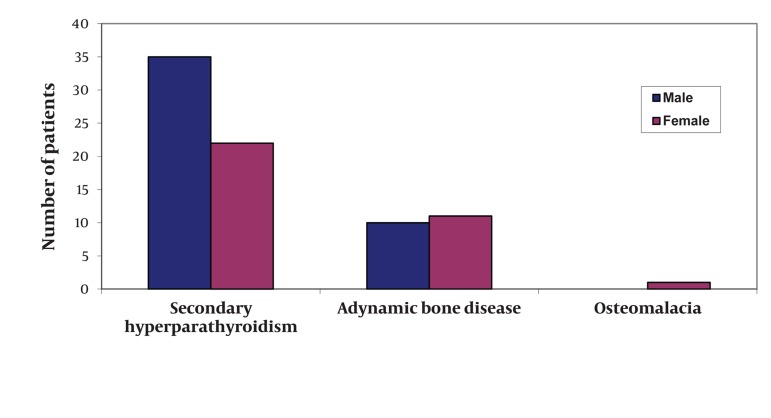
We included 118 patients and 79 of them presented CKD-BMD (prevalence of was 66.9 %). Mean age of CKD-MBD patients was 47.8 ± 15.7 years (16-81 years) and sex-ratio (Male/Female) was 1.15. Secondary hyperparathyroidism was the most frequent disorder (57 patients) followed by adynamic bone disease (21 patients) and osteomalacia (1 patients). The main clinical manifestations were bone pain (17.5% of cases), pruritus (36.8% of cases) and pathological fractures (2.5% of cases). Bone biopsy was not available. Valvular and peripheral vascular calcification were present in 24.5% and 21.2% of patients respectively. Management of CKD-MBD included optimization of dialysis, calcium bicarbonate, sevelamer, vitamin D analogues and calcimimetics. The NKF/DOQI recommended levels of serum calcium, phosphate and parathormone PTH were not achieved in one third of patients. Six patients presented major cardiovascular events during their dialysis period.
CKD-MBD are frequent in Senegalese hemodialysis patients and they are dominated by high turn-over disease. Clinical and biological manifestations are unspecific and accurate diagnoses are often difficult in absence of histomorphometry. Treatment is suboptimal for many patients in a context of limited resources.
慢性肾脏病相关矿物质和骨疾病(CKD-MBD)是全球血液透析患者面临的一项挑战。在塞内加尔,透析患者数量不断增加,但关于其骨疾病的数据却很少。
描述塞内加尔透析患者的CKD-MBD模式。
我们进行了一项横断面研究,纳入了来自塞内加尔三个透析中心的患者。不同类型CKD-MBD的诊断依赖于从透析病历中收集的临床、生物学和放射学数据。
我们纳入了118例患者,其中79例患有CKD-BMD(患病率为66.9%)。CKD-MBD患者的平均年龄为47.8±15.7岁(16-81岁),性别比(男/女)为1.15。继发性甲状旁腺功能亢进是最常见的疾病(57例),其次是动力缺乏性骨病(21例)和骨软化症(1例)。主要临床表现为骨痛(17.5%的病例)、瘙痒(36.8%的病例)和病理性骨折(2.5%的病例)。无法进行骨活检。分别有24.5%和21.2%的患者存在瓣膜和外周血管钙化。CKD-MBD的治疗包括优化透析、碳酸钙、司维拉姆、维生素D类似物和拟钙剂。三分之一的患者未达到美国国家肾脏基金会(NKF)/肾脏病预后质量倡议(DOQI)推荐的血清钙、磷和甲状旁腺激素(PTH)水平。6例患者在透析期间发生了严重心血管事件。
CKD-MBD在塞内加尔血液透析患者中很常见,且以高转换型疾病为主。临床和生物学表现不具有特异性,在缺乏组织形态计量学的情况下,准确诊断往往很困难。在资源有限的情况下,许多患者的治疗并不理想。