Grain Forage and Bioenergy Research Unit, Agricultural Research Service - United States Department of Agriculture Lincoln, NE, USA ; Department of Agronomy and Horticulture, University of Nebraska at Lincoln Lincoln, NE, USA.
Front Plant Sci. 2013 Apr 5;4:70. doi: 10.3389/fpls.2013.00070. eCollection 2013.
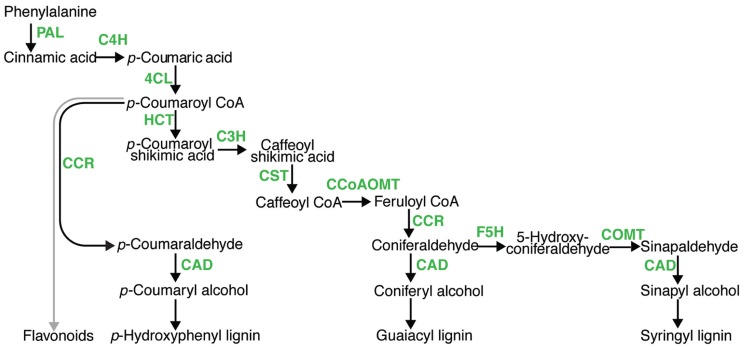
Lignin is a ubiquitous polymer present in cell walls of all vascular plants, where it rigidifies and strengthens the cell wall structure through covalent cross-linkages to cell wall polysaccharides. The presence of lignin makes the cell wall recalcitrant to conversion into fermentable sugars for bioenergy uses. Therefore, reducing lignin content and modifying its linkages have become major targets for bioenergy feedstock development through either biotechnology or traditional plant breeding. In addition, lignin synthesis has long been implicated as an important plant defense mechanism against pathogens, because lignin synthesis is often induced at the site of pathogen attack. This article explores the impact of lignin modifications on the susceptibility of a range of plant species to their associated pathogens, and the implications for development of feedstocks for the second-generation biofuels industry. Surprisingly, there are some instances where plants modified in lignin synthesis may display increased resistance to associated pathogens, which is explored in this article.
木质素是一种普遍存在的聚合物,存在于所有维管束植物的细胞壁中,通过与细胞壁多糖形成共价交联来使细胞壁结构变硬并增强。木质素的存在使细胞壁难以转化为可发酵糖,从而用于生物能源用途。因此,通过生物技术或传统的植物育种,降低木质素含量和修饰其键合已成为生物能源原料开发的主要目标。此外,木质素的合成长期以来一直被认为是植物抵御病原体的重要防御机制,因为木质素的合成通常在病原体攻击的部位被诱导。本文探讨了木质素修饰对一系列植物物种对其相关病原体易感性的影响,以及对第二代生物燃料产业中饲料原料开发的影响。令人惊讶的是,在某些情况下,木质素合成修饰的植物可能表现出对相关病原体的增强抗性,本文对此进行了探讨。