Philipsen S, Talbot D, Fraser P, Grosveld F
Laboratory of Gene Structure and Expression, National Institute for Medical Research, Mill Hill, London, UK.
EMBO J. 1990 Jul;9(7):2159-67. doi: 10.1002/j.1460-2075.1990.tb07385.x.
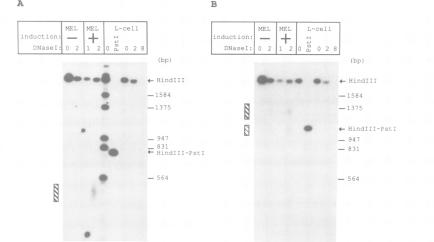
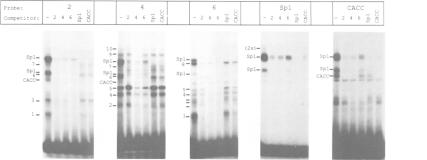
The Dominant Control Region (DCR) of the human beta-globin gene locus consists of four strong hypersensitive sites (HSS) upstream of the epsilon-globin gene. Addition of these sites confers copy number dependent expression on the human beta-globin gene in murine erythroleukaemia cells and transgenic mice, at levels comparable with the endogenous mouse globin genes. We have shown previously that a 1.9 kb fragment comprising HSS 2 accounts for 40-50% of the full effect of the DCR. In this paper we describe a deletional analysis of HSS 2. We show that a 225 bp fragment is sufficient to direct high levels of expression of the human beta-globin gene which is copy number dependent and integration site independent. This 225 bp fragment overlaps the major region that is hypersensitive 'in vivo'. DNase I footprinting shows the presence of four binding sites for the erythroid specific protein NF-E1; the three other footprinted regions display a remarkable redundancy of the sequence GGTGG and bind a number of proteins including Sp1 and the CACC box protein. The significance of these results for the regulation of globin gene expression is discussed.
人类β-珠蛋白基因座的显性控制区(DCR)由ε-珠蛋白基因上游的四个强超敏位点(HSS)组成。这些位点的添加使人类β-珠蛋白基因在鼠红细胞白血病细胞和转基因小鼠中呈现拷贝数依赖性表达,其表达水平与内源性小鼠珠蛋白基因相当。我们之前已经表明,包含HSS 2的1.9 kb片段占DCR全部效应的40 - 50%。在本文中,我们描述了对HSS 2的缺失分析。我们发现一个225 bp的片段足以指导人类β-珠蛋白基因的高水平表达,该表达具有拷贝数依赖性且与整合位点无关。这个225 bp的片段与“体内”超敏的主要区域重叠。DNA酶I足迹分析显示存在四个红细胞特异性蛋白NF-E1的结合位点;其他三个足迹区域显示出序列GGTGG的显著冗余,并结合包括Sp1和CACC盒蛋白在内的多种蛋白质。本文讨论了这些结果对珠蛋白基因表达调控的意义。