Institute for Neurobiology, University of Tübingen, Tübingen, Germany.
PLoS One. 2013 Apr 8;8(4):e60752. doi: 10.1371/journal.pone.0060752. Print 2013.
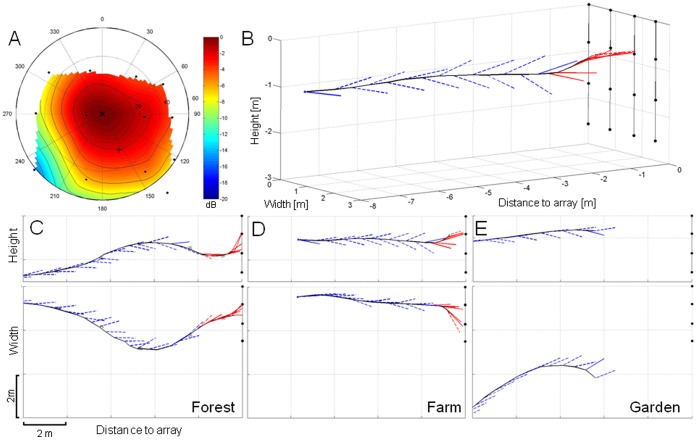
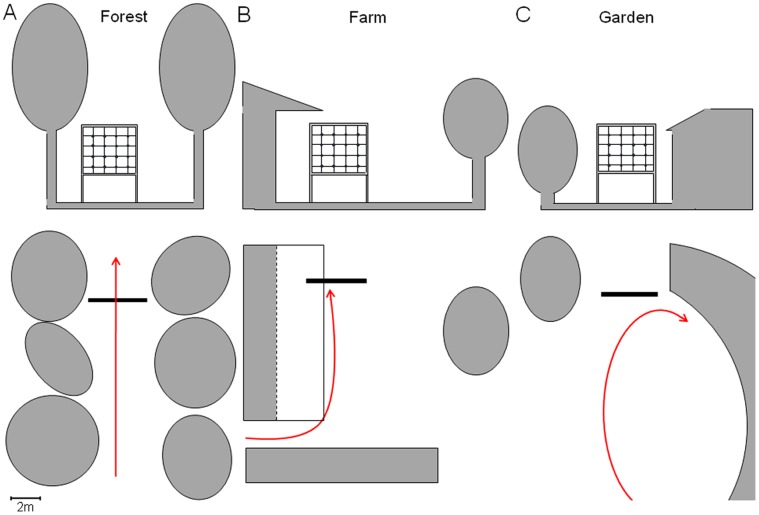
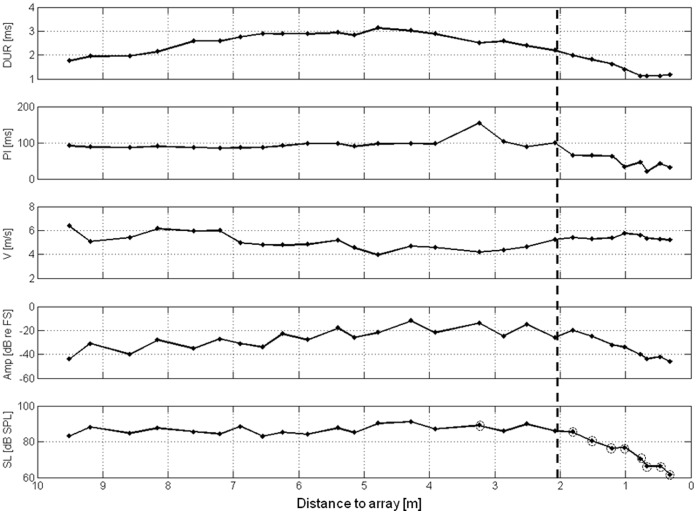
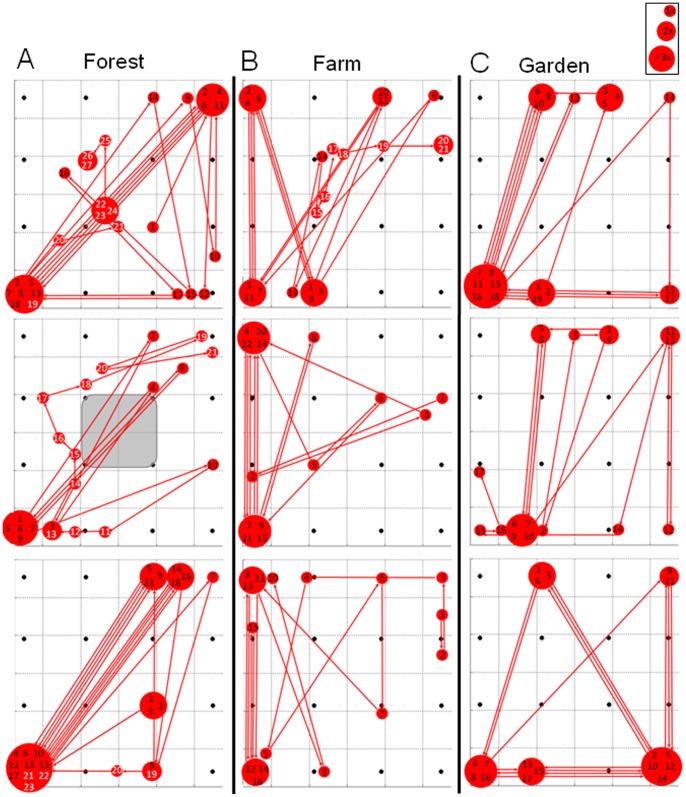
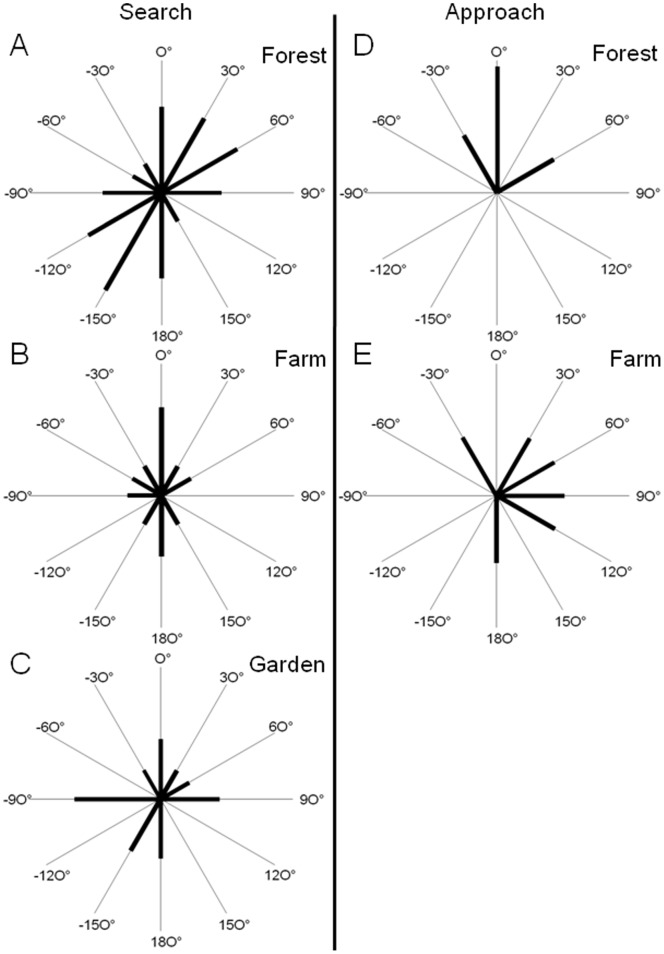
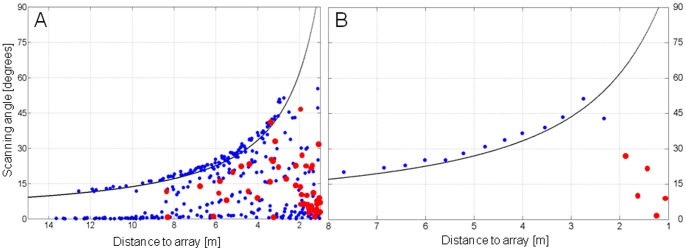
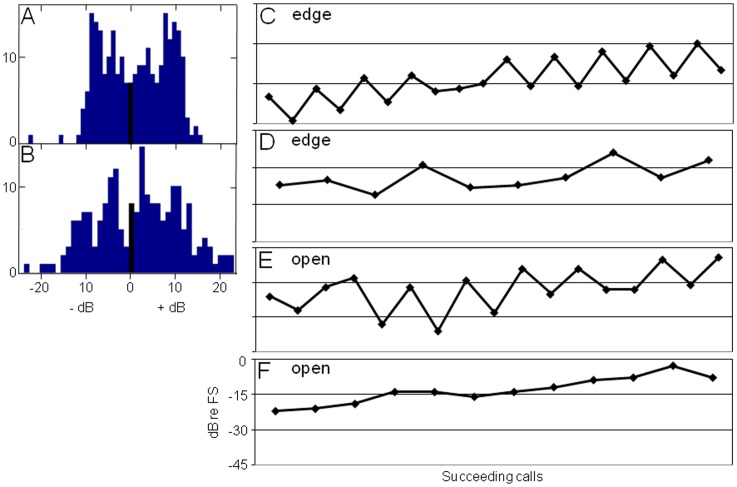
Echolocating bats construct an auditory world sequentially by analyzing successive pulse-echo pairs. Many other mammals rely upon a visual world, acquired by sequential foveal fixations connected by visual gaze saccades. We investigated the scanning behavior of bats and compared it to visual scanning. We assumed that each pulse-echo pair evaluation corresponds to a foveal fixation and that sonar beam movements between pulses can be seen as acoustic gaze saccades. We used a two-dimensional 16 microphone array to determine the sonar beam direction of succeeding pulses and to characterize the three dimensional scanning behavior in the common pipistrelle bat (Pipistrellus pipistrellus) flying in the field. We also used variations of signal amplitude of single microphone recordings as indicator for scanning behavior in open space. We analyzed 33 flight sequences containing more than 700 echolocation calls to determine bat positions, source levels, and beam aiming. When searching for prey and orienting in space, bats moved their sonar beam in all directions, often alternately back and forth. They also produced sequences with irregular or no scanning movements. When approaching the array, the scanning movements were much smaller and the beam was moved over the array in small steps. Differences in the scanning pattern at various recording sites indicated that the scanning behavior depended on the echolocation task that was being performed. The scanning angles varied over a wide range and were often larger than the maximum angle measurable by our array. We found that echolocating bats use a "saccade and fixate" strategy similar to vision. Through the use of scanning movements, bats are capable of finding and exploring targets in a wide search cone centered along flight direction.
回声定位蝙蝠通过分析连续的脉冲-回波对来构建一个顺序的听觉世界。许多其他哺乳动物依赖于一个视觉世界,通过连接在视觉注视扫视中的顺序中央凹注视获得。我们研究了蝙蝠的扫描行为,并将其与视觉扫描进行了比较。我们假设每次对脉冲-回波对的评估对应于一个中央凹注视,并且脉冲之间的声纳波束运动可以看作是声学注视扫视。我们使用二维 16 个麦克风阵列来确定后续脉冲的声纳波束方向,并描述在野外飞行的普通伏翼蝙蝠(Pipistrellus pipistrellus)中的三维扫描行为。我们还使用单个麦克风记录的信号幅度变化作为开放空间中扫描行为的指示。我们分析了 33 个飞行序列,其中包含超过 700 次回声定位叫声,以确定蝙蝠的位置、声源水平和波束指向。当寻找猎物和在空间中定向时,蝙蝠会将声纳波束向各个方向移动,通常是交替来回移动。它们还产生了具有不规则或无扫描运动的序列。当接近阵列时,扫描运动要小得多,波束以小步移动到阵列上。在各个记录点的扫描模式差异表明,扫描行为取决于正在执行的回声定位任务。扫描角度变化范围很广,并且经常大于我们的阵列可测量的最大角度。我们发现,回声定位蝙蝠使用类似于视觉的“扫视和注视”策略。通过使用扫描运动,蝙蝠能够在以飞行方向为中心的宽搜索圆锥中找到并探索目标。