Department of Gynecology and Obstetrics, Technische Universität München, Munich, Germany.
PLoS One. 2013 Apr 8;8(4):e60359. doi: 10.1371/journal.pone.0060359. Print 2013.
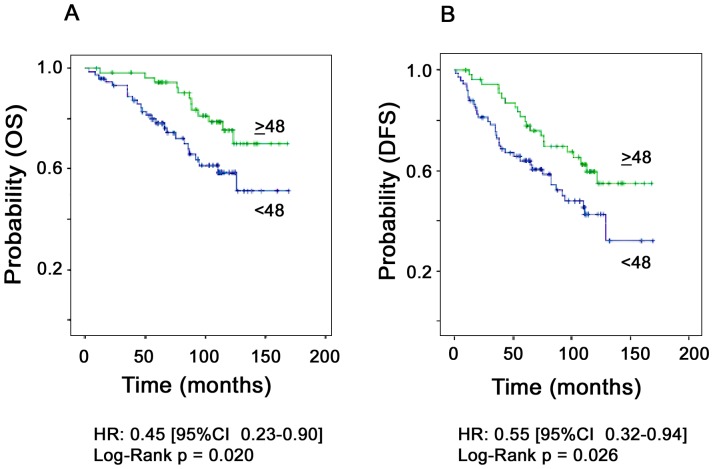
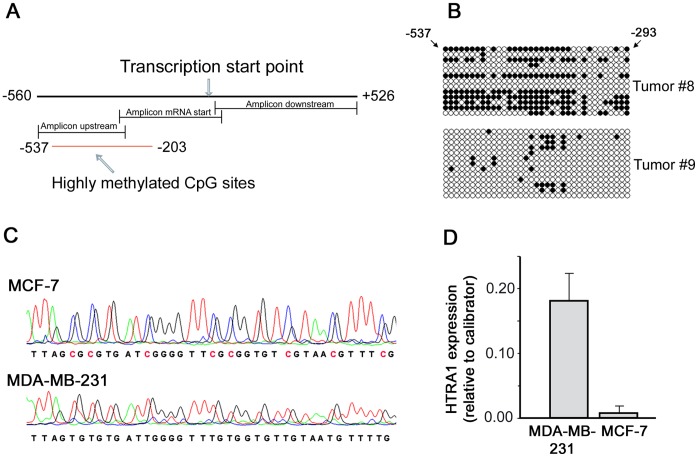
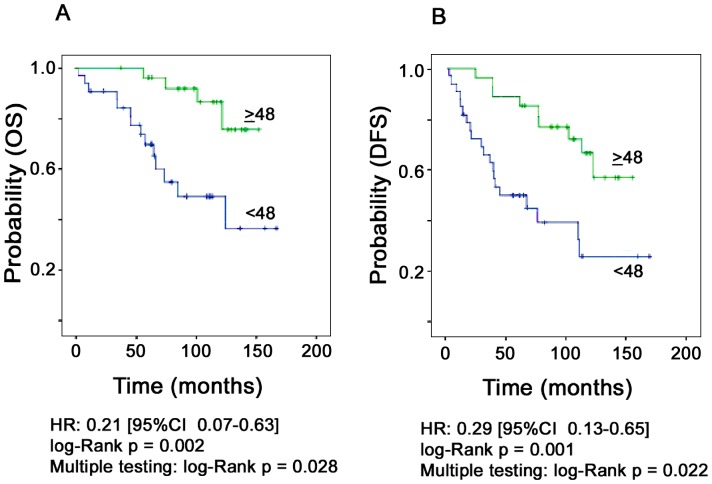
HTRA1 is a highly conserved serine protease which has been implicated in suppression of epithelial-to-mesenchymal-transition (EMT) and cell motility in breast cancer. Its prognostic relevance for breast cancer is unclear so far. Therefore, we evaluated the impact of HTRA1 mRNA expression on patient outcome using a cohort of 131 breast cancer patients as well as a validation cohort including 2809 publically available data sets. Additionally, we aimed at investigating for the presence of promoter hypermethylation as a mechanism for silencing the HTRA1 gene in breast tumors. HTRA1 downregulation was detected in more than 50% of the breast cancer specimens and was associated with higher tumor stage (p = 0.025). By applying Cox proportional hazard models, we observed favorable overall (OS) and disease-free survival (DFS) related to high HTRA1 expression (HR = 0.45 [CI 0.23-0.90], p = 0.023; HR = 0.55 [CI 0.32-0.94], p = 0.028, respectively), with even more pronounced impact in node-positive patients (HR = 0.21 [CI 0.07-0.63], p = 0.006; HR = 0.29 [CI 0.13-0.65], p = 0.002, respectively). Moreover, HTRA1 remained a statistically significant factor predicting DFS among established clinical parameters in the multivariable analysis. Its impact on patient outcome was independently confirmed in the validation set (for relapse-free survival (n = 2809): HR = 0.79 [CI 0.7-0.9], log-rank p = 0.0003; for OS (n = 971): HR = 0.63 [CI 0.48-0.83], log-rank p = 0.0009). In promoter analyses, we in fact detected methylation of HTRA1 in a small subset of breast cancer specimens (two out of a series of 12), and in MCF-7 breast cancer cells which exhibited 22-fold lower HTRA1 mRNA expression levels compared to unmethylated MDA-MB-231 cells. In conclusion, we show that downregulation of HTRA1 is associated with shorter patient survival, particularly in node-positive breast cancer. Since HTRA1 loss was demonstrated to induce EMT and cancer cell invasion, these patients might benefit from demethylating agents or histone deacetylase inhibitors previously reported to lead to HTRA1 upregulation, or from novel small-molecule inhibitors targeting EMT-related processes.
HTRA1 是一种高度保守的丝氨酸蛋白酶,已被证明可抑制乳腺癌中的上皮-间充质转化(EMT)和细胞迁移。其对乳腺癌的预后相关性目前尚不清楚。因此,我们使用包含 131 例乳腺癌患者的队列以及包含 2809 个公共数据集的验证队列,评估了 HTRA1 mRNA 表达对患者预后的影响。此外,我们旨在研究启动子超甲基化是否是导致乳腺癌中 HTRA1 基因沉默的机制。我们在超过 50%的乳腺癌标本中检测到 HTRA1 下调,且与更高的肿瘤分期相关(p=0.025)。通过应用 Cox 比例风险模型,我们观察到高 HTRA1 表达与总生存(OS)和无病生存(DFS)相关(HR=0.45[CI 0.23-0.90],p=0.023;HR=0.55[CI 0.32-0.94],p=0.028),在淋巴结阳性患者中影响更为显著(HR=0.21[CI 0.07-0.63],p=0.006;HR=0.29[CI 0.13-0.65],p=0.002)。此外,在多变量分析中,HTRA1 仍然是预测DFS 的统计学显著因素,独立于既定临床参数。在验证组中,HTRA1 对患者预后的影响得到了独立证实(无复发生存率(n=2809):HR=0.79[CI 0.7-0.9],对数秩检验 p=0.0003;OS(n=971):HR=0.63[CI 0.48-0.83],对数秩检验 p=0.0009)。在启动子分析中,我们实际上在一小部分乳腺癌标本(12 个系列中的 2 个)中检测到 HTRA1 的甲基化,并且在 MCF-7 乳腺癌细胞中检测到 HTRA1 mRNA 表达水平比未甲基化的 MDA-MB-231 细胞低 22 倍。总之,我们表明 HTRA1 的下调与患者生存时间缩短相关,特别是在淋巴结阳性的乳腺癌中。由于 HTRA1 缺失已被证明可诱导 EMT 和癌细胞侵袭,因此这些患者可能受益于先前报道可导致 HTRA1 上调的去甲基化剂或组蛋白去乙酰化酶抑制剂,或受益于针对 EMT 相关过程的新型小分子抑制剂。