Moad Mohammad, Pal Deepali, Hepburn Anastasia C, Williamson Stuart C, Wilson Laura, Lako Majlinda, Armstrong Lyle, Hayward Simon W, Franco Omar E, Cates Justin M, Fordham Sarah E, Przyborski Stefan, Carr-Wilkinson Jane, Robson Craig N, Heer Rakesh
Northern Institute for Cancer Research, Newcastle University, UK.
Eur Urol. 2013 Nov;64(5):753-61. doi: 10.1016/j.eururo.2013.03.054. Epub 2013 Apr 6.
Primary culture and animal and cell-line models of prostate and bladder development have limitations in describing human biology, and novel strategies that describe the full spectrum of differentiation from foetal through to ageing tissue are required. Recent advances in biology demonstrate that direct reprogramming of somatic cells into pluripotent embryonic stem cell (ESC)-like cells is possible. These cells, termed induced pluripotent stem cells (iPSCs), could theoretically generate adult prostate and bladder tissue, providing an alternative strategy to study differentiation.
To generate human iPSCs derived from normal, ageing, human prostate (Pro-iPSC), and urinary tract (UT-iPSC) tissue and to assess their capacity for lineage-directed differentiation.
DESIGN, SETTING, AND PARTICIPANTS: Prostate and urinary tract stroma were transduced with POU class 5 homeobox 1 (POU5F1; formerly OCT4), SRY (sex determining region Y)-box 2 (SOX2), Kruppel-like factor 4 (gut) (KLF4), and v-myc myelocytomatosis viral oncogene homolog (avian) (MYC, formerly C-MYC) genes to generate iPSCs.
The potential for differentiation into prostate and bladder lineages was compared with classical skin-derived iPSCs. The student t test was used.
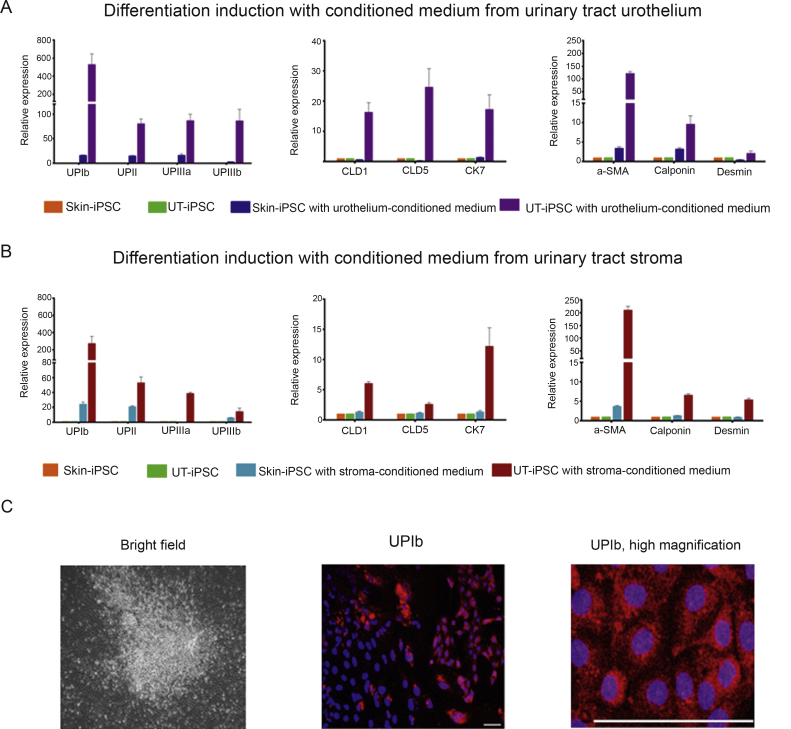
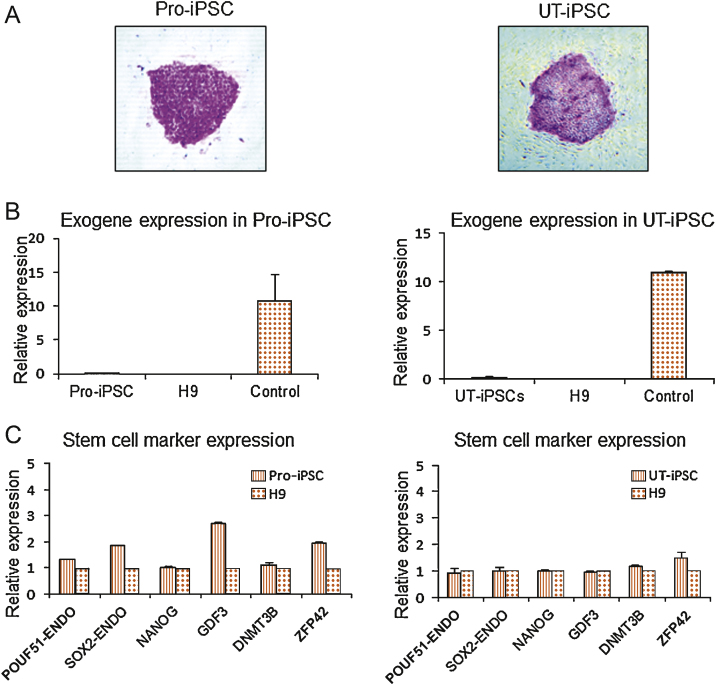
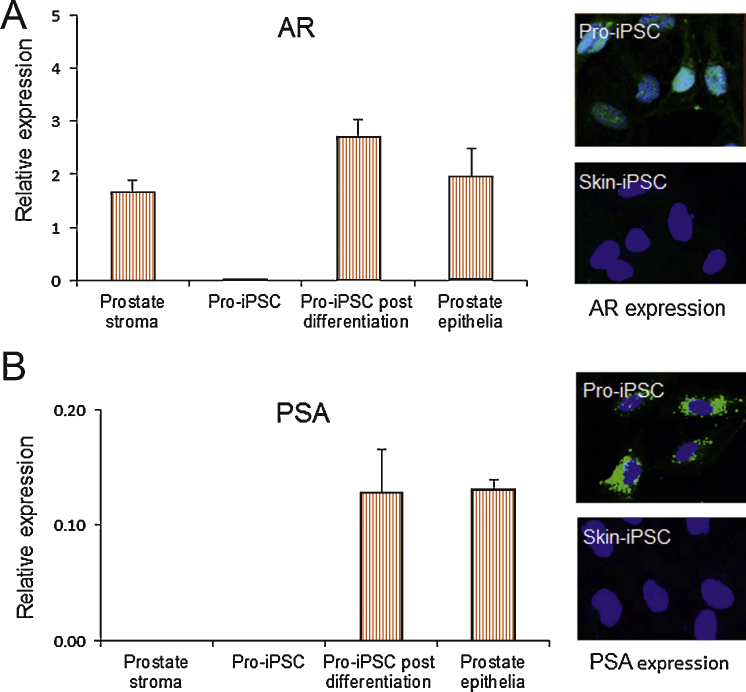
Successful reprogramming of prostate tissue into Pro-iPSCs and bladder and ureter into UT-iPSCs was demonstrated by characteristic ESC morphology, marker expression, and functional pluripotency in generating all three germ-layer lineages. In contrast to conventional skin-derived iPSCs, Pro-iPSCs showed a vastly increased ability to generate prostate epithelial-specific differentiation, as characterised by androgen receptor and prostate-specific antigen induction. Similarly, UT-iPSCs were shown to be more efficient than skin-derived iPSCs in undergoing bladder differentiation as demonstrated by expression of urothelial-specific markers: uroplakins, claudins, and cytokeratin; and stromal smooth muscle markers: α-smooth-muscle actin, calponin, and desmin. These disparities are likely to represent epigenetic differences between individual iPSC lines and highlight the importance of organ-specific iPSCs for tissue-specific studies.
IPSCs provide an exciting new model to characterise mechanisms regulating prostate and bladder differentiation and to develop novel approaches to disease modelling. Regeneration of bladder cells also provides an exceptional opportunity for translational tissue engineering.
前列腺和膀胱发育的原代培养以及动物和细胞系模型在描述人类生物学方面存在局限性,因此需要能够描述从胎儿到衰老组织全部分化谱的新策略。生物学领域的最新进展表明,将体细胞直接重编程为多能胚胎干细胞(ESC)样细胞是可行的。这些细胞被称为诱导多能干细胞(iPSC),理论上可以生成成人前列腺和膀胱组织,为研究分化提供了一种替代策略。
从正常、衰老的人类前列腺(Pro-iPSC)和泌尿道(UT-iPSC)组织中生成人类iPSC,并评估其定向分化的能力。
设计、设置和参与者:用POU5类同源盒1(POU5F1;原称OCT4)、SRY(性别决定区Y)盒2(SOX2)、Kruppel样因子4(肠道)(KLF4)和v-myc髓细胞瘤病毒癌基因同源物(禽类)(MYC,原称C-MYC)基因转导前列腺和泌尿道基质以生成iPSC。
将向前列腺和膀胱谱系分化的潜力与经典的皮肤来源iPSC进行比较。使用学生t检验。
通过特征性的ESC形态、标志物表达以及生成所有三个胚层谱系的功能多能性,证明了前列腺组织成功重编程为Pro-iPSC,膀胱和输尿管成功重编程为UT-iPSC。与传统的皮肤来源iPSC相比,Pro-iPSC表现出极大增强的生成前列腺上皮特异性分化的能力,其特征为雄激素受体和前列腺特异性抗原的诱导。同样,UT-iPSC在经历膀胱分化方面比皮肤来源iPSC更有效,这通过尿路上皮特异性标志物:尿板蛋白、紧密连接蛋白和细胞角蛋白的表达;以及基质平滑肌标志物:α-平滑肌肌动蛋白、钙调蛋白和结蛋白得以证明。这些差异可能代表了各个iPSC系之间的表观遗传差异,并突出了器官特异性iPSC在组织特异性研究中的重要性。
iPSC为表征调节前列腺和膀胱分化的机制以及开发疾病建模的新方法提供了一个令人兴奋的新模型。膀胱细胞的再生也为转化组织工程提供了一个绝佳的机会。