Bueche Celine Zoe, Garz Cornelia, Kropf Siegfried, Bittner Daniel, Li Wenjie, Goertler Michael, Heinze Hans-Jochen, Reymann Klaus, Braun Holger, Schreiber Stefanie
Department of Neurology, Otto-von-Guericke-University, Leipziger Strasse 44, Magdeburg, 39120, Germany.
Institute of Biometry and Medical Informatics, Otto-von-Guericke-University, Leipziger Strasse 44, Magdeburg, 39120, Germany.
Exp Transl Stroke Med. 2013 Apr 15;5:5. doi: 10.1186/2040-7378-5-5. eCollection 2013.
N-Acetylcystein (NAC) reduces the reperfusion injury and infarct size in experimental macroangiopathic stroke. Here we now investigate the impact of NAC on the development of the histopathology of microangiopathic cerebrovascular disease including initial intravasal erythrocyte accumulations, blood-brain-barrier (BBB)-disturbances, microbleeds and infarcts.
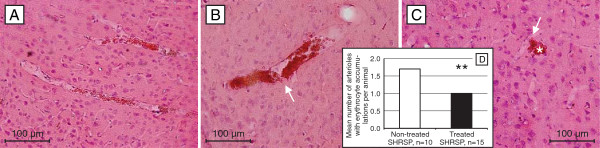
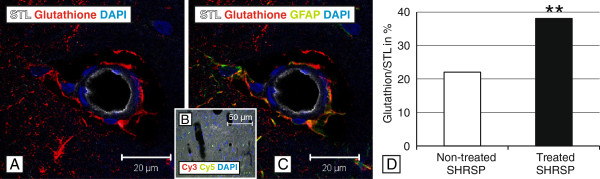
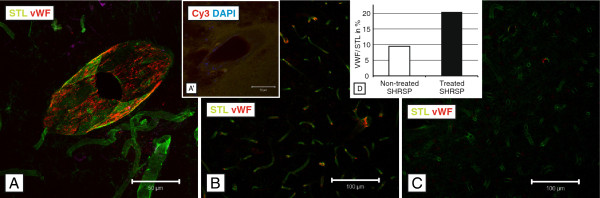
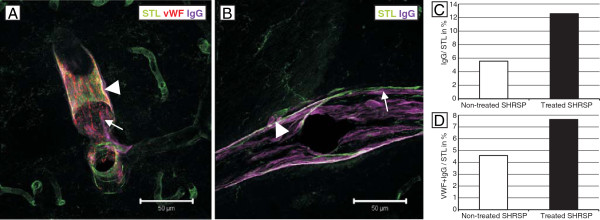
Spontaneously Hypertensive Stroke-Prone Rats (SHRSP) were treated with NAC (12 mg/kg body weight, daily oral application for three to 30 weeks) and compared to untreated SHRSP. In all rats the number of microbleeds, thromboses, infarcts and stases were quantified by HE-staining. Exemplary brains were stained against von Willebrand factor (vWF), IgG, Glutathione and GFAP.
NAC animals exhibited significant more microbleeds, a greater number of vessels with BBB-disturbances, but also an elevation of Glutathione-levels in astrocytes surrounding small vessels. NAC-treatment reduced the numbers of thromboses, infarcts and arteriolar stases.
NAC reduces the frequency of thromboses and infarcts to the expense of an increase of small microbleeds in a rat model of microangiopathic cerebrovascular disease. We suppose that NAC acts via an at least partial inactivation of vWF resulting in an insufficient sealing of initial endothelial injury leading to more small microbleeds. By elevating Glutathione-levels NAC most likely exerts a radical scavenger function and protects small vessels against extended ruptures and subsequent infarcts. Finally, it reveals that stases are mainly caused by endothelial injuries and restricted thromboses.
N-乙酰半胱氨酸(NAC)可减轻实验性大血管病变性卒中的再灌注损伤和梗死面积。在此,我们研究NAC对微血管性脑血管疾病组织病理学发展的影响,包括初始血管内红细胞聚集、血脑屏障(BBB)破坏、微出血和梗死。
自发性高血压易卒中大鼠(SHRSP)接受NAC治疗(12mg/kg体重,每日口服,持续3至30周),并与未治疗的SHRSP进行比较。对所有大鼠,通过苏木精-伊红(HE)染色对微出血、血栓形成、梗死和淤滞的数量进行定量。选取代表性大脑进行血管性血友病因子(vWF)、免疫球蛋白G(IgG)、谷胱甘肽和胶质纤维酸性蛋白(GFAP)染色。
NAC处理的动物出现显著更多的微出血,更多伴有BBB破坏的血管,但小血管周围星形胶质细胞中的谷胱甘肽水平也有所升高。NAC治疗减少了血栓形成、梗死和小动脉淤滞的数量。
在微血管性脑血管疾病大鼠模型中,NAC降低了血栓形成和梗死的频率,但代价是小微出血增加。我们推测NAC通过至少部分使vWF失活起作用,导致初始内皮损伤的密封不足,从而导致更多小微出血。通过提高谷胱甘肽水平,NAC很可能发挥自由基清除功能,保护小血管免受广泛破裂和随后梗死的影响。最后,研究表明淤滞主要由内皮损伤和局限性血栓形成引起。