Horikoshi Nobuo, Kumar Pankaj, Sharma Girdhar G, Chen Min, Hunt Clayton R, Westover Kenneth, Chowdhury Shantanu, Pandita Tej K
Department of Radiation Oncology, Division of Molecular Radiation Biology, University of Texas Southwestern Medical Center, Dallas, TX 75390, USA.
Department of Radiation Oncology, Washington University School of Medicine, St. Louis, MO, 63108, USA.
Genome Integr. 2013 Apr 12;4(1):3. doi: 10.1186/2041-9414-4-3.
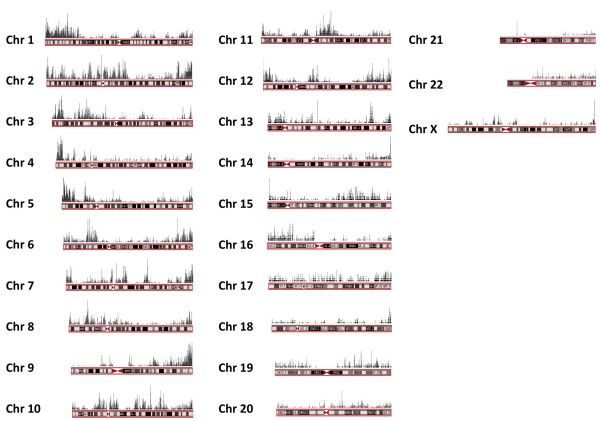
Histone post-translational modifications are critical determinants of chromatin structure and function, impacting multiple biological processes including DNA transcription, replication, and repair. The post-translational acetylation of histone H4 at lysine 16 (H4K16ac) was initially identified in association with dosage compensation of the Drosophila male X chromosome. However, in mammalian cells, H4K16ac is not associated with dosage compensation and the genomic distribution of H4K16ac is not precisely known. Therefore, we have mapped the genome-wide H4K16ac distribution in human cells.
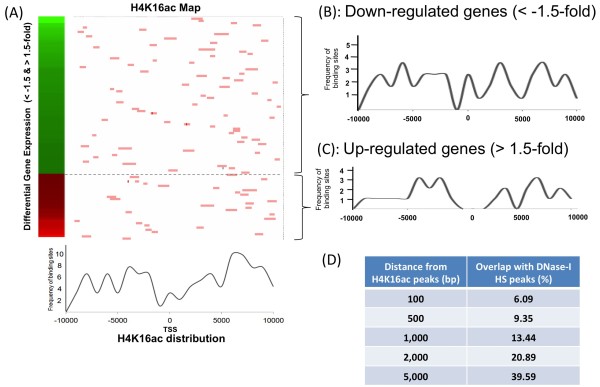
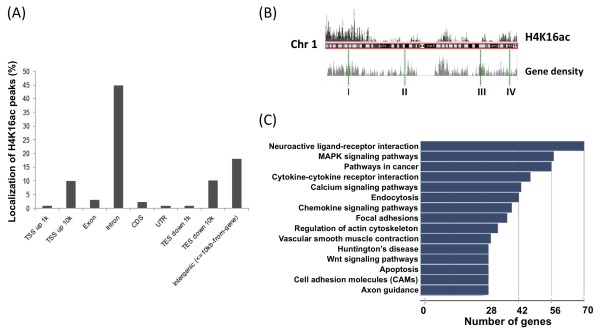
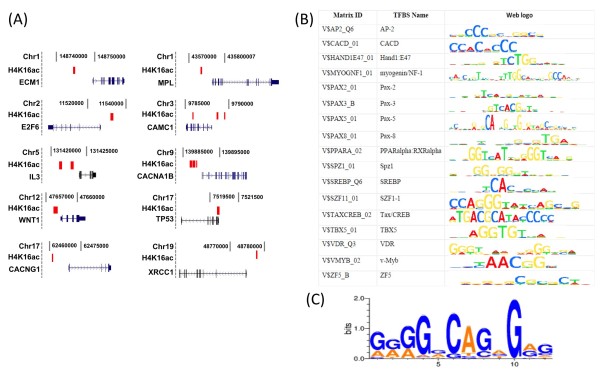
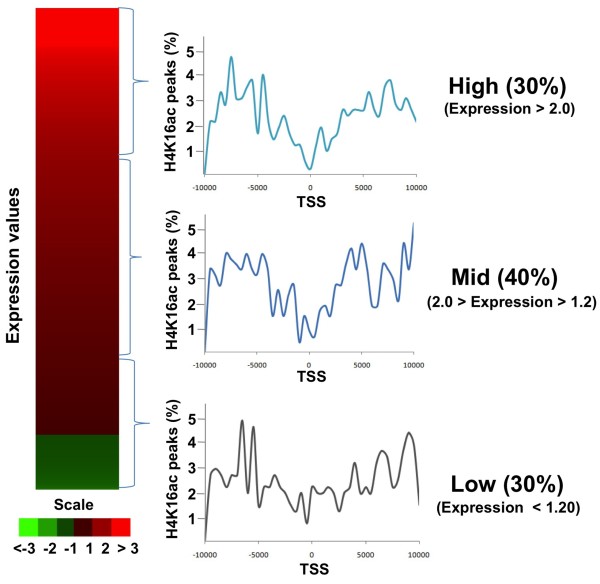
We performed H4K16ac chromatin immunoprecipitation from human embryonic kidney 293 (HEK293) cells followed by hybridization to whole-genome tiling arrays and identified 25,893 DNA regions (false discovery rate <0.005) with average length of 692 nucleotides. Interestingly, although a majority of H4K16ac sites localized within genes, only a relatively small fraction (~10%) was found near promoters, in contrast to the distribution of the acetyltransferase, MOF, responsible for acetylation at K16 of H4. Using differential gene expression profiling data, 73 genes (> ±1.5-fold) were identified as potential H4K16ac-regulated genes. Seventeen transcription factor-binding sites were significantly associated with H4K16ac occupancy (p < 0.0005). In addition, a consensus 12-nucleotide guanine-rich sequence motif was identified in more than 55% of the H4K16ac peaks.
The results suggest that H4K16 acetylation has a limited effect on transcription regulation in HEK293 cells, whereas H4K16ac has been demonstrated to have critical roles in regulating transcription in mouse embryonic stem cells. Thus, H4K16ac-dependent transcription regulation is likely a cell type specific process.
组蛋白翻译后修饰是染色质结构和功能的关键决定因素,影响包括DNA转录、复制和修复在内的多个生物学过程。组蛋白H4赖氨酸16位点(H4K16ac)的翻译后乙酰化最初是在果蝇雄性X染色体的剂量补偿中被发现的。然而,在哺乳动物细胞中,H4K16ac与剂量补偿无关,其在基因组中的分布也尚不明确。因此,我们绘制了人类细胞中全基因组范围的H4K16ac分布图谱。
我们对人胚肾293(HEK293)细胞进行了H4K16ac染色质免疫沉淀,随后与全基因组平铺阵列杂交,并鉴定出25,893个DNA区域(错误发现率<0.005),平均长度为692个核苷酸。有趣的是,尽管大多数H4K16ac位点位于基因内,但与负责H4第16位赖氨酸乙酰化的乙酰转移酶MOF的分布相反,只有相对较小的一部分(约10%)位于启动子附近。利用差异基因表达谱数据,73个基因(>±1.5倍)被鉴定为潜在的H4K16ac调控基因。17个转录因子结合位点与H4K16ac的占据显著相关(p < 0.0005)。此外,在超过55%的H4K16ac峰中鉴定出一个共有12个核苷酸的富含鸟嘌呤的序列基序。
结果表明,H4K16乙酰化对HEK293细胞中的转录调控作用有限,而H4K16ac已被证明在小鼠胚胎干细胞的转录调控中起关键作用。因此,H4K16ac依赖的转录调控可能是一个细胞类型特异性过程。