Department of Radiological Sciences, David Geffen School of Medicine, University of California Los Angeles, Los Angeles, CA, USA.
Spinal Cord. 2013 Jul;51(7):558-63. doi: 10.1038/sc.2013.31. Epub 2013 Apr 16.
A single-center magnetic resonance imaging and spectroscopic study involving 21 patients with advanced cervical spondylosis and 11 healthy controls.
We assessed the utility of magnetic resonance spectroscopy (MRS) to quantify biochemical changes within the spinal cord and serve as a potential biomarker in patients with cervical spondylosis with or without T2 hyperintensity within the cord.
Los Angeles, California, USA.
Twenty-one patients with cervical spondylosis and eleven healthy controls were evaluated. Single-voxel MRS was performed in the cervical cord. Morphometry of the spinal canal space was measured. N-Acetyl aspartylglutamic acid (NAA), choline (Cho), myo-inositol (Myo-I), glutamine-glutamate complex (Glx) and lactate metabolite concentration ratios with respect to total creatine (Cr) were quantified using an LC model algorithm and compared between healthy controls and spondylosis patients. Correlation of MRS metabolites with modified Japanese Orthopaedic Association (mJOA) score was also performed.
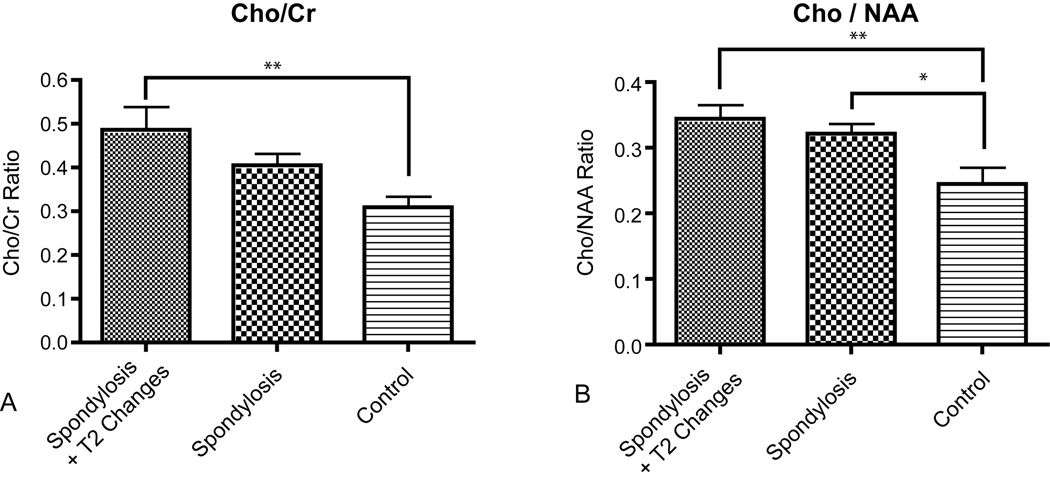
The spinal canal space was significantly different between patients and controls (analysis of variance (ANOVA), P<0.0001). Total Cho-to-Cr ratio was significantly elevated in patients with spondylosis and T2-hyperintensity compared with healthy controls (ANOVA, P<0.01). A significantly higher Cho-to-NAA ratio was observed in spondylosis patients compared with healthy controls (ANOVA, P<0.01). Slightly elevated Glx and Myo-I were encountered in patients with stenosis without T2 hyperintensity. A linear correlation between Cho-NAA ratio and mJOA was also observed (P<0.01).
MRS appears sensitive to biochemical changes occurring in advanced cervical spondylosis patients. The Cho/NAA ratio was significantly correlated with the mJOA score, providing a potentially clinically useful radiographical biomarker for the management of advanced cervical spondylosis patients.
一项单中心磁共振成像和波谱研究,共纳入 21 例晚期颈椎病患者和 11 例健康对照者。
评估磁共振波谱(MRS)定量脊髓内生化变化的能力,并作为伴有或不伴有脊髓内 T2 高信号的颈椎病患者的潜在生物标志物。
美国加利福尼亚州洛杉矶。
对 21 例颈椎病患者和 11 例健康对照者进行评估。在颈椎脊髓内进行单体素 MRS 检查。测量椎管空间的形态计量学。使用 LC 模型算法定量测定 N-乙酰天门冬氨酸(NAA)、胆碱(Cho)、肌醇(Myo-I)、谷氨酰胺-谷氨酸复合物(Glx)和乳酸代谢物与总肌酸(Cr)的浓度比,并与健康对照组和颈椎病患者进行比较。还对 MRS 代谢物与改良日本骨科协会(mJOA)评分的相关性进行了分析。
患者组和对照组的椎管空间有显著差异(方差分析(ANOVA),P<0.0001)。与健康对照组相比,伴有 T2 高信号的颈椎病患者的总 Cho/Cr 比值明显升高(ANOVA,P<0.01)。与健康对照组相比,颈椎病患者的 Cho/NAA 比值明显升高(ANOVA,P<0.01)。无 T2 高信号狭窄的患者中,Glx 和 Myo-I 略有升高。还观察到 Cho-NAA 比值与 mJOA 之间存在线性相关性(P<0.01)。
MRS 对晚期颈椎病患者发生的生化变化敏感。Cho/NAA 比值与 mJOA 评分显著相关,为晚期颈椎病患者的管理提供了一种潜在的临床有用的影像学生物标志物。