Institute of Statistical Science, Academia Sinica, 128 Academia Road, Section 2, Taipei 115, Taiwan.
BMC Med. 2013 Apr 16;11:106. doi: 10.1186/1741-7015-11-106.
Chemosensitivity and tumor metastasis are two primary issues in cancer management. Cancer cells often exhibit a wide range of sensitivity to anti-cancer compounds. To gain insight on the genetic mechanism of drug sensitivity, one powerful approach is to employ the panel of 60 human cancer cell lines developed by the National Cancer Institute (NCI). Cancer cells also show a broad range of invasion ability. However, a genome-wide portrait on the contributing molecular factors to invasion heterogeneity is lacking.
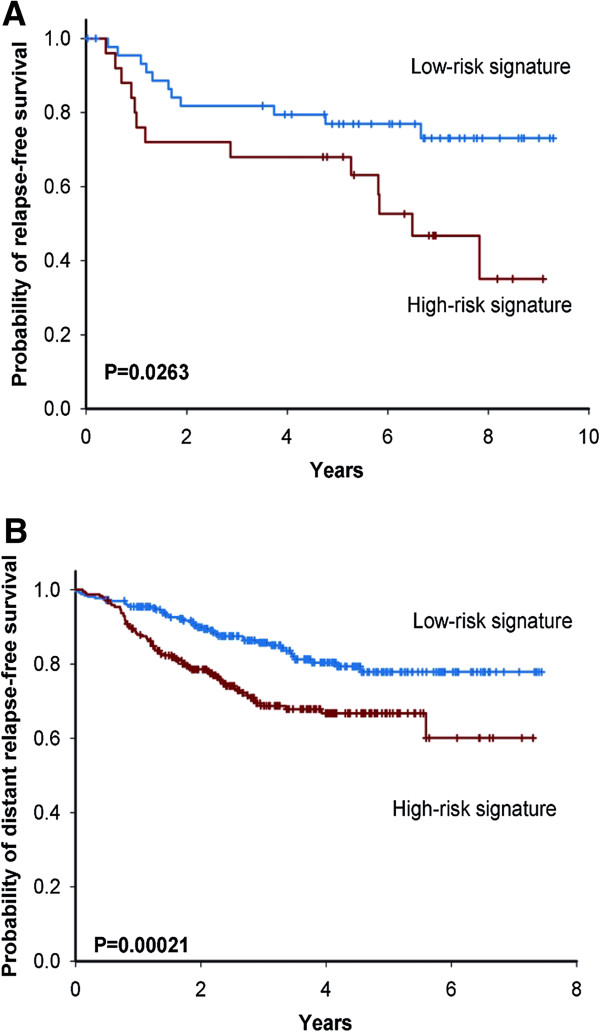
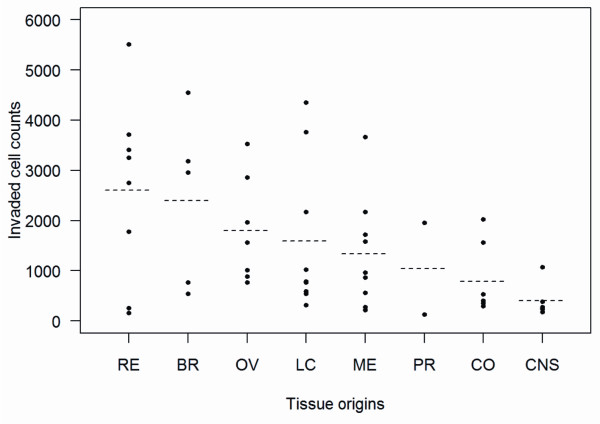
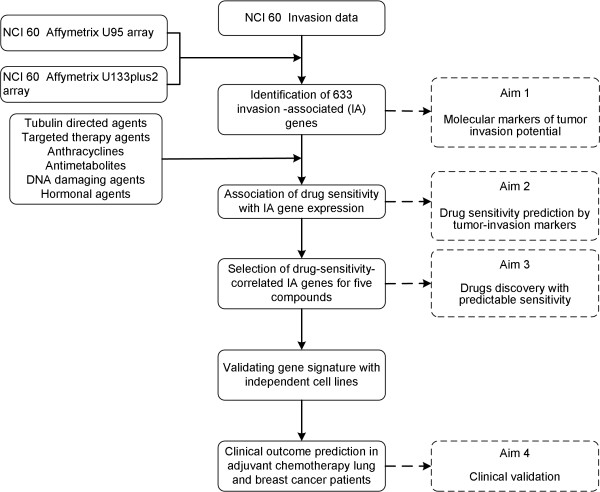
Our lab performed an invasion assay on the NCI-60 panel. We identified invasion-associated (IA) genes by correlating our invasion profiling data with the Affymetrix gene expression data on NCI-60. We then employed the recently released chemosensitivity data of 99 anti-cancer drugs of known mechanism to investigate the gene-drug correlation, focusing on the IA genes. Afterwards, we collected data from four independent drug-testing experiments to validate our findings on compound response prediction. Finally, we obtained published clinical and molecular data from two recent adjuvant chemotherapy cohorts, one on lung cancer and one on breast cancer, to test the performance of our gene signature for patient outcome prediction.
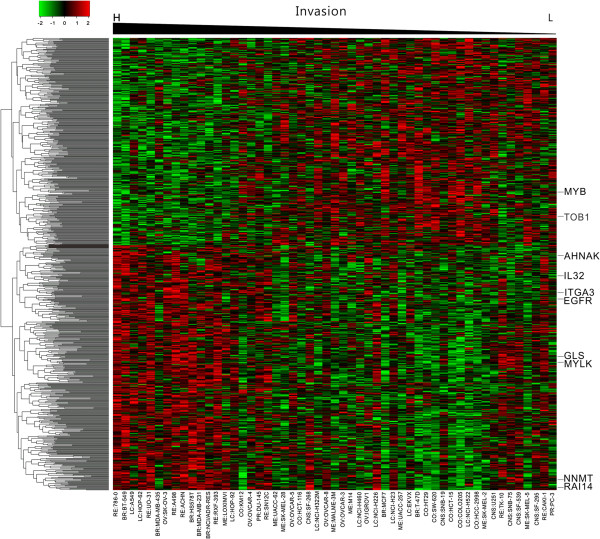
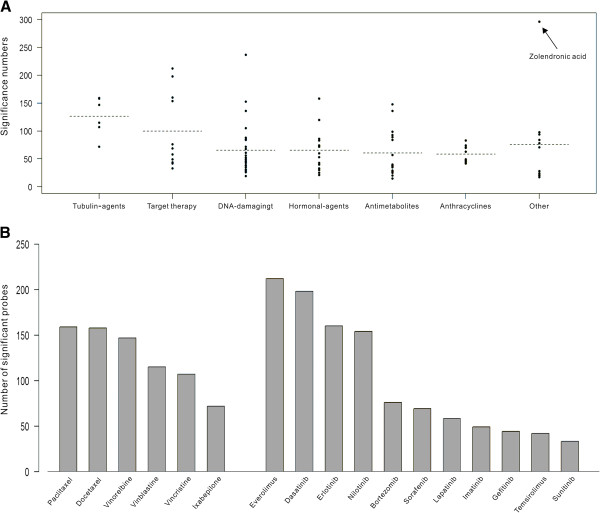
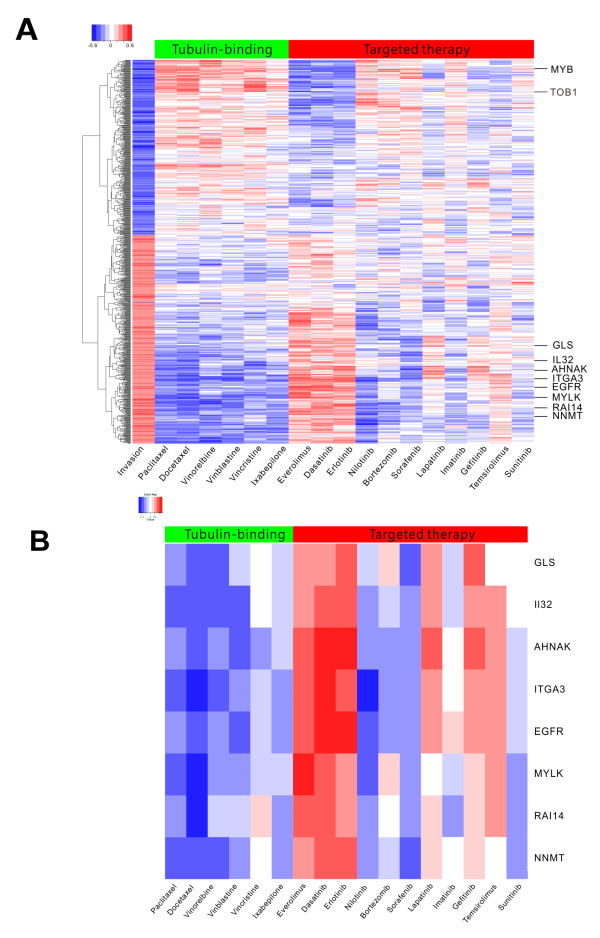
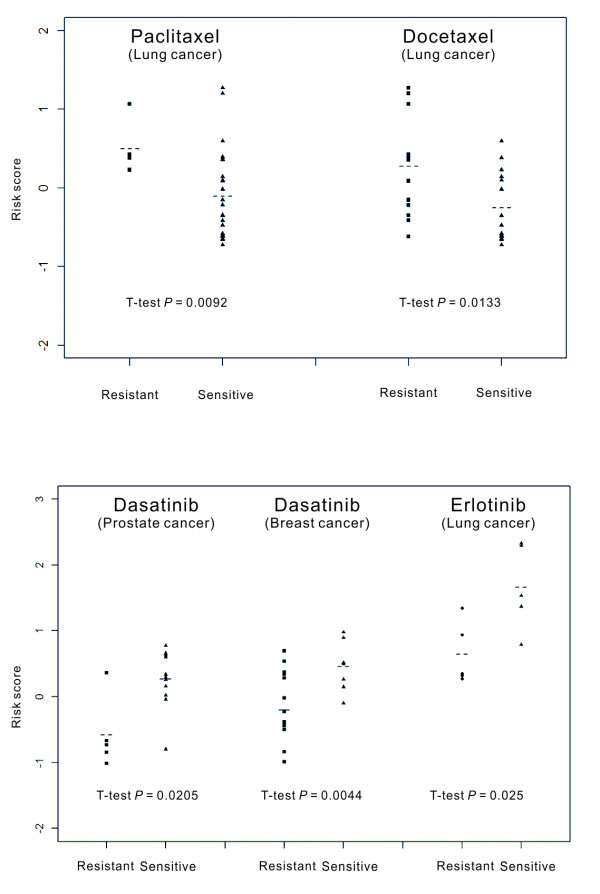
First, we found 633 IA genes from the invasion-gene expression correlation study. Then, for each of the 99 drugs, we obtained a subset of IA genes whose expression levels correlated with drug-sensitivity profiles. We identified a set of eight genes (EGFR, ITGA3, MYLK, RAI14, AHNAK, GLS, IL32 and NNMT) showing significant gene-drug correlation with paclitaxel, docetaxel, erlotinib, everolimus and dasatinib. This eight-gene signature (derived from NCI-60) for chemosensitivity prediction was validated by a total of 107 independent drug tests on 78 tumor cell lines, most of which were outside of the NCI-60 panel. The eight-gene signature predicted relapse-free survival for the lung and breast cancer patients (log-rank P = 0.0263; 0.00021). Multivariate Cox regression yielded a hazard ratio of our signature of 5.33 (95% CI = 1.76 to 16.1) and 1.81 (95% CI = 1.19 to 2.76) respectively. The eight-gene signature features the cancer hallmark epidermal growth factor receptor (EGFR) and genes involved in cell adhesion, migration, invasion, tumor growth and progression.
Our study sheds light on the intricate three-way interplay among gene expression, invasion and compound-sensitivity. We report the finding of a unique signature that predicts chemotherapy survival for both lung and breast cancer. Augmenting the NCI-60 model with in vitro characterization of important phenotype-like invasion potential is a cost-effective approach to power the genomic chemosensitivity analysis.
化疗敏感性和肿瘤转移是癌症管理中的两个主要问题。癌细胞通常对抗癌化合物表现出广泛的敏感性。为了深入了解药物敏感性的遗传机制,一种强大的方法是利用美国国立癌症研究所(NCI)开发的 60 个人类癌细胞系进行研究。癌细胞还表现出广泛的侵袭能力。然而,对于导致侵袭异质性的贡献分子因素,目前还缺乏全基因组图谱。
我们实验室对 NCI-60 面板进行了侵袭分析。我们通过将我们的侵袭分析数据与 NCI-60 的 Affymetrix 基因表达数据相关联,确定了与侵袭相关的(IA)基因。然后,我们利用最近发布的 99 种已知机制的抗癌药物的化疗敏感性数据,研究基因-药物相关性,重点关注 IA 基因。之后,我们从四个独立的药物测试实验中收集数据,以验证我们在化合物反应预测方面的发现。最后,我们从两个最近的辅助化疗队列(一个肺癌队列和一个乳腺癌队列)中获取已发表的临床和分子数据,以测试我们的基因特征在患者预后预测方面的性能。
首先,我们从侵袭-基因表达相关性研究中发现了 633 个 IA 基因。然后,对于每一种 99 种药物,我们获得了一组与其敏感性谱相关的 IA 基因。我们确定了一组 8 个基因(EGFR、ITGA3、MYLK、RAI14、AHNAK、GLS、IL32 和 NNMT)与紫杉醇、多西他赛、厄洛替尼、依维莫司和达沙替尼具有显著的基因-药物相关性。这个由 NCI-60 得出的用于化疗敏感性预测的 8 个基因特征(signature)在 78 个肿瘤细胞系的 107 个独立药物测试中得到了验证,其中大多数细胞系不在 NCI-60 面板内。这 8 个基因特征(来自 NCI-60)对肺癌和乳腺癌患者的无复发生存率进行了预测(对数秩 P=0.0263;0.00021)。多变量 Cox 回归得到我们的特征的风险比为 5.33(95%CI=1.76 至 16.1)和 1.81(95%CI=1.19 至 2.76)。8 个基因特征具有癌症标志表皮生长因子受体(EGFR)和参与细胞黏附、迁移、侵袭、肿瘤生长和进展的基因。
我们的研究揭示了基因表达、侵袭和化合物敏感性之间错综复杂的三向相互作用。我们报告了一种独特的特征,它可以预测肺癌和乳腺癌的化疗生存率。用体外侵袭特性的重要表型特征对 NCI-60 模型进行补充,是一种具有成本效益的方法,可以增强基因组化疗敏感性分析。