Laboratoire de Psychologie et NeuroCognition, CNRS-UMR 5105, Université Pierre-Mendès-France, Grenoble, France.
PLoS One. 2013 Apr 4;8(4):e58097. doi: 10.1371/journal.pone.0058097. Print 2013.
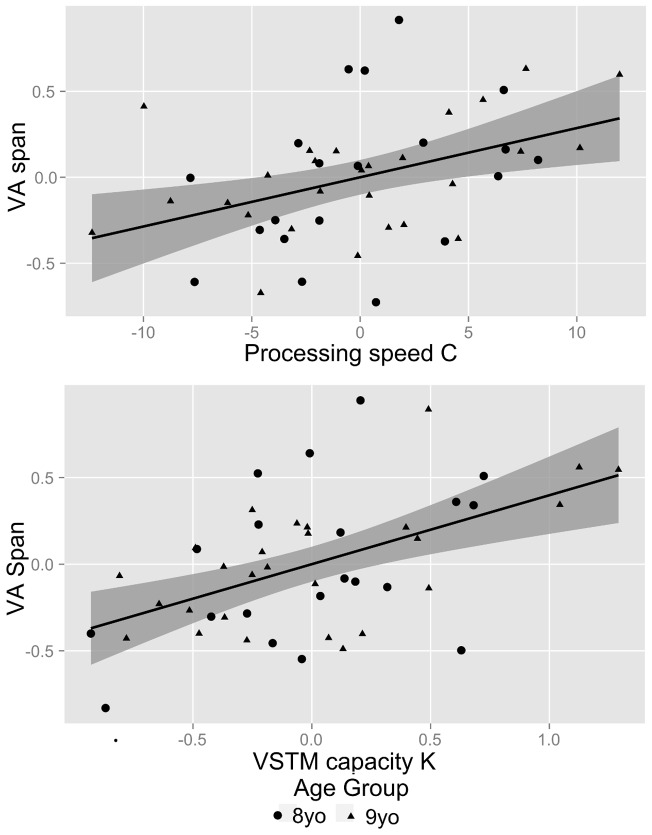
A steady increase in reading speed is the hallmark of normal reading acquisition. However, little is known of the influence of visual attention capacity on children's reading speed. The number of distinct visual elements that can be simultaneously processed at a glance (dubbed the visual attention span), predicts single-word reading speed in both normal reading and dyslexic children. However, the exact processes that account for the relationship between the visual attention span and reading speed remain to be specified. We used the Theory of Visual Attention to estimate visual processing speed and visual short-term memory capacity from a multiple letter report task in eight and nine year old children. The visual attention span and text reading speed were also assessed. Results showed that visual processing speed and visual short term memory capacity predicted the visual attention span. Furthermore, visual processing speed predicted reading speed, but visual short term memory capacity did not. Finally, the visual attention span mediated the effect of visual processing speed on reading speed. These results suggest that visual attention capacity could constrain reading speed in elementary school children.
阅读速度的稳定提高是正常阅读习得的标志。然而,人们对视觉注意容量对儿童阅读速度的影响知之甚少。一次可以同时处理的不同视觉元素的数量(称为视觉注意广度),可以预测正常阅读和阅读障碍儿童的单词阅读速度。然而,解释视觉注意广度和阅读速度之间关系的确切过程仍有待确定。我们使用视觉注意理论,从八、九岁儿童的多个字母报告任务中估计视觉处理速度和视觉短期记忆容量,同时评估视觉注意广度和文本阅读速度。结果表明,视觉处理速度和视觉短期记忆容量预测了视觉注意广度。此外,视觉处理速度预测了阅读速度,但视觉短期记忆容量没有。最后,视觉注意广度中介了视觉处理速度对阅读速度的影响。这些结果表明,在小学生中,视觉注意能力可能会限制阅读速度。