Uniformed Services University of Health Sciences, Center for Study of Traumatic Stress, Bethesda, Maryland, USA.
PLoS One. 2013 Apr 11;8(4):e59236. doi: 10.1371/journal.pone.0059236. Print 2013.
We conducted a systematic review of the literature to explore the longitudinal course of PTSD in DSM-5-defined trauma exposed populations to identify the course of illness and recovery for individuals and populations experiencing PTSD.
We reviewed the published literature from January 1, 1998 to December 31, 2010 for longitudinal studies of directly exposed trauma populations in order to: (1) review rates of PTSD in the first year after a traumatic event; (2) examine potential types of proposed DSM-5 direct trauma exposure (intentional and non-intentional); and (3) identify the clinical course of PTSD (early onset, later onset, chronicity, remission, and resilience). Of the 2537 identified articles, 58 articles representing 35 unique subject populations met the proposed DSM-5 criteria for experiencing a traumatic event, and assessed PTSD at two or more time points within 12 months of the traumatic event.
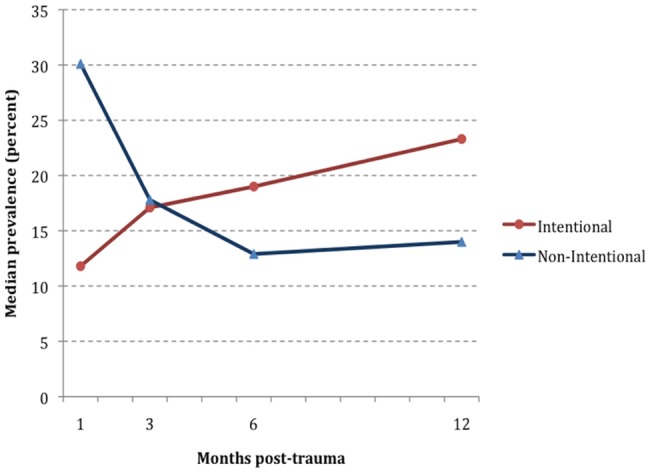
The mean prevalence of PTSD across all studies decreases from 28.8% (range =3.1-87.5%) at 1 month to 17.0% (range =0.6-43.8%) at 12 months. However, when traumatic events are classified into intentional and non-intentional, the median prevalences trend down for the non-intentional trauma exposed populations, while the median prevalences in the intentional trauma category steadily increase from 11.8% to 23.3%. Across five studies with sufficient data, 37.1% of those exposed to intentional trauma develop PTSD. Among those with PTSD, about one third (34.8%) remit after 3 months. Nearly 40% of those with PTSD (39.1%) have a chronic course, and only a very small fraction (3.5%) of new PTSD cases appears after three months.
Understanding the trajectories of PTSD over time, and how it may vary by type of traumatic event (intentional vs. non-intentional) will assist public health planning and treatment.
我们对文献进行了系统回顾,以探索 DSM-5 定义的创伤暴露人群中 PTSD 的纵向病程,以确定经历 PTSD 的个体和人群的疾病和康复过程。
我们回顾了 1998 年 1 月 1 日至 2010 年 12 月 31 日发表的纵向直接暴露于创伤人群的研究文献,以便:(1)审查创伤后 1 年内 PTSD 的发生率;(2)检查拟议的 DSM-5 直接创伤暴露的潜在类型(故意和非故意);(3)确定 PTSD 的临床病程(早期发病、后期发病、慢性、缓解和恢复力)。在确定的 2537 篇文章中,有 58 篇文章代表 35 个独特的研究人群,符合经历创伤事件的拟议 DSM-5 标准,并在创伤事件后 12 个月内进行了两次或两次以上的 PTSD 评估。
所有研究中 PTSD 的平均患病率从创伤后 1 个月的 28.8%(范围=3.1-87.5%)下降到 12 个月的 17.0%(范围=0.6-43.8%)。然而,当将创伤事件分为故意和非故意时,非故意创伤暴露人群的中值患病率呈下降趋势,而故意创伤类别的中值患病率则从 11.8%稳步上升至 23.3%。在五项有足够数据的研究中,有 37.1%的故意创伤暴露者患有 PTSD。在患有 PTSD 的人中,约有三分之一(34.8%)在 3 个月后缓解。近 40%的 PTSD 患者(39.1%)病程慢性,只有很小一部分(3.5%)新的 PTSD 病例出现在 3 个月后。
了解 PTSD 随时间的轨迹以及它如何因创伤事件的类型(故意与非故意)而变化,将有助于公共卫生规划和治疗。