Faculty of Science, University of South Bohemia, České Budějovice, Czech Republic.
PLoS One. 2013 Apr 10;8(4):e59299. doi: 10.1371/journal.pone.0059299. Print 2013.
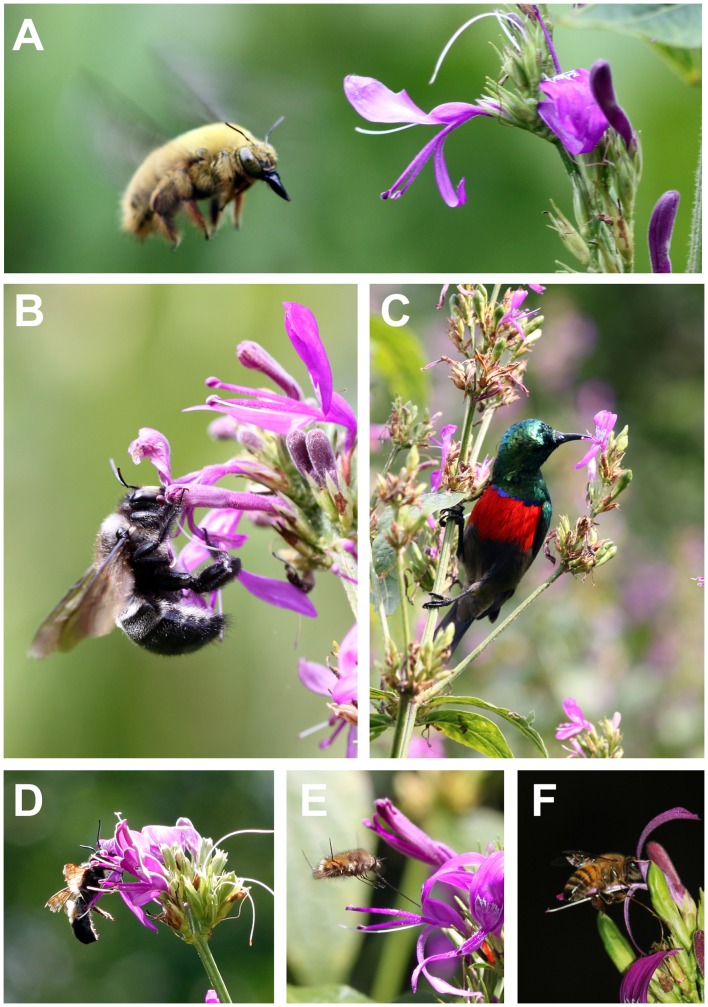
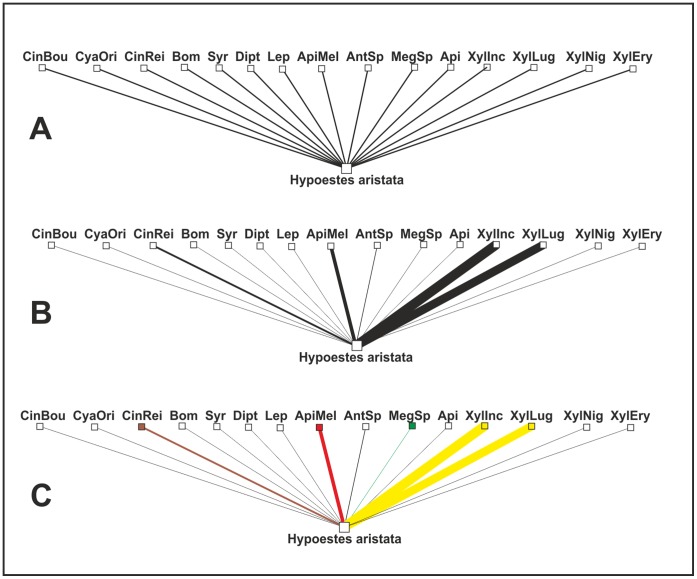
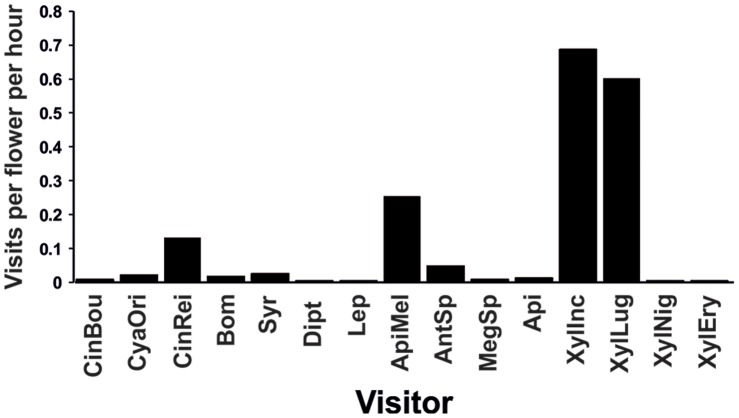
Many recent studies have suggested that the majority of animal-pollinated plants have a higher diversity of pollinators than that expected according to their pollination syndrome. This broad generalization, often based on pollination web data, has been challenged by the fact that some floral visitors recorded in pollination webs are ineffective pollinators. To contribute to this debate, and to obtain a contrast between visitors and pollinators, we studied insect and bird visitors to virgin flowers of Hypoestes aristata in the Bamenda Highlands, Cameroon. We observed the flowers and their visitors for 2-h periods and measured the seed production as a metric of reproductive success. We determined the effects of individual visitors using 2 statistical models, single-visit data that were gathered for more frequent visitor species, and frequency data. This approach enabled us to determine the positive as well as neutral or negative impact of visitors on H. aristata's reproductive success. We found that (i) this plant is not generalized but rather specialized; although we recorded 15 morphotaxa of visitors, only 3 large bee species seemed to be important pollinators; (ii) the carpenter bee Xylocopa cf. inconstans was both the most frequent and the most effective pollinator; (iii) the honey bee Apis mellifera acted as a nectar thief with apparent negative effects on the plant reproduction; and (iv) the close relationship between H. aristata and carpenter bees was in agreement with the large-bee pollination syndrome of this plant. Our results highlight the need for studies detecting the roles of individual visitors. We showed that such an approach is necessary to evaluate the pollination syndrome hypothesis and create relevant evolutionary and ecological hypotheses.
许多近期的研究表明,与根据授粉综合征所预期的相比,大多数动物授粉植物的授粉者多样性更高。这种广泛的概括,通常基于授粉网络数据,已经受到一些在授粉网络中记录的传粉者实际上是无效传粉者的事实的挑战。为了对这一争论做出贡献,并获得访客和传粉者之间的对比,我们在喀麦隆巴门达高地研究了 Hypoestes aristata 处女花的昆虫和鸟类访客。我们观察了花朵及其访客 2 小时,并测量了种子产量作为繁殖成功的指标。我们使用 2 个统计模型确定了单个访客的影响,这些模型针对更频繁的访客物种收集了单次访问数据,以及频率数据。这种方法使我们能够确定访客对 H. aristata 繁殖成功的积极、中性或消极影响。我们发现:(i)这种植物不是广义的,而是专门的;尽管我们记录了 15 种访客形态分类群,但似乎只有 3 种大型蜜蜂物种是重要的传粉者;(ii)木匠蜂 Xylocopa cf. inconstans 既是最频繁的也是最有效的传粉者;(iii)蜜蜂 Apis mellifera 充当花蜜盗贼,对植物繁殖有明显的负面影响;(iv)H. aristata 与木匠蜂之间的密切关系与这种植物的大型蜜蜂授粉综合征一致。我们的结果强调了需要研究检测个别访客的作用。我们表明,这种方法对于评估授粉综合征假说和创建相关的进化和生态假说都是必要的。