Department of Biology, University of Copenhagen, Copenhagen, Denmark.
PLoS One. 2013 Apr 8;8(4):e60193. doi: 10.1371/journal.pone.0060193. Print 2013.
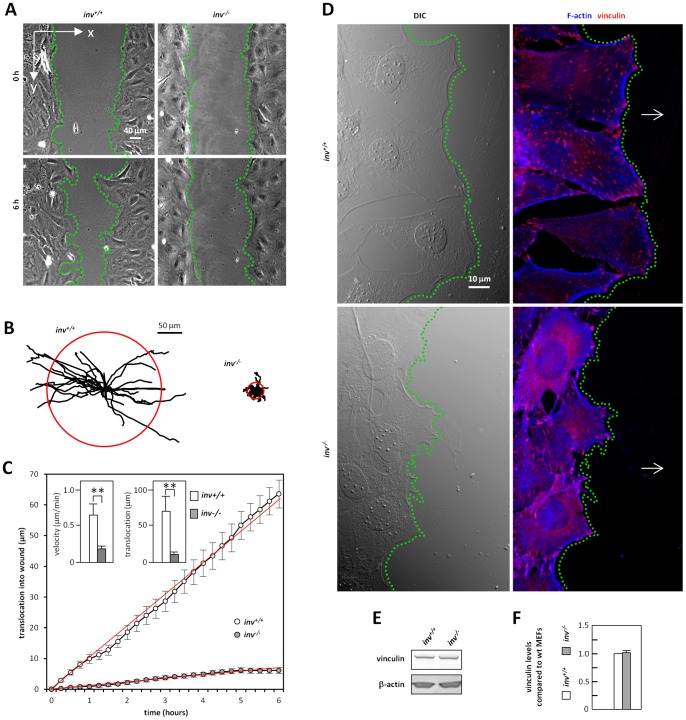
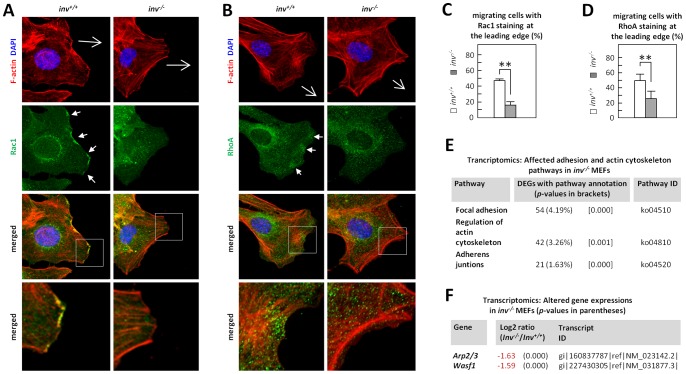
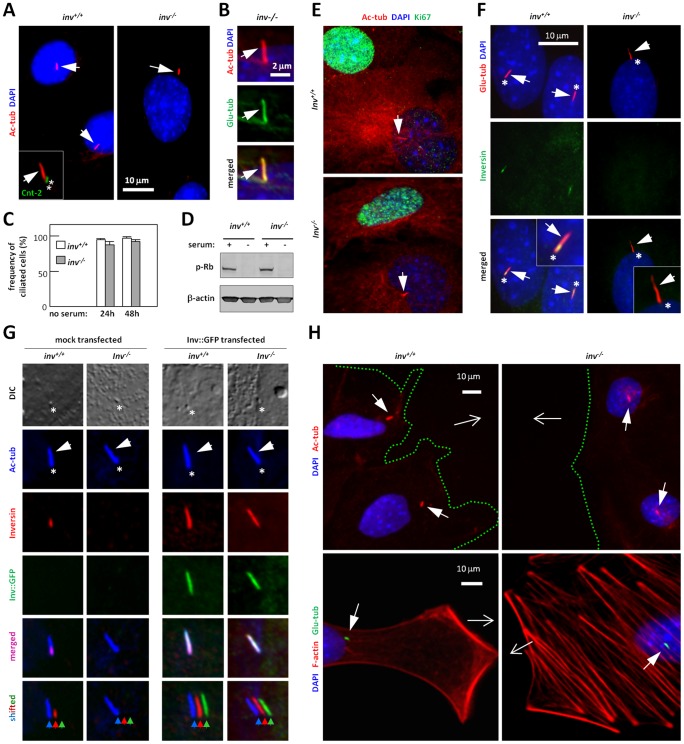
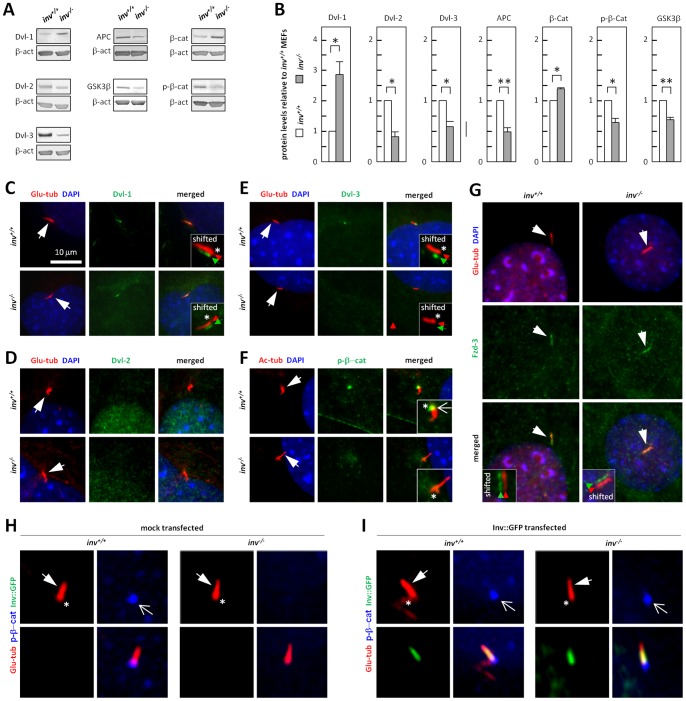
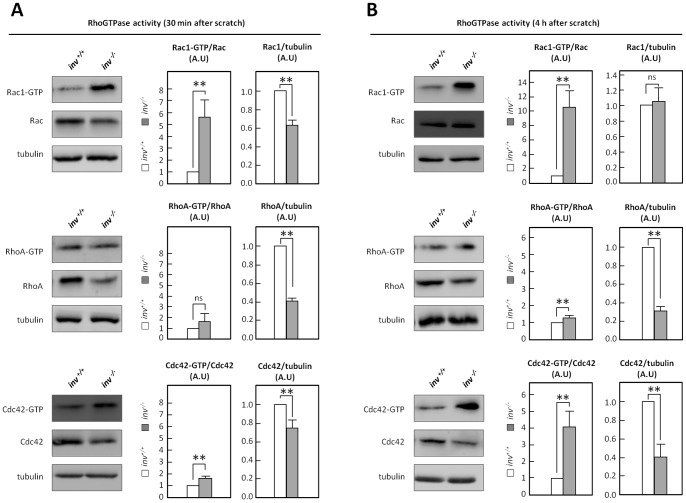
Inversin is a ciliary protein that critically regulates developmental processes and tissue homeostasis in vertebrates, partly through the degradation of Dishevelled (Dvl) proteins to coordinate Wnt signaling in planar cell polarity (PCP). Here, we investigated the role of Inversin in coordinating cell migration, which highly depends on polarity processes at the single-cell level, including the spatial and temporal organization of the cytoskeleton as well as expression and cellular localization of proteins in leading edge formation of migrating cells. Using cultures of mouse embryonic fibroblasts (MEFs) derived from inv(-/-) and inv(+/+) animals, we confirmed that both inv(-/-) and inv(+/+) MEFs form primary cilia, and that Inversin localizes to the primary cilium in inv(+/+) MEFs. In wound healing assays, inv(-/-) MEFs were severely compromised in their migratory ability and exhibited cytoskeletal rearrangements, including distorted lamellipodia formation and cilia orientation. Transcriptome analysis revealed dysregulation of Wnt signaling and of pathways regulating actin organization and focal adhesions in inv(-/-) MEFs as compared to inv(+/+) MEFs. Further, Dvl-1 and Dvl-3 localized to MEF primary cilia, and β-catenin/Wnt signaling was elevated in inv(-/-) MEFs, which moreover showed reduced ciliary localization of Dvl-3. Finally, inv(-/-) MEFs displayed dramatically altered activity and localization of RhoA, Rac1, and Cdc42 GTPases, and aberrant expression and targeting of the Na(+)/H(+) exchanger NHE1 and ezrin/radixin/moesin (ERM) proteins to the edge of cells facing the wound. Phosphorylation of β-catenin at the ciliary base and formation of well-defined lamellipodia with localization and activation of ERM to the leading edge of migrating cells were restored in inv(-/-) MEFs expressing Inv-GFP. Collectively, our findings point to the significance of Inversin in controlling cell migration processes, at least in part through transcriptional regulation of genes involved in Wnt signaling and pathways that control cytoskeletal organization and ion transport.
反转蛋白是一种纤毛蛋白,它在脊椎动物中通过降解 Dishevelled(Dvl)蛋白来协调 Wnt 信号转导,从而在平面细胞极性(PCP)中发挥关键的调节发育过程和组织内稳态的作用。在这里,我们研究了反转蛋白在协调细胞迁移中的作用,细胞迁移高度依赖于单细胞水平的极性过程,包括细胞骨架的时空组织以及细胞迁移前沿形成中蛋白质的表达和细胞定位。使用源自 inv(-/-)和 inv(+/+)动物的小鼠胚胎成纤维细胞(MEFs)培养物,我们证实 inv(-/-)和 inv(+/+) MEFs 都能形成初级纤毛,并且 Inversin 在 inv(+/+) MEFs 中定位于初级纤毛。在划痕愈合实验中,inv(-/-) MEFs 的迁移能力严重受损,并表现出细胞骨架重排,包括变形的片状伪足形成和纤毛取向。转录组分析显示,与 inv(+/+) MEFs 相比,inv(-/-) MEFs 中 Wnt 信号和调节肌动蛋白组织和焦点黏附的途径失调。此外,Dvl-1 和 Dvl-3 定位于 MEF 初级纤毛,β-catenin/Wnt 信号在 inv(-/-) MEFs 中升高,此外 inv(-/-) MEFs 中 Dvl-3 的纤毛定位减少。最后,inv(-/-) MEFs 显示 RhoA、Rac1 和 Cdc42 GTPase 的活性和定位明显改变,Na(+)/H(+)交换器 NHE1 和 ezrin/radixin/moesin(ERM)蛋白的异常表达和靶向到面向伤口的细胞边缘。在表达 Inv-GFP 的 inv(-/-) MEFs 中,β-catenin 在纤毛基底的磷酸化以及具有定位和激活 ERM 到迁移细胞前缘的明确的片状伪足形成得到恢复。总之,我们的发现表明,反转蛋白在控制细胞迁移过程中具有重要意义,至少部分是通过参与 Wnt 信号转导和控制细胞骨架组织和离子转运途径的基因的转录调控。