Life Sciences Group, Agilent Technologies, Santa Clara, California, United States of America.
PLoS One. 2013 Apr 9;8(4):e60840. doi: 10.1371/journal.pone.0060840. Print 2013.
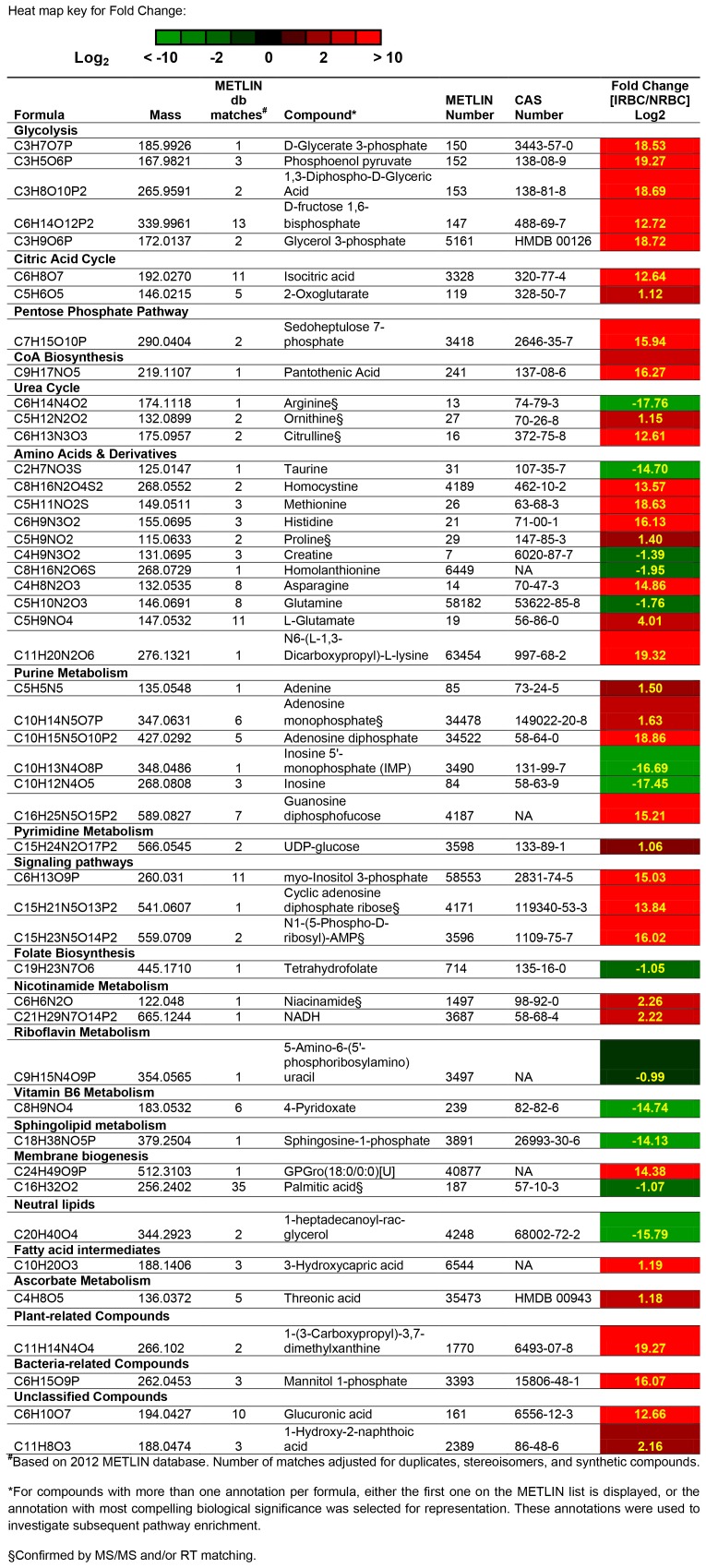
Malaria is a global infectious disease that threatens the lives of millions of people. Transcriptomics, proteomics and functional genomics studies, as well as sequencing of the Plasmodium falciparum and Homo sapiens genomes, have shed new light on this host-parasite relationship. Recent advances in accurate mass measurement mass spectrometry, sophisticated data analysis software, and availability of biological pathway databases, have converged to facilitate our global, untargeted biochemical profiling study of in vitro P. falciparum-infected (IRBC) and uninfected (NRBC) erythrocytes. In order to expand the number of detectable metabolites, several key analytical steps in our workflows were optimized. Untargeted and targeted data mining resulted in detection of over one thousand features or chemical entities. Untargeted features were annotated via matching to the METLIN metabolite database. For targeted data mining, we queried the data using a compound database derived from a metabolic reconstruction of the P. falciparum genome. In total, over one hundred and fifty differential annotated metabolites were observed. To corroborate the representation of known biochemical pathways from our data, an inferential pathway analysis strategy was used to map annotated metabolites onto the BioCyc pathway collection. This hypothesis-generating approach resulted in over-representation of many metabolites onto several IRBC pathways, most prominently glycolysis. In addition, components of the "branched" TCA cycle, partial urea cycle, and nucleotide, amino acid, chorismate, sphingolipid and fatty acid metabolism were found to be altered in IRBCs. Interestingly, we detected and confirmed elevated levels for cyclic ADP ribose and phosphoribosyl AMP in IRBCs, a novel observation. These metabolites may play a role in regulating the release of intracellular Ca(2+) during P. falciparum infection. Our results support a strategy of global metabolite profiling by untargeted data acquisition. Untargeted and targeted data mining workflows, when used together to perform pathway-inferred metabolomics, have the benefit of obviating MS/MS confirmation for every detected compound.
疟疾是一种全球性传染病,威胁着数百万人的生命。转录组学、蛋白质组学和功能基因组学研究,以及疟原虫和人类基因组的测序,为这种宿主-寄生虫关系提供了新的线索。精确质量测量质谱、复杂数据分析软件的最新进展,以及生物途径数据库的可用性,汇聚在一起,促进了我们对体外感染疟原虫(IRBC)和未感染(NRBC)红细胞的全球、无目标生化特征的研究。为了扩大可检测代谢物的数量,我们对工作流程中的几个关键分析步骤进行了优化。非靶向和靶向数据挖掘检测到了一千多个特征或化学实体。通过与 METLIN 代谢物数据库匹配对非靶向特征进行注释。对于靶向数据挖掘,我们使用源自疟原虫基因组代谢重建的化合物数据库对数据进行查询。总共观察到一百五十多个差异注释代谢物。为了证实我们的数据中已知生化途径的代表性,我们使用了一种推断途径分析策略,将注释代谢物映射到 BioCyc 途径集合上。这种产生假说的方法导致许多代谢物在几个 IRBC 途径中过度表达,最突出的是糖酵解途径。此外,IRBC 中还发现了“分支”三羧酸循环、部分尿素循环以及核苷酸、氨基酸、色氨酸、鞘脂和脂肪酸代谢的组成部分发生了改变。有趣的是,我们检测并证实了 IRBC 中环腺苷二磷酸核糖和磷酸核糖 AMP 的水平升高,这是一个新的发现。这些代谢物可能在调节疟原虫感染期间细胞内 Ca(2+)的释放中发挥作用。我们的结果支持通过非靶向数据采集进行全局代谢物特征分析的策略。非靶向和靶向数据挖掘工作流程一起用于执行途径推断代谢组学,可以避免对每个检测到的化合物进行 MS/MS 确认。