Department of Molecular Biology and Lewis-Sigler Institute for Integrative Genomics, Princeton University, Princeton, New Jersey 08544, USA.
Nature. 2010 Aug 5;466(7307):774-8. doi: 10.1038/nature09301.
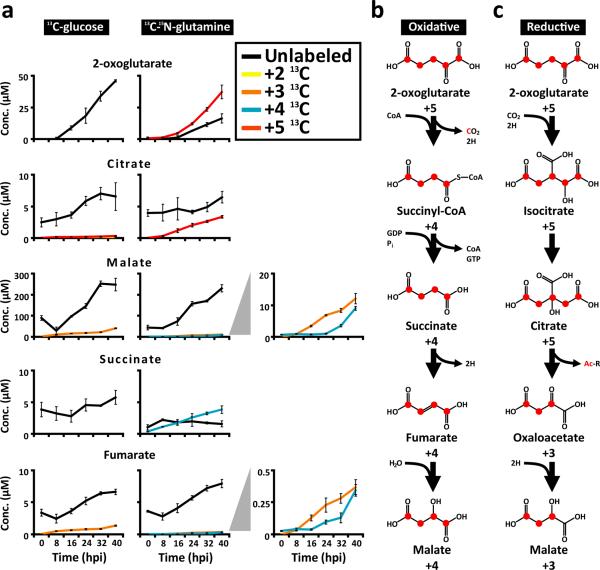
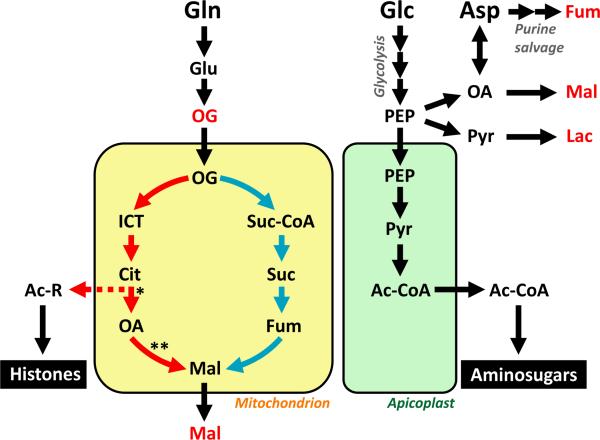
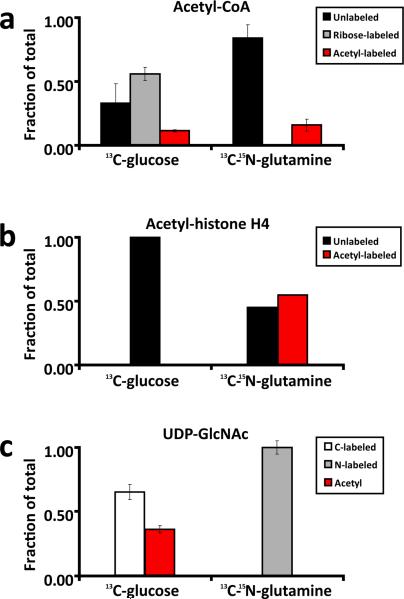
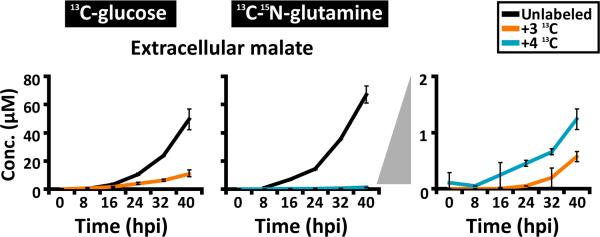
A central hub of carbon metabolism is the tricarboxylic acid cycle, which serves to connect the processes of glycolysis, gluconeogenesis, respiration, amino acid synthesis and other biosynthetic pathways. The protozoan intracellular malaria parasites (Plasmodium spp.), however, have long been suspected of possessing a significantly streamlined carbon metabolic network in which tricarboxylic acid metabolism plays a minor role. Blood-stage Plasmodium parasites rely almost entirely on glucose fermentation for energy and consume minimal amounts of oxygen, yet the parasite genome encodes all of the enzymes necessary for a complete tricarboxylic acid cycle. Here, by tracing (13)C-labelled compounds using mass spectrometry we show that tricarboxylic acid metabolism in the human malaria parasite Plasmodium falciparum is largely disconnected from glycolysis and is organized along a fundamentally different architecture from the canonical textbook pathway. We find that this pathway is not cyclic, but rather is a branched structure in which the major carbon sources are the amino acids glutamate and glutamine. As a consequence of this branched architecture, several reactions must run in the reverse of the standard direction, thereby generating two-carbon units in the form of acetyl-coenzyme A. We further show that glutamine-derived acetyl-coenzyme A is used for histone acetylation, whereas glucose-derived acetyl-coenzyme A is used to acetylate amino sugars. Thus, the parasite has evolved two independent production mechanisms for acetyl-coenzyme A with different biological functions. These results significantly clarify our understanding of the Plasmodium metabolic network and highlight the ability of altered variants of central carbon metabolism to arise in response to unique environments.
碳代谢的中心枢纽是三羧酸循环,它将糖酵解、糖异生、呼吸、氨基酸合成和其他生物合成途径联系起来。然而,原生动物内寄生疟原虫(Plasmodium spp.)长期以来一直被怀疑拥有一个明显简化的碳代谢网络,其中三羧酸代谢的作用较小。血期疟原虫寄生虫几乎完全依赖葡萄糖发酵来获取能量,并且消耗极少的氧气,但寄生虫基因组编码了完成三羧酸循环所需的所有酶。在这里,我们通过使用质谱追踪(13)C 标记的化合物,表明人类疟原虫 Plasmodium falciparum 中的三羧酸代谢与糖酵解基本没有联系,并且沿着与经典教科书途径完全不同的结构组织。我们发现,该途径不是循环的,而是分支结构,主要碳源是氨基酸谷氨酸和谷氨酰胺。由于这种分支结构,一些反应必须以标准方向的相反方向进行,从而以乙酰辅酶 A 的形式产生二碳单位。我们进一步表明,谷氨酰胺衍生的乙酰辅酶 A 用于组蛋白乙酰化,而葡萄糖衍生的乙酰辅酶 A 用于乙酰化氨基糖。因此,寄生虫已经进化出两种具有不同生物学功能的独立的乙酰辅酶 A 产生机制。这些结果显著阐明了我们对疟原虫代谢网络的理解,并强调了中央碳代谢的改变变体能够响应独特的环境而产生的能力。