Zhao Yangxing, Zhou Huafu, Ma Kelong, Sun Jinfeng, Feng Xu, Geng Junfeng, Gu Jun, Wang Wei, Zhang Hongyu, He Yinghua, Guo Shicheng, Zhou Xiaoyu, Yu Jian, Lin Qiang
State Key Laboratory of Oncogenes and Related Genes, Shanghai Cancer Institute, Renji Hospital, Shanghai Jiao Tong University School of Medicine, Shanghai 200032;
Oncol Lett. 2013 Apr;5(4):1211-1218. doi: 10.3892/ol.2013.1161. Epub 2013 Jan 29.
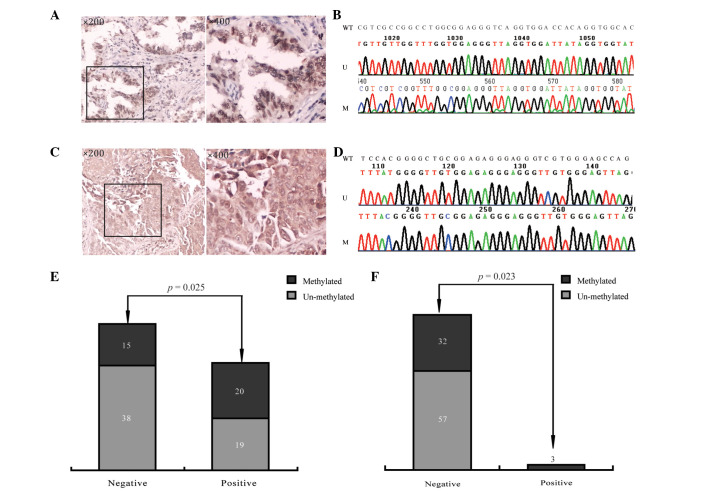
To identify novel abnormally methylated genes in early stage non-small cell lung cancer (NSCLC), we analyzed the methylation status of 13 genes (ALX1, BCL2, FOXL2, HPP1, MYF6, OC2, PDGFRA, PHOX2A, PITX2, RARB, SIX6, SMPD3 and SOX1) in cancer tissues from 101 cases of stage I NSCLC patients and lung tissues from 30 cases of non-cancerous lung disease controls, using methylation-specific PCR (MSP). The methylation frequencies (29.70-64.36%) of 7 genes (MYF6, SIX6, SOX1, RARB, BCL2, PHOX2A and FOLX2) in stage I NSCLC were significantly higher compared with those in non-cancerous lung disease controls (P<0.05). The co-methylation of SIX6 and SOX1, or the co-methyaltion of SIX6, RARB and SOX1 was associated with adenosquamous carcinoma (ADC), and the co-methylation of BCL2, RARB and SIX6 was associated with smoking. A panel of 4 genes (MYF6, SIX6, BCL2 and RARB) may offer a sensitivity of 93.07% and a specificity of 83.33% in the diagnosis of stage I NSCLC. Furthermore, we also detected the expression of 8 pathological markers (VEGF, HER-2, P53, P21, EGFR, CHGA, SYN and EMA) in cancer tissues of stage I NSCLC by immunohistochemistry, and found that high expression levels of p53 and CHGA were associated with the methylation of BCL2 (P=0.025) and PHOX2A (P=0.023), respectively. In this study, among the 7 genes which demonstrated hypermethylation in stage I NSCLC compared with non-cancerous lung diseases, 5 genes (MYF6, SIX6, PHOX2A, FOLX2 and SOX1) were found for the first time to be abonormally methylated in NSCLC. Further study of these genes shed light on the carcinogenesis of NSCLC.
为了鉴定早期非小细胞肺癌(NSCLC)中新型异常甲基化基因,我们使用甲基化特异性PCR(MSP)分析了101例I期NSCLC患者癌组织及30例非癌性肺疾病对照的肺组织中13个基因(ALX1、BCL2、FOXL2、HPP1、MYF6、OC2、PDGFRA、PHOX2A、PITX2、RARB、SIX6、SMPD3和SOX1)的甲基化状态。I期NSCLC中7个基因(MYF6、SIX6、SOX1、RARB、BCL2、PHOX2A和FOLX2)的甲基化频率(29.70 - 64.36%)显著高于非癌性肺疾病对照(P<0.05)。SIX6和SOX1的共甲基化,或SIX6、RARB和SOX1的共甲基化与腺鳞癌(ADC)相关,BCL2、RARB和SIX6的共甲基化与吸烟相关。一个由4个基因(MYF6、SIX6、BCL2和RARB)组成的组合在I期NSCLC诊断中可能具有93.07%的敏感性和83.33%的特异性。此外,我们还通过免疫组织化学检测了I期NSCLC癌组织中8种病理标志物(VEGF、HER-2、P53、P21、EGFR、CHGA、SYN和EMA)的表达,发现p53和CHGA的高表达水平分别与BCL2(P = 0.025)和PHOX2A(P = 0.023)的甲基化相关。在本研究中,与非癌性肺疾病相比,I期NSCLC中显示高甲基化的7个基因中,有5个基因(MYF6、SIX6、PHOX2A、FOLX2和SOX1)首次被发现在NSCLC中异常甲基化。对这些基因的进一步研究为NSCLC的致癌机制提供了线索。