Chen Xiaochi, Wang Tiezheng, Yang Deyong, Wang Jianbo, Li Xiancheng, He Zhongzhou, Chen Feng, Che Xiangyu, Song Xishuang
Department of Urology, First Affiliated Hospital of Dalian Medical University, Dalian, Liaoning 116011, P.R. China.
Oncol Lett. 2013 Apr;5(4):1278-1284. doi: 10.3892/ol.2013.1150. Epub 2013 Jan 23.
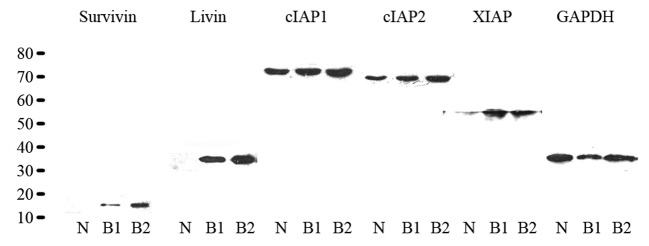
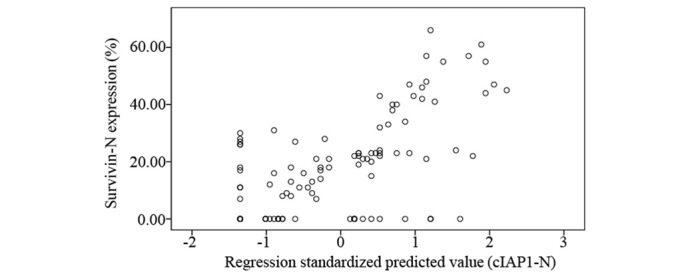
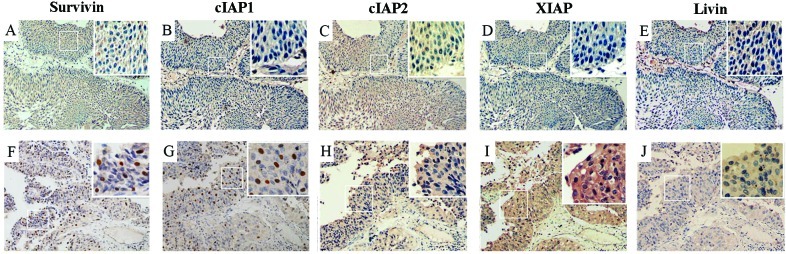
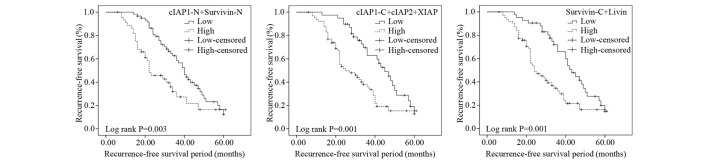
The inhibitors of apoptosis (IAPs) are a group of anti-apoptotic factors in the apoptotic pathway that render cancer cells insensitive to apoptotic stimulation. Recently, several members of the IAP family have been investigated in the context of bladder cancer, and some of these have been associated with specific clinical and pathological tumor features, and with prognosis. These data suggested that the expression of an individual nuclear IAP has an important relationship with the progression of bladder cancer. To date, there are no studies concerning the overall tendencies of IAPs and their comparative therapeutic values in bladder cancer. In this study, we investigated the overall expression trends of the five tumor-related proteins, Survivin, cIAP1, cIAP2, XIAP and Livin, in normal bladder tissues and bladder cancer tissues. We classified and compared the gene expression data of these IAPs with the corresponding clinical and pathological tumor features, and with prognosis, in the development and progression of bladder cancer. The differences in IAP expression levels between archival bladder specimens from 36 normal controls and 105 patients who underwent surgery at our facility were examined using western blot analysis. The localization and expression level of each protein in low- and high-grade bladder cancer tissues were examined through immunohistochemistry. The cytoplasmic expression levels of each protein were scored as 0 (negative), +1 (weak), +2 (medium) or +3 (strong). The nuclear expression levels of cIAP1 and Survivin were scored as 0 (0%), +1 (1-25%), +2 (26-50%) or +3 (>50%). The results demonstrated that the expression of IAPs acted cooperatively to predict prognosis in human bladder cancer patients.
凋亡抑制蛋白(IAPs)是凋亡途径中的一组抗凋亡因子,可使癌细胞对凋亡刺激不敏感。最近,IAP家族的几个成员已在膀胱癌的背景下进行了研究,其中一些与特定的临床和病理肿瘤特征以及预后相关。这些数据表明,单个核IAP的表达与膀胱癌的进展具有重要关系。迄今为止,尚无关于IAPs在膀胱癌中的总体趋势及其比较治疗价值的研究。在本研究中,我们调查了正常膀胱组织和膀胱癌组织中五种肿瘤相关蛋白Survivin、cIAP1、cIAP2、XIAP和Livin的总体表达趋势。我们在膀胱癌的发生和发展过程中,将这些IAPs的基因表达数据与相应的临床和病理肿瘤特征以及预后进行了分类和比较。使用蛋白质印迹分析检测了36例正常对照和105例在我们机构接受手术的患者的存档膀胱标本之间IAP表达水平的差异。通过免疫组织化学检查每种蛋白质在低级别和高级别膀胱癌组织中的定位和表达水平。每种蛋白质的细胞质表达水平评分为0(阴性)、+1(弱阳性)、+2(中等阳性)或+3(强阳性)。cIAP1和Survivin的核表达水平评分为0(0%)、+1(1-25%)、+2(26-50%)或+3(>50%)。结果表明,IAPs的表达协同作用可预测人类膀胱癌患者的预后。