Centre for Mental Health, Addiction and Suicide Research, School of Social and Community Medicine, University of Bristol, Bristol BS8 2BN, UK.
BMJ. 2013 Apr 19;346:f2059. doi: 10.1136/bmj.f2059.
To study the association between parental depression and maternal antidepressant use during pregnancy with autism spectrum disorders in offspring.
Population based nested case-control study.
Stockholm County, Sweden, 2001-07.
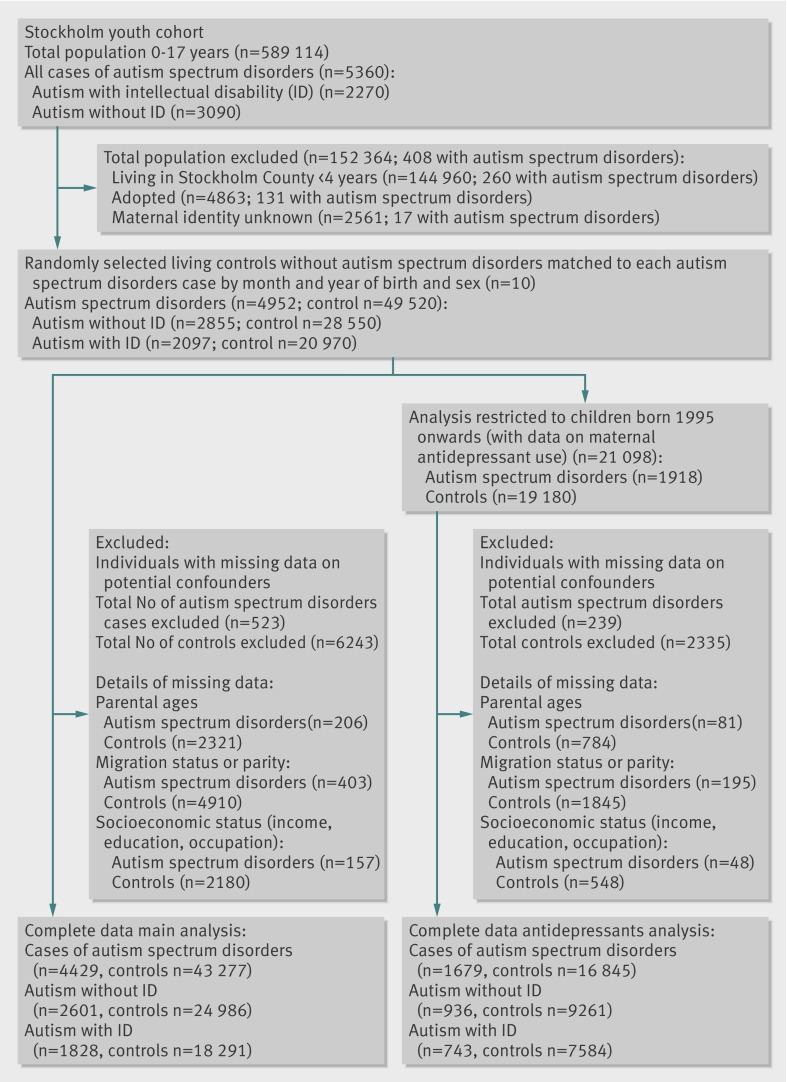
4429 cases of autism spectrum disorder (1828 with and 2601 without intellectual disability) and 43,277 age and sex matched controls in the full sample (1679 cases of autism spectrum disorder and 16,845 controls with data on maternal antidepressant use nested within a cohort (n=589,114) of young people aged 0-17 years.
A diagnosis of autism spectrum disorder, with or without intellectual disability.
Parental depression and other characteristics prospectively recorded in administrative registers before the birth of the child. Maternal antidepressant use, recorded at the first antenatal interview, was available for children born from 1995 onwards.
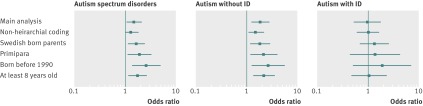
A history of maternal (adjusted odds ratio 1.49, 95% confidence interval 1.08 to 2.08) but not paternal depression was associated with an increased risk of autism spectrum disorders in offspring. In the subsample with available data on drugs, this association was confined to women reporting antidepressant use during pregnancy (3.34, 1.50 to 7.47, P=0.003), irrespective of whether selective serotonin reuptake inhibitors (SSRIs) or non-selective monoamine reuptake inhibitors were reported. All associations were higher in cases of autism without intellectual disability, there being no evidence of an increased risk of autism with intellectual disability. Assuming an unconfounded, causal association, antidepressant use during pregnancy explained 0.6% of the cases of autism spectrum disorder.
In utero exposure to both SSRIs and non-selective monoamine reuptake inhibitors (tricyclic antidepressants) was associated with an increased risk of autism spectrum disorders, particularly without intellectual disability. Whether this association is causal or reflects the risk of autism with severe depression during pregnancy requires further research. However, assuming causality, antidepressant use during pregnancy is unlikely to have contributed significantly towards the dramatic increase in observed prevalence of autism spectrum disorders as it explained less than 1% of cases.
研究父母抑郁与孕期母亲使用抗抑郁药与后代自闭症谱系障碍之间的关联。
基于人群的巢式病例对照研究。
瑞典斯德哥尔摩县,2001-07 年。
4429 例自闭症谱系障碍病例(1828 例伴有和 2601 例不伴有智力残疾)和全样本中 43277 名年龄和性别匹配的对照者(1679 例自闭症谱系障碍病例和 16845 例嵌套在一个队列中的母亲使用抗抑郁药数据的对照者(n=589114),队列中的年轻人年龄为 0-17 岁。
自闭症谱系障碍的诊断,伴有或不伴有智力残疾。
在孩子出生前,前瞻性地在行政登记册中记录父母的抑郁情况和其他特征。在 1995 年以后出生的孩子中,可以记录到母亲在第一次产前检查时使用的抗抑郁药。
母亲有抑郁史(调整后的优势比 1.49,95%置信区间 1.08 至 2.08)与后代自闭症谱系障碍的风险增加相关。在有药物数据的亚样本中,这种关联仅限于报告怀孕期间使用抗抑郁药的女性(3.34,1.50 至 7.47,P=0.003),无论报告的是选择性 5-羟色胺再摄取抑制剂(SSRIs)还是非选择性单胺再摄取抑制剂。所有关联在没有智力残疾的自闭症病例中更高,没有证据表明有智力残疾的自闭症风险增加。假设存在未混杂的因果关联,怀孕期间使用抗抑郁药解释了自闭症谱系障碍病例的 0.6%。
在宫内暴露于 SSRIs 和非选择性单胺再摄取抑制剂(三环类抗抑郁药)与自闭症谱系障碍的风险增加相关,特别是在没有智力残疾的情况下。这种关联是否是因果关系,还是反映了怀孕期间严重抑郁症的自闭症风险,需要进一步研究。然而,假设因果关系,怀孕期间使用抗抑郁药不太可能对观察到的自闭症谱系障碍患病率的显著增加做出重大贡献,因为它仅解释了不到 1%的病例。