Kępińska Adrianna P, Smout Shelby, Robakis Thalia K, Cohen Lily E, Mahjani Ingrid Christina Gustavsson, Skalkidou Alkistis, Bergink Veerle, Mahjani Behrang
Seaver Autism Center for Research and Treatment, Icahn School of Medicine at Mount Sinai, New York, NY, USA.
Department of Psychiatry, Icahn School of Medicine at Mount Sinai, New York, NY, USA.
medRxiv. 2024 Sep 13:2024.09.12.24313571. doi: 10.1101/2024.09.12.24313571.
Parental prenatal mood and anxiety disorders (PMAD) are linked to child neurodevelopmental disorders (NDDs), but evaluations of the magnitude and mechanisms of this association are limited. This study estimates the strength of the association and whether it is impacted by genetic and environmental factors.
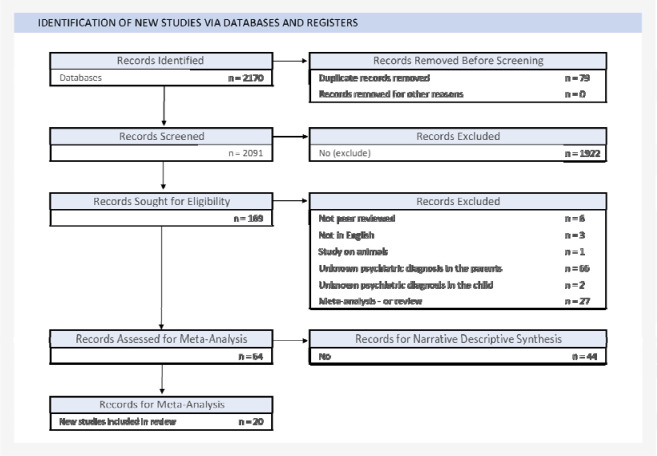
A systematic search of PubMed, CENTRAL, PsycINFO, OVID, and Google Scholar was performed for articles published from January 1988 to January 2024. Of 2,170 articles screened, 64 met the inclusion criteria. Meta-analyses were conducted on 20 studies, and 44 were included in the narrative synthesis. We conducted random-effects meta-analyses, along with tests for heterogeneity (I) and publication bias (Egger's test). The review followed PRISMA and MOOSE guidelines.
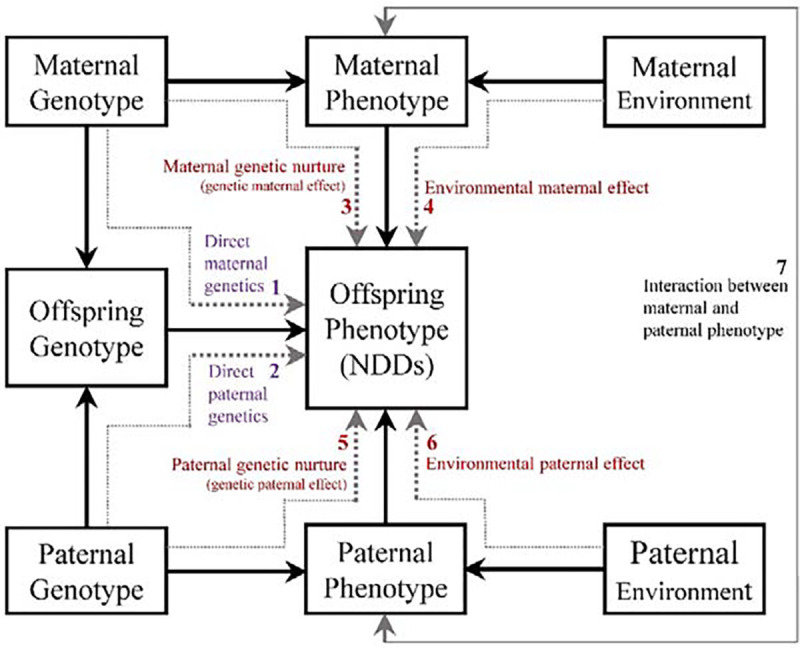
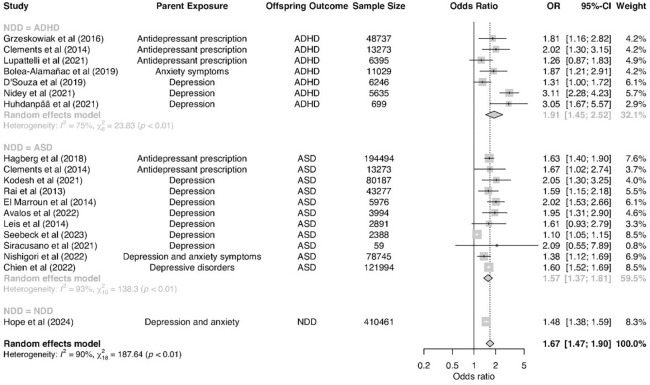
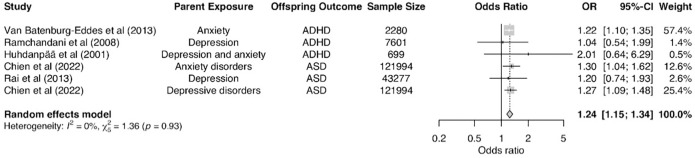
Maternal PMADs were associated with a significantly increased risk of ADHD (OR 1.91, 95% CI 1.45-2.52) and ASD (OR 1.57, 95% CI 1.37-1.81) in children. Paternal PMADs were also associated with the risk of NDDs, with combined odds for ASD and ADHD (OR 1.24, 95% CI 1.15-1.34). Several studies suggested that the link between parental PMADs and offspring NDDs might be impacted by both genetic and environmental factors, including the impact of ongoing parental depression on child behavior.
Parental PMADs are significantly associated with an increased risk of NDDs in children. These associations may be influenced by both genetic predispositions and environmental factors. Understanding these pathways is important for informing interventions aimed at mitigating mental health risks in families and supporting child development.
父母产前情绪和焦虑障碍(PMAD)与儿童神经发育障碍(NDD)相关,但对这种关联的程度和机制的评估有限。本研究估计了这种关联的强度以及它是否受到遗传和环境因素的影响。
对1988年1月至2024年1月发表的文章在PubMed、CENTRAL、PsycINFO、OVID和谷歌学术上进行系统检索。在筛选的2170篇文章中,64篇符合纳入标准。对20项研究进行了荟萃分析,44项纳入叙述性综合分析。我们进行了随机效应荟萃分析,以及异质性检验(I²)和发表偏倚检验(Egger检验)。本综述遵循PRISMA和MOOSE指南。
母亲的PMAD与儿童患多动症(OR 1.91,95%CI 1.45 - 2.52)和自闭症谱系障碍(ASD,OR 1.57,95%CI 1.37 - 1.81)的风险显著增加相关。父亲的PMAD也与NDD的风险相关,ASD和多动症的综合比值比为(OR 1.24,95%CI 1.15 - 1.34)。几项研究表明,父母的PMAD与后代NDD之间的联系可能受到遗传和环境因素的影响,包括父母持续抑郁对儿童行为的影响。
父母的PMAD与儿童患NDD的风险显著增加相关。这些关联可能受到遗传易感性和环境因素的影响。了解这些途径对于制定旨在降低家庭心理健康风险和支持儿童发育的干预措施非常重要。