Department of Pathogen Biology, Second Military Medical University, Shanghai, China.
Parasit Vectors. 2013 Apr 22;6:115. doi: 10.1186/1756-3305-6-115.
Phlebotomus chinensis is a primary vector of visceral leishmaniasis; it occurs in various biotopes with a large geographical distribution, ranging from Yangtze River to northeast China. Phlebotomus sichuanensis, a species closely related to P. chinensis in high altitude regions, has a long term disputation on its taxonomic status. Both species occur in the current epidemic regions and are responsible for the transmission of leishmaniasis. Population genetic analysis will help to understand the population structure and infer the relationship for morphologically indistinguishable cryptic species. In this study, microsatellite markers were used for studying the genetic differentiation between P. chinensis and P. sichuanensis.
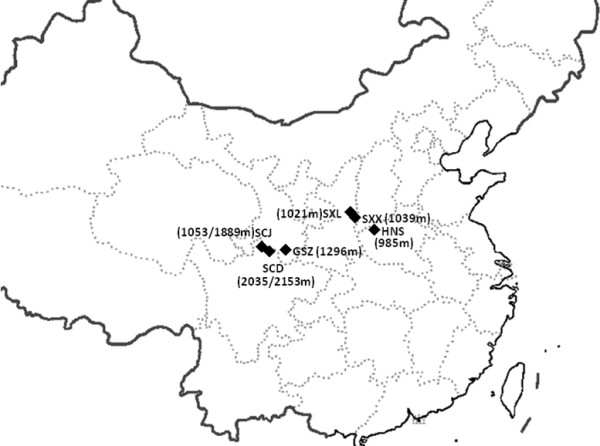
Sandflies were collected in 6 representative localities in China in 2005-2009. Ten microsatellite loci were used to estimate population genetic diversity. The intra-population genetic diversity, genetic differentiation and effective population size were estimated.
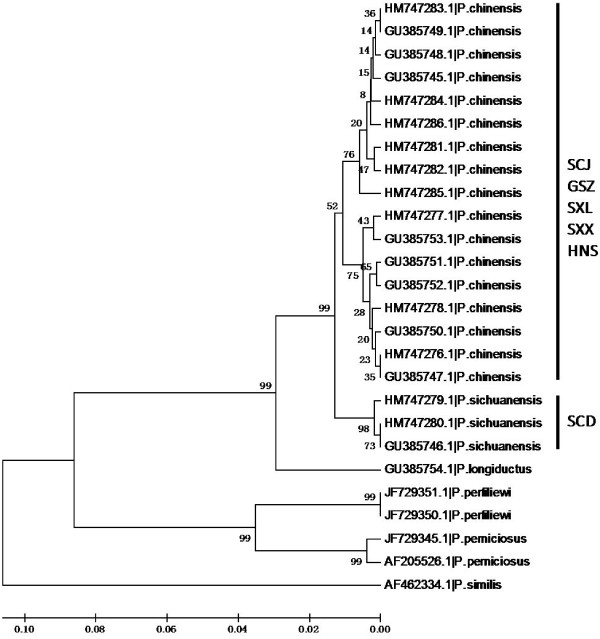
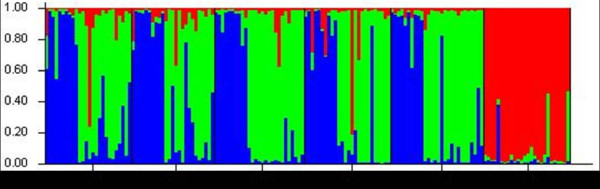
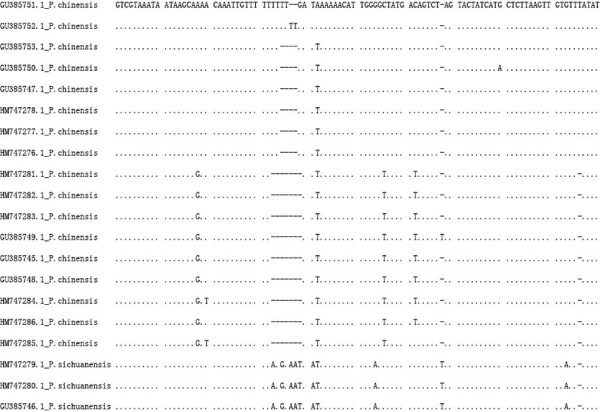
All 10 microsatellite loci were highly polymorphic across populations, with high allelic richness and heterozygosity. Hardy-Weinberg disequilibrium was found in 23 out of 60 (38.33%) comparisons associated with heterozygote deficits, which was likely caused by the presence of null allele and the Wahlund effect. Bayesian clustering analysis revealed three clusters. The cluster I included almost all specimens in the sample SCD collected at high altitude habitats in Sichuan. The other two clusters were shared by the remaining 5 populations, SCJ in Sichuan, GSZ in Gansu, SXL and SXX in Shaanxi and HNS in Henan. The diversity among these 5 populations was low (FST = -0.003-0.090) and no isolation by distance was detected. AMOVA analysis suggested that the variations were largely derived from individuals within populations and among individuals. Consistently, the analysis of ribosomal DNA second internal transcribed spacer (ITS2) sequence uncovered three types of variants, which corresponded with the three gene pools revealed by microsatellites.
The data suggested that the SCD population carried a distinct gene pool, which was differentiated from the other populations. The high altitude ecological habitats, distinctive ITS2 and herein divergence inferred by microsatellite loci support the species status of P. sichuanensis. The P. chinensis populations did not have a significant divergence from each another.
中华白蛉是内脏利什曼病的主要媒介;它存在于从长江到中国东北的各种生物区系中,分布广泛。在高海拔地区与中华白蛉密切相关的四川白蛉,其分类地位长期存在争议。这两个物种都出现在当前的流行地区,是利什曼病传播的原因。种群遗传分析将有助于了解种群结构,并推断形态上无法区分的隐种之间的关系。在这项研究中,使用微卫星标记研究了中华白蛉和四川白蛉之间的遗传分化。
2005 年至 2009 年,在中国 6 个有代表性的地区采集白蛉。使用 10 个微卫星位点估计种群遗传多样性。估计了种群内遗传多样性、遗传分化和有效种群大小。
所有 10 个微卫星位点在种群间均高度多态,等位基因丰富度和杂合度高。在 60 次比较中有 23 次(38.33%)发现 Hardy-Weinberg 不平衡,这可能是由于存在无效等位基因和 Wahlund 效应所致。贝叶斯聚类分析显示了 3 个聚类。聚类 I 包含了在四川高海拔栖息地采集的样本 SCD 中的几乎所有标本。另外两个聚类由其余 5 个种群共享,即四川的 SCJ、甘肃的 GSZ、陕西的 SXL 和 SXX 以及河南的 HNS。这 5 个种群之间的多样性较低(FST=-0.003-0.090),没有检测到距离隔离。AMOVA 分析表明,变异主要来自种群内个体和个体之间。同样,核糖体 DNA 第二内部转录间隔区(ITS2)序列分析揭示了三种变体,与微卫星揭示的三个基因库相对应。
数据表明,SCD 种群携带独特的基因库,与其他种群分化。高海拔生态栖息地、独特的 ITS2 以及微卫星推断的此处分歧支持四川白蛉的物种地位。中华白蛉种群彼此之间没有明显的分化。