BMC Infect Dis. 2013 Apr 22;13:183. doi: 10.1186/1471-2334-13-183.
Deep neck infections (DNIs) in HIV-infected patients often produce severe complications, even death. Data on the incidence rates and risks of DNI among HIV-infected patients are scarce, particularly with the widespread use of highly active antiretroviral therapy (HAART). We evaluated the incidence rates and risks for DNI among HIV-infected patients and observed the long-term trends.
A total of 9888 new HIV-infected patients diagnosed in 2001-2007 were included and matched with 49440 randomly selected subjects. The HIV-infected subjects were offered free access to HAART. All subjects were traced until December 2009. A Kaplan-Meier analysis generated the cumulative DNI incidence rate. The adjusted hazard ratio was computed using Cox proportional hazard regressions.
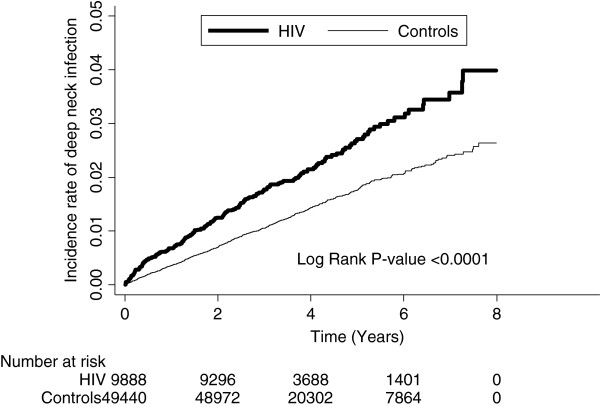
From the HIV-infected and comparison cohorts, 222 individuals (57.01 cases per 10000 person-years) and 735 individuals (35.54 cases per 10000 person-years) developed DNI, respectively. The log rank test indicated that patients with HIV had a significantly higher 8-year incidence rate of DNI than the control group (P < 0.0001). The adjusted hazard ratio for developing DNI after an HIV attack during the mean 3.94 years follow-up period was 1.59. The incidence rate and relative risk of DNI were 74.58 (per 10000 person-years) and 2.05 (P < 0.0001). Both figures were highest in the first follow-up year and decreased year-by-year thereafter.
The risk of developing DNI is significantly elevated among HIV-infected patients, even with free access to HAART. Additional research is needed to examine the role of HAART in reducing the risk.
HIV 感染者发生深部颈部感染(DNI)常导致严重并发症,甚至死亡。尽管广泛应用高效抗逆转录病毒治疗(HAART),但有关 HIV 感染者 DNI 的发病率和风险的数据仍很有限。我们评估了 HIV 感染者发生 DNI 的发病率和风险,并观察了长期趋势。
共纳入 9888 例 2001-2007 年确诊的新 HIV 感染者,并与 49440 例随机选择的对象相匹配。HIV 感染者可免费获得 HAART。所有对象均追踪至 2009 年 12 月。Kaplan-Meier 分析计算累积 DNI 发病率。Cox 比例风险回归计算校正后的危险比。
HIV 感染者队列和对照组分别有 222 例(57.01 例/10000 人年)和 735 例(35.54 例/10000 人年)发生 DNI。对数秩检验显示,HIV 感染者发生 DNI 的 8 年累积发病率显著高于对照组(P<0.0001)。在平均 3.94 年的随访期间,HIV 发作后发生 DNI 的校正危险比为 1.59。DNI 的发病率和相对风险分别为 74.58(每 10000 人年)和 2.05(P<0.0001)。两者在随访的第一年最高,随后逐年下降。
即使 HIV 感染者可免费获得 HAART,发生 DNI 的风险仍显著升高。需要进一步研究 HAART 在降低风险方面的作用。