Kozu Yoshiki, Maniwa Tomohiro, Takahashi Shoji, Isaka Mitsuhiro, Ohde Yasuhisa, Nakajima Takashi
J Cardiothorac Surg. 2013 Apr 22;8:106. doi: 10.1186/1749-8090-8-106.
Until date, there are no clear recommendations for regular perioperative measurements of serum CEA levels for lung cancer in any guidelines. The purpose in the present study is to evaluate the prognostic significance of perioperative serum carcinoembryonic antigen (CEA) levels in patients with pathological-stage I non-small cell lung cancer (NSCLC).
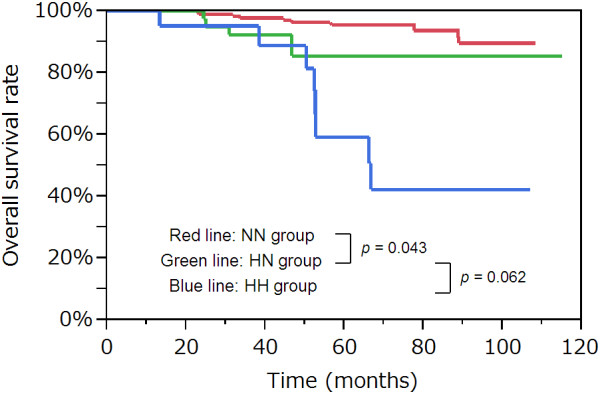
We retrospectively reviewed 263 completely resected pathological-stage I NSCLC patients whose preoperative and postoperative serum CEA levels were measured. Patients were subdivided according to the perioperative change of CEA levels: continuously normal CEA levels (NN group), continuously high CEA levels (HH group), and high preoperative CEA levels that returned to normal levels post-operation (HN group). The clinicopathological factors and overall survival (OS) among these 3 groups were compared. Univariate and multivariate analyses of the correlation between clinicopathological factors and OS were performed.
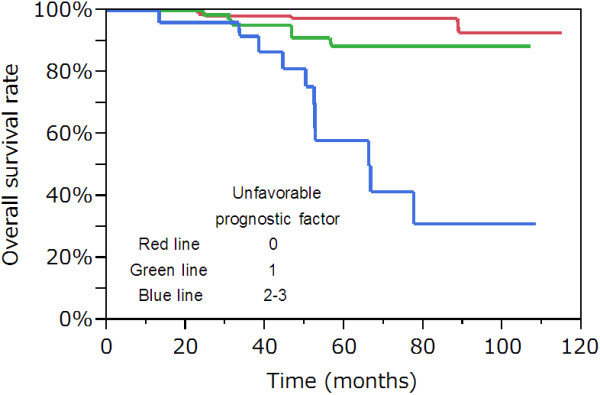
High preoperative CEA levels significantly correlated with men aged >70 years with smoking history, high serum CYFRA 21-1 levels, greater tumor diameter, presence of visceral pleural invasion (VPI), and moderate-to-poor differentiation. Five-year OS rates in the NN and HH groups were 95.5% and 59.3%, respectively. Four-year OS rate in the HN group was 85.5%. Multivariate analyses indicated tumor diameter of more than 30 mm, presence of VPI, and the HH group were independent unfavorable prognostic factors.
A high postoperative CEA level was an independent unfavorable prognostic factor in pathological-stage I NSCLC patients. Patients with high postoperative CEA levels may benefit from adjuvant chemotherapy.
迄今为止,尚无任何指南对肺癌围手术期定期检测血清癌胚抗原(CEA)水平给出明确建议。本研究旨在评估病理I期非小细胞肺癌(NSCLC)患者围手术期血清癌胚抗原(CEA)水平的预后意义。
我们回顾性分析了263例接受根治性手术的病理I期NSCLC患者,检测了其术前和术后血清CEA水平。根据CEA水平的围手术期变化将患者分为:CEA水平持续正常组(NN组)、CEA水平持续升高组(HH组)和术前CEA水平高但术后恢复正常组(HN组)。比较这三组患者的临床病理因素和总生存期(OS)。对临床病理因素与OS之间的相关性进行单因素和多因素分析。
术前CEA水平高与年龄>70岁、有吸烟史的男性、血清CYFRA 21-1水平高、肿瘤直径大、存在脏层胸膜侵犯(VPI)以及中低分化显著相关。NN组和HH组的5年总生存率分别为95.5%和59.3%。HN组的4年总生存率为85.5%。多因素分析表明,肿瘤直径大于30 mm、存在VPI以及HH组是独立的不良预后因素。
术后CEA水平高是病理I期NSCLC患者独立的不良预后因素。术后CEA水平高的患者可能从辅助化疗中获益。