Thompson Debbe, Bhatt Riddhi, Lazarus Melanie, Cullen Karen, Baranowski Janice, Baranowski Tom
USDA/ARS Children's Nutrition Research Center, Department of Pediatrics, Baylor College of Medicine, Houston, TX, United States.
JMIR Res Protoc. 2012 Nov 21;1(2):e19. doi: 10.2196/resprot.2348.
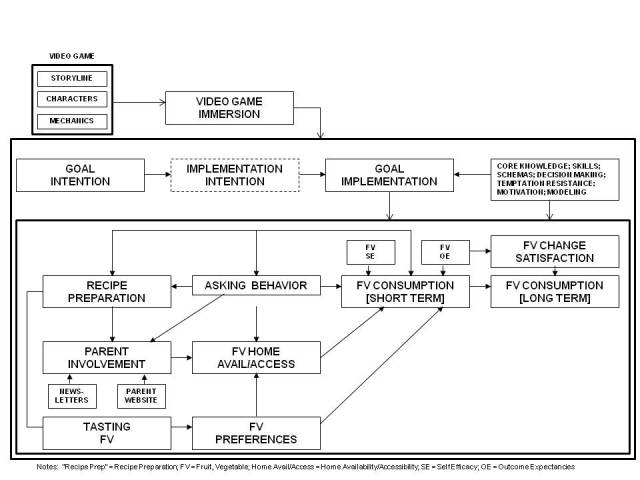
Youths eat fewer fruits and vegetables than recommended. Effective methods are needed to increase and maintain their fruit and vegetable consumption. Goal setting has been an effective behavior change procedure among adults, but has had limited effectiveness among youths. Implementation intentions are specific plans to facilitate goal attainment. Redefining goal setting to include implementation intentions may be an effective way to increase effectiveness. Video games offer a controlled venue for conducting behavioral research and testing hypotheses to identify mechanisms of effect.
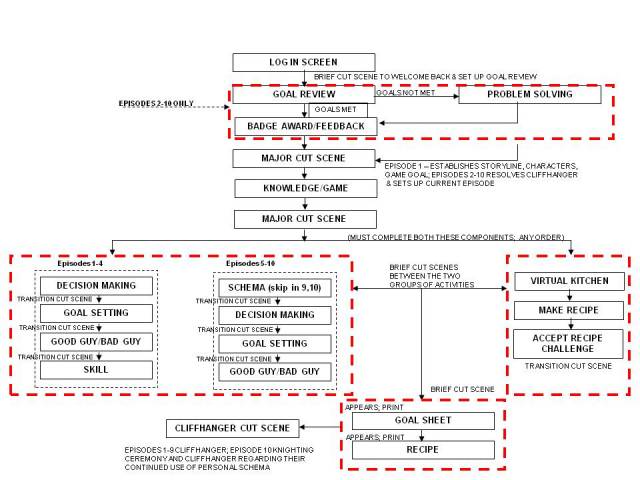
This report describes the protocol that guided the design and evaluation of Squire's Quest! II, a video game aimed to increase child fruit and vegetable consumption.
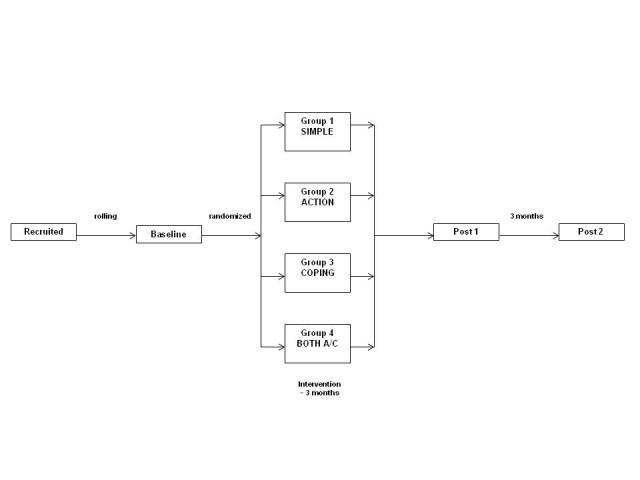
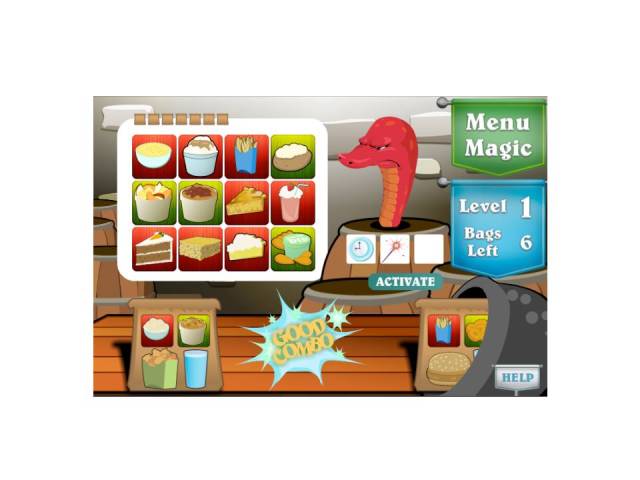
Squire's Quest! II is a 10-episode videogame promoting fruit and vegetable consumption to 4th and 5th grade children (approximately 9-11 year old youths). A four group randomized design (n=400 parent/child dyads) was used to systematically test the effect of two types of implementation intentions (action, coping) on fruit and vegetable goal attainment and consumption of 4th and 5th graders. Data collection occurred at baseline, immediately post game-play, and 3 months later. Child was the unit of assignment. Three dietary recalls were collected at each data collection period by trained interviewers using the Nutrient Data System for Research (NDSR 2009). Psychosocial and process data were also collected.
To our knowledge, this is the first research to explore the effect of implementation intentions on child fruit and vegetable goal attainment and consumption.
This intervention will contribute valuable information regarding whether implementation intentions are effective with elementary age children.
ClinicalTrials.gov NCT01004094.
青少年食用的水果和蔬菜比推荐量少。需要有效的方法来增加并维持他们对水果和蔬菜的摄入量。设定目标在成年人中是一种有效的行为改变方法,但在青少年中的效果有限。实施意图是促进目标实现的具体计划。将目标设定重新定义为包含实施意图可能是提高有效性的有效方法。电子游戏为进行行为研究和检验假设以确定影响机制提供了一个可控的场所。
本报告描述了指导《乡绅的探索!II》设计与评估的方案,这是一款旨在增加儿童水果和蔬菜摄入量的电子游戏。
《乡绅的探索!II》是一款10集的电子游戏,向四年级和五年级的儿童(约9 - 11岁的青少年)推广水果和蔬菜的摄入。采用四组随机设计(n = 400对亲子)来系统地测试两种实施意图(行动、应对)对四年级和五年级学生水果和蔬菜目标达成情况及摄入量的影响。数据收集在基线、游戏结束后立即以及3个月后进行。以儿童为分配单位。在每个数据收集期,由经过培训的访谈员使用研究用营养数据系统(NDSR 2009)收集三次饮食回忆信息。还收集了心理社会和过程数据。
据我们所知,这是第一项探索实施意图对儿童水果和蔬菜目标达成情况及摄入量影响的研究。
这项干预将提供关于实施意图对小学年龄段儿童是否有效的有价值信息。
ClinicalTrials.gov NCT01004094。