Yeast Molecular Genetics Laboratory, International Centre for Genetic Engineering and Biotechnology, Trieste, Italy.
PLoS One. 2013 Apr 17;8(4):e60926. doi: 10.1371/journal.pone.0060926. Print 2013.
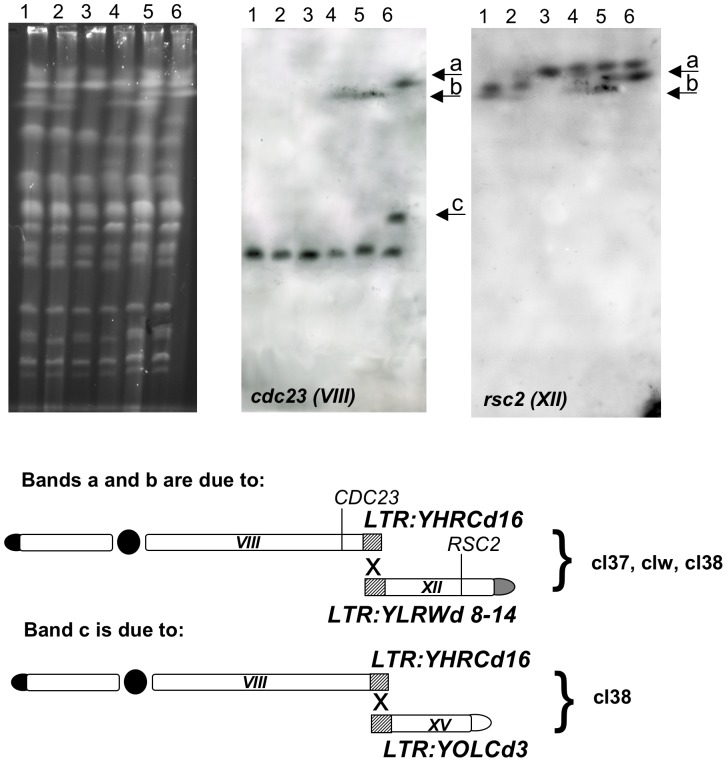
While in mammalian cells the genetic determinism of chromosomal translocation remains unclear, the yeast Saccharomyces cerevisiae has become an ideal model system to generate ad hoc translocations and analyze their cellular and molecular outcome. A linear DNA cassette carrying a selectable marker flanked by perfect homologies to two chromosomes triggers a bridge-induced translocation (BIT) in budding yeast, with variable efficiency. A postulated two-step process to produce BIT translocants is based on the cooperation between the Homologous Recombination System (HRS) and Break-Induced Replication (BIR); however, a clear indication of the molecular factors underlying the genetic mechanism is still missing. In this work we provide evidence that BIT translocation is elicited by the Rad54 helicase and completed by a Pol32-independent replication pathway. Our results demonstrate also that Rdh54 is involved in the stability of the translocants, suggesting a mitotic role in chromosome pairing and segregation. Moreover, when RAD54 is over-expressed, an ensemble of secondary rearrangements between repeated DNA tracts arise after the initial translocation event, leading to severe aneuploidy with loss of genetic material, which prompts the identification of fragile sites within the yeast genome.
虽然哺乳动物细胞中染色体易位的遗传决定因素尚不清楚,但酵母酿酒酵母已成为生成特定易位并分析其细胞和分子结果的理想模型系统。一个携带选择性标记的线性 DNA 盒,两侧是与两条染色体完全同源的序列,可在出芽酵母中引发桥诱导易位(BIT),其效率可变。据推测,产生 BIT 易位子的两步过程基于同源重组系统(HRS)和断裂诱导复制(BIR)之间的合作;然而,遗传机制的分子因素仍然缺乏明确的指示。在这项工作中,我们提供的证据表明 BIT 易位是由 Rad54 解旋酶引发的,并由 Pol32 独立的复制途径完成。我们的结果还表明,Rdh54 参与了易位子的稳定性,表明其在染色体配对和分离中具有有丝分裂作用。此外,当 RAD54 过表达时,在初始易位事件之后,在重复 DNA 片段之间会出现一系列二级重排,导致遗传物质丢失的严重非整倍体,这促使我们在酵母基因组中鉴定脆性位点。