Instituto de Ciencias Agrarias (ICA), Consejo Superior de Investigaciones Científicas (CSIC), Madrid, Spain.
PLoS One. 2013 Apr 16;8(4):e61543. doi: 10.1371/journal.pone.0061543. Print 2013.
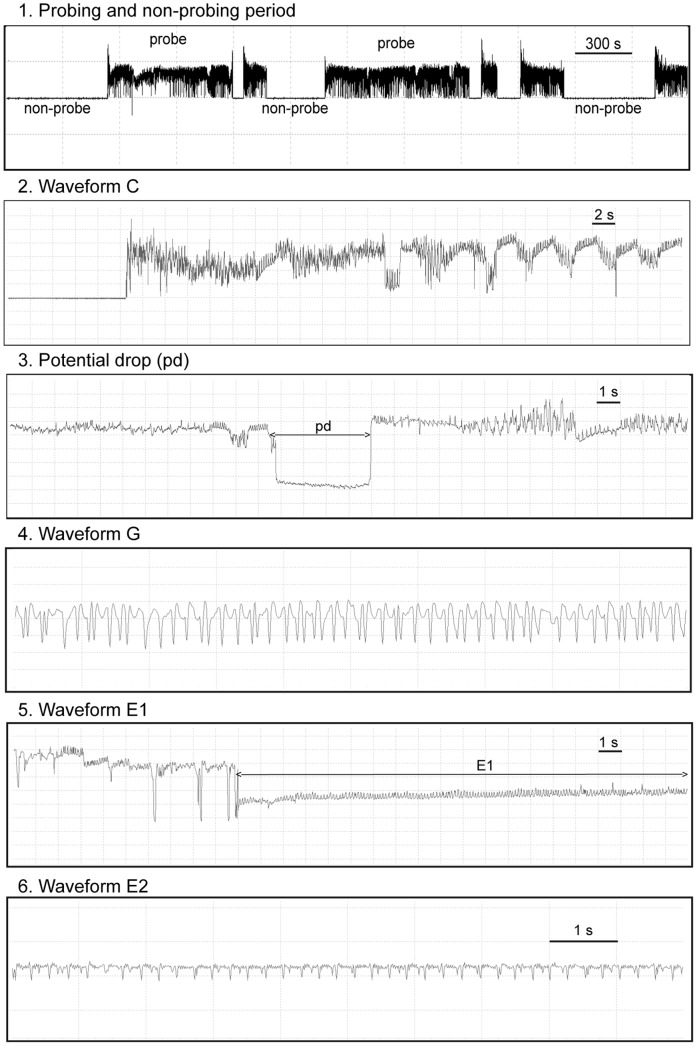
Plant viruses can produce direct and plant-mediated indirect effects on their insect vectors, modifying their life cycle, fitness and behavior. Viruses may benefit from such changes leading to enhanced transmission efficiency and spread. In our study, female adults of Bemisia tabaci were subjected to an acquisition access period of 72 h in Tomato yellow leaf curl virus (TYLCV)-infected and non-infected tomato plants to obtain viruliferous and non-viruliferous whiteflies, respectively. Insects that were exposed to virus-infected plants were checked by PCR to verify their viruliferous status. Results of the Ethovision video tracking bioassays indicated that TYLCV induced an arrestant behavior of B. tabaci, as viruliferous whitefly adults remained motionless for more time and moved slower than non-viruliferous whiteflies after their first contact with eggplant leaf discs. In fact, Electrical Penetration Graphs showed that TYLCV-viruliferous B. tabaci fed more often from phloem sieve elements and made a larger number of phloem contacts (increased number of E1, E2 and sustained E2 per insect, p<0.05) in eggplants than non-viruliferous whiteflies. Furthermore, the duration of the salivation phase in phloem sieve elements (E1) preceding sustained sap ingestion was longer in viruliferous than in non-viruliferous whiteflies (p<0.05). This particular probing behavior is known to significantly enhance the inoculation efficiency of TYLCV by B. tabaci. Our results show evidence that TYLCV directly manipulates the settling, probing and feeding behavior of its vector B. tabaci in a way that enhances virus transmission efficiency and spread. Furthermore, TYLCV-B. tabaci interactions are mutually beneficial to both the virus and its vector because B. tabaci feeds more efficiently after acquisition of TYLCV. This outcome has clear implications in the epidemiology and management of the TYLCV-B. tabaci complex.
植物病毒可以直接影响其昆虫介体,并通过植物介导间接影响其昆虫介体,改变其生命周期、适合度和行为。病毒可能会受益于这些变化,从而提高传播效率和传播范围。在我们的研究中,烟粉虱的成年雌性在感染和未感染番茄黄曲叶病毒(TYLCV)的番茄植株上进行 72 小时的取食接触期,以分别获得带毒和不带毒的粉虱。用 PCR 检查暴露于病毒感染植物的昆虫,以验证其带毒状态。Ethovision 视频跟踪生物测定的结果表明,TYLCV 诱导烟粉虱产生了一种停滞行为,带毒白僵菌成虫在与茄子叶片首次接触后,静止不动的时间更长,移动速度更慢。事实上,电穿透图谱显示,与不带毒的粉虱相比,TYLCV 带毒的烟粉虱从韧皮部筛管中取食的次数更多,并且在茄子上进行了更多的韧皮部接触(每只昆虫的 E1、E2 和持续 E2 的数量增加,p<0.05)。此外,在持续吸取韧皮部汁液之前,E1 中唾液分泌阶段的持续时间在带毒粉虱中比在不带毒粉虱中更长(p<0.05)。这种特殊的探测行为已知可显著提高烟粉虱对 TYLCV 的接种效率。我们的研究结果表明,TYLCV 以一种增强病毒传播效率和传播范围的方式直接操纵其载体烟粉虱的定殖、探测和取食行为。此外,TYLCV-烟粉虱相互作用对病毒和其载体都是互利的,因为烟粉虱在获得 TYLCV 后取食效率更高。这一结果在 TYLCV-烟粉虱复合体的流行病学和管理方面具有明确的意义。