Institute of Microbial Technology, Council of Scientific and Industrial Research, Chandigarh, India.
PLoS One. 2013 Apr 17;8(4):e62178. doi: 10.1371/journal.pone.0062178. Print 2013.
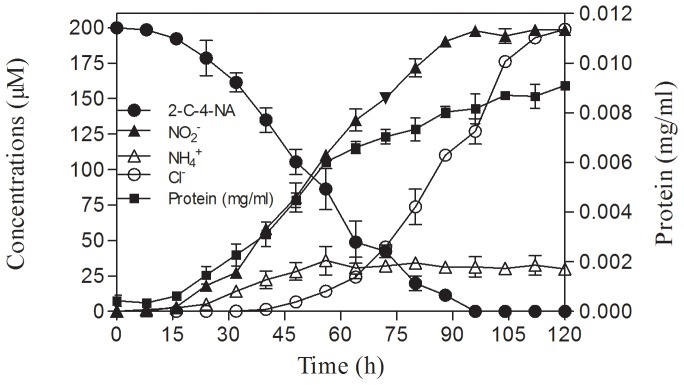
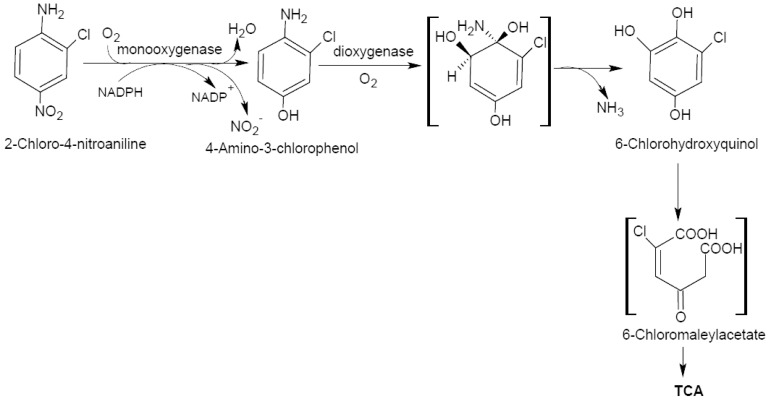
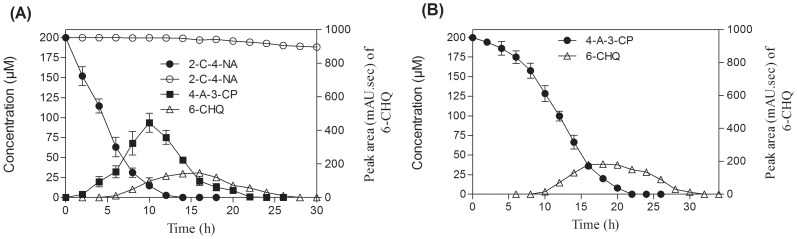
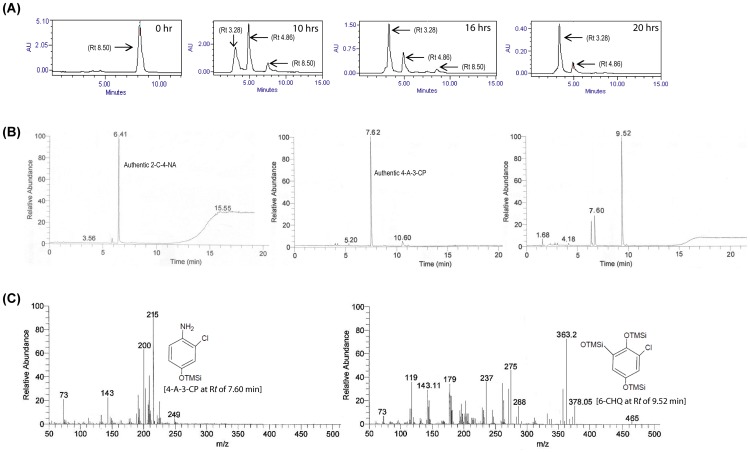
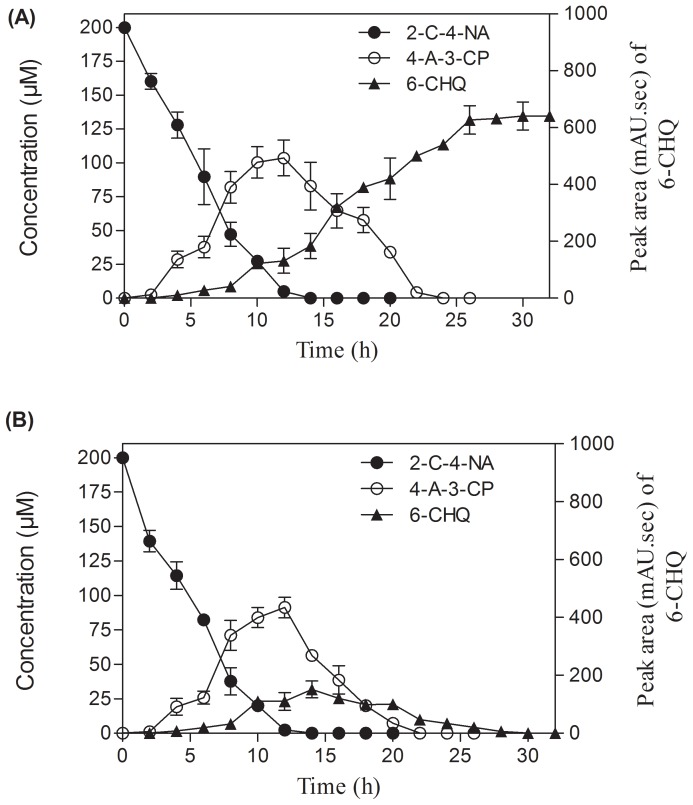
2-chloro-4-nitroaniline (2-C-4-NA) is used as an intermediate in the manufacture of dyes, pharmaceuticals, corrosion inhibitor and also used in the synthesis of niclosamide, a molluscicide. It is marked as a black-listed substance due to its poor biodegradability. We report biodegradation of 2-C-4-NA and its pathway characterization by Rhodococcus sp. strain MB-P1 under aerobic conditions. The strain MB-P1 utilizes 2-C-4-NA as the sole carbon, nitrogen, and energy source. In the growth medium, the degradation of 2-C-4-NA occurs with the release of nitrite ions, chloride ions, and ammonia. During the resting cell studies, the 2-C-4-NA-induced cells of strain MB-P1 transformed 2-C-4-NA stoichiometrically to 4-amino-3-chlorophenol (4-A-3-CP), which subsequently gets transformed to 6-chlorohydroxyquinol (6-CHQ) metabolite. Enzyme assays by cell-free lysates prepared from 2-C-4-NA-induced MB-P1 cells, demonstrated that the first enzyme in the 2-C-4-NA degradation pathway is a flavin-dependent monooxygenase that catalyzes the stoichiometric removal of nitro group and production of 4-A-3-CP. Oxygen uptake studies on 4-A-3-CP and related anilines by 2-C-4-NA-induced MB-P1 cells demonstrated the involvement of aniline dioxygenase in the second step of 2-C-4-NA degradation. This is the first report showing 2-C-4-NA degradation and elucidation of corresponding metabolic pathway by an aerobic bacterium.
2-氯-4-硝基苯胺(2-C-4-NA)用作染料、制药、缓蚀剂的中间体,也用于杀螺剂氯硝柳胺的合成。由于其较差的生物降解性,它被标记为黑名单物质。我们报告了好氧条件下 Rhodococcus sp. 菌株 MB-P1 对 2-C-4-NA 的生物降解及其途径特征。该菌株 MB-P1 将 2-C-4-NA 用作唯一的碳、氮和能源。在生长培养基中,2-C-4-NA 的降解伴随着亚硝酸盐离子、氯离子和氨的释放。在静止细胞研究中,MB-P1 菌株的 2-C-4-NA 诱导细胞将 2-C-4-NA 化学计量转化为 4-氨基-3-氯苯酚(4-A-3-CP),随后转化为 6-氯羟基喹啉(6-CHQ)代谢物。用 2-C-4-NA 诱导的 MB-P1 细胞制备的无细胞裂解物进行的酶测定表明,2-C-4-NA 降解途径中的第一个酶是黄素依赖性单加氧酶,它催化硝基基团的化学计量去除和 4-A-3-CP 的产生。用 2-C-4-NA 诱导的 MB-P1 细胞对 4-A-3-CP 和相关苯胺进行的氧摄取研究表明,苯胺双加氧酶参与了 2-C-4-NA 降解的第二步。这是首次报道好氧细菌对 2-C-4-NA 降解及其相应代谢途径的阐明。