Green Ezekiel, Obi Lawrence C, Okoh Anthony I, Nchabeleng Maphoshane, de Villiers Babsie E, Letsoalo Tomas, Hoosen Anwar A, Bessong Pascal O, Ndip Roland N
School of Mathematics and Natural Sciences, Department of Microbiology, University of Venda, Private Bag X5050, Thohoyandou 0960, South Africa.
J Health Popul Nutr. 2013 Mar;31(1):1-10. doi: 10.3329/jhpn.v31i1.14743.
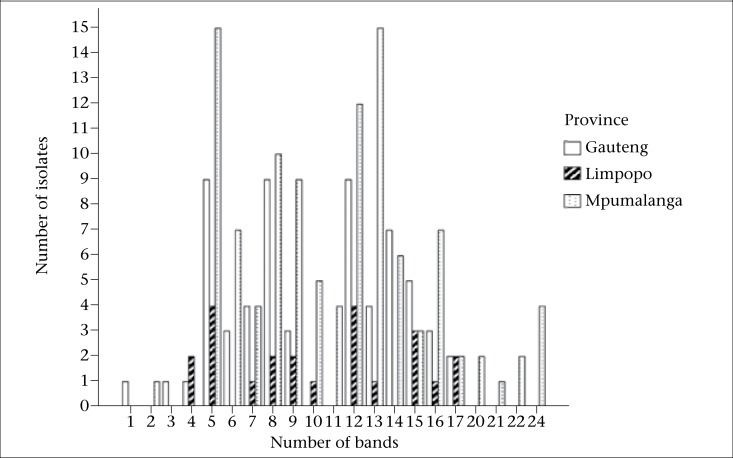
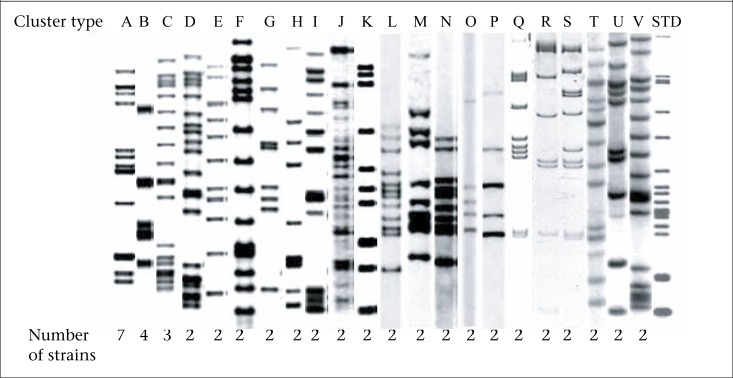
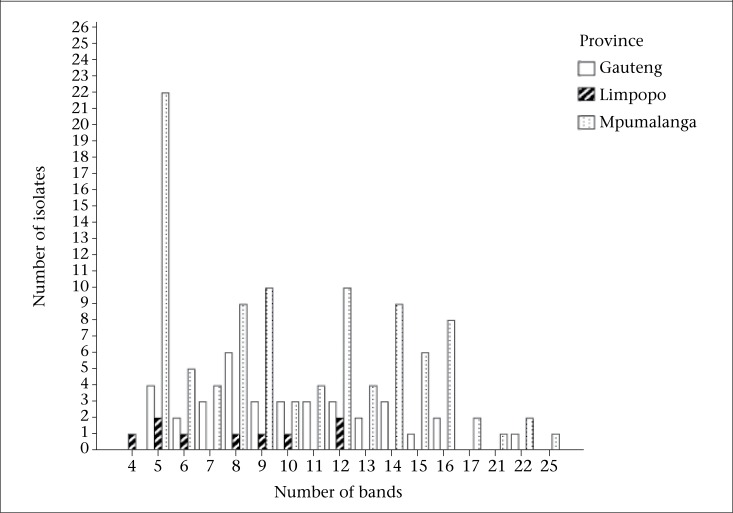
Tuberculosis (TB) remains a deadly infectious disease affecting millions of people worldwide; 95% of TB cases, with 98% of death occur in developing countries. The situation in South Africa merits special attention. A total of 21,913 sputum specimens of suspected TB patients from three provinces of South Africa routinely submitted to the TB laboratory of Dr. George Mukhari (DGM) Hospital were assayed for Mycobacterium tuberculosis (MTB) growth and antibiotic susceptibility. The genetic diversity of 338 resistant strains were also studied. DNA isolated from the strains were restricted with Pvu II, transferred on to a nylon membrane and hybridized with a PCR-amplified horseradish peroxidase 245 bp IS6110 probe. Of the 338 resistant strains, 2.09% had less than 5 bands of IS6110, and 98% had 5 or more bands. Unique restriction fragment length polymorphism (RFLP) patterns were observed in 84.3% of the strains, showing their epidemiological independence, and 15.7% were grouped into 22 clusters. Thirty-two strains (61.5%) from the 52 that clustered were from Mpumalanga, 16/52 (30.8%) from Gauteng, and 4/52 (9.6%) from Limpopo province. Clustering was not associated with age. However, strains from male patients in Mpumalanga were more likely to be clustered than strains from male patients in Limpopo and/or Gauteng province. The minimum estimate for the proportion of resistant TB that was due to transmission is 9.06% (52-22 = 30/331). Our results indicate that transmission of drug-resistant strains may contribute substantially to the emergence of drug-resistant tuberculosis in South Africa.
结核病仍然是一种致命的传染病,影响着全球数百万人;95%的结核病病例以及98%的死亡病例发生在发展中国家。南非的情况值得特别关注。对南非三个省份常规提交给乔治·穆哈里博士(DGM)医院结核病实验室的21913份疑似结核病患者的痰标本进行了结核分枝杆菌(MTB)生长及抗生素敏感性检测。还研究了338株耐药菌株的基因多样性。从菌株中分离的DNA用Pvu II酶切,转移到尼龙膜上,并用PCR扩增的辣根过氧化物酶245 bp IS6110探针进行杂交。在338株耐药菌株中,2.09%的菌株IS6110条带少于5条,98%的菌株有5条或更多条带。84.3%的菌株观察到独特的限制性片段长度多态性(RFLP)模式,表明它们在流行病学上具有独立性,15.7%的菌株被归为22个簇。在聚类的52株菌株中,32株(61.5%)来自姆普马兰加省,16/52(30.8%)来自豪登省,4/52(9.6%)来自林波波省。聚类与年龄无关。然而,姆普马兰加省男性患者的菌株比林波波省和/或豪登省男性患者的菌株更有可能聚类。耐药结核病中因传播导致的比例的最低估计为9.06%(52 - 22 = 30/331)。我们的结果表明,耐药菌株的传播可能在很大程度上导致了南非耐药结核病的出现。