Temereva Elena N, Tsitrin Eugeni B
Department of Invertebrate Zoology, Biological faculty, Moscow State University, Moscow, Russia.
BMC Dev Biol. 2013 Apr 24;13:14. doi: 10.1186/1471-213X-13-14.
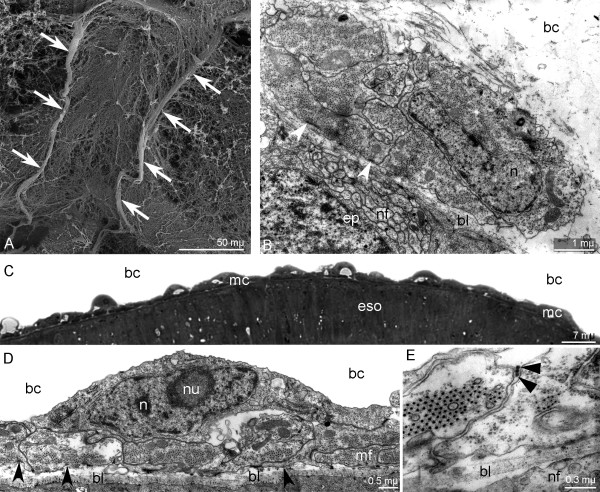
The phoronid larva, which is called the actinotrocha, is one of the most remarkable planktotrophic larval types among marine invertebrates. Actinotrochs live in plankton for relatively long periods and undergo catastrophic metamorphosis, in which some parts of the larval body are consumed by the juvenile. The development and organization of the muscular system has never been described in detail for actinotrochs and for other stages in the phoronid life cycle.
In Phoronopsis harmeri, muscular elements of the preoral lobe and the collar originate in the mid-gastrula stage from mesodermal cells, which have immigrated from the anterior wall of the archenteron. Muscles of the trunk originate from posterior mesoderm together with the trunk coelom. The organization of the muscular system in phoronid larvae of different species is very complex and consists of 14 groups of muscles. The telotroch constrictor, which holds the telotroch in the larval body during metamorphosis, is described for the first time. This unusual muscle is formed by apical myofilaments of the epidermal cells. Most larval muscles are formed by cells with cross-striated organization of myofibrils. During metamorphosis, most elements of the larval muscular system degenerate, but some of them remain and are integrated into the juvenile musculature.
Early steps of phoronid myogenesis reflect the peculiarities of the actinotroch larva: the muscle of the preoral lobe is the first muscle to appear, and it is important for food capture. The larval muscular system is organized in differently in different phoronid larvae, but always exhibits a complexity that probably results from the long pelagic life, planktotrophy, and catastrophic metamorphosis. Degeneration of the larval muscular system during phoronid metamorphosis occurs in two ways, i.e., by complete or by incomplete destruction of larval muscular elements. The organization and remodeling of the muscular system in phoronids exhibits the combination of protostome-like and deuterostome-like features. This combination, which has also been found in the organization of some other systems in phoronids, can be regarded as an important characteristic and one that probably reflects the basal position of phoronids within the Lophotrochozoa.
帚虫幼虫,即辐轮幼虫,是海洋无脊椎动物中最显著的浮游生物营养型幼虫类型之一。辐轮幼虫在浮游生物中生活相对较长时间,并经历灾难性变态,在此过程中幼虫身体的某些部分会被幼体消耗。对于辐轮幼虫以及帚虫生命周期中的其他阶段,肌肉系统的发育和组织从未被详细描述过。
在哈氏帚虫中,口前叶和领部的肌肉成分起源于原肠胚中期从原肠前壁迁移而来的中胚层细胞。躯干部的肌肉与躯干部体腔一起起源于后中胚层。不同种类帚虫幼虫的肌肉系统组织非常复杂,由14组肌肉组成。首次描述了在变态过程中将尾纤毛固定在幼虫体内的尾纤毛收缩肌。这种不寻常的肌肉由表皮细胞的顶端肌丝形成。大多数幼虫肌肉由具有横纹肌原纤维组织的细胞形成。在变态过程中,幼虫肌肉系统的大多数成分退化,但其中一些保留下来并整合到幼体肌肉组织中。
帚虫肌肉发生的早期步骤反映了辐轮幼虫的特点:口前叶的肌肉是最早出现的肌肉,对捕获食物很重要。不同帚虫幼虫的幼虫肌肉系统组织不同,但总是表现出一种复杂性,这可能是由于长时间的浮游生活、浮游生物营养型以及灾难性变态所致。帚虫变态过程中幼虫肌肉系统的退化以两种方式发生,即幼虫肌肉成分的完全或不完全破坏。帚虫肌肉系统的组织和重塑表现出原口动物样和后口动物样特征的结合。这种结合也在帚虫其他一些系统的组织中被发现,可以被视为一个重要特征,可能反映了帚虫在触手冠动物中的基础地位。