Department of Invertebrate Zoology, Biological faculty, Lomonosov State University, Leninskie Gory 1/12, Moscow 119992, Russian Federation.
Institute of Developmental Biology, Russian Academy of Sciences, Moscow 117808, Russia.
Front Zool. 2014 Apr 28;11:35. doi: 10.1186/1742-9994-11-35. eCollection 2014.
Metamorphic remodeling of the nervous system and its organization in juvenile may shed light on early steps of evolution and can be used as an important criterion for establishing the relationships among large groups of animals. The protostomian affiliation of phoronids does not still have certain morphological and embryological proofs. In addition, the relationship of phoronids and other former "lophophorates" is still uncertain. The resolving of these conflicts requires detailed information from poorly investigated members of phoronids, such as Phoronopsis harmeri.
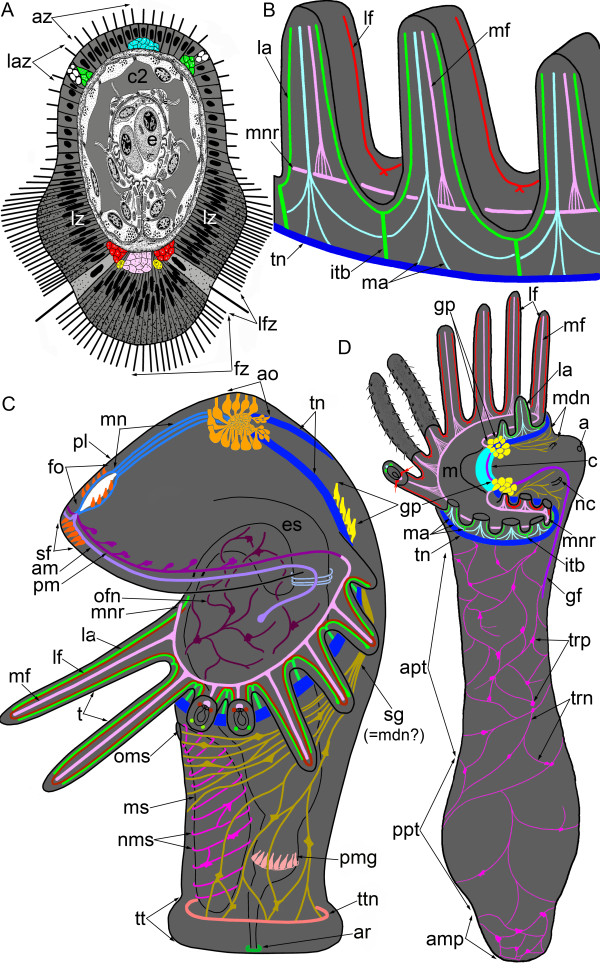
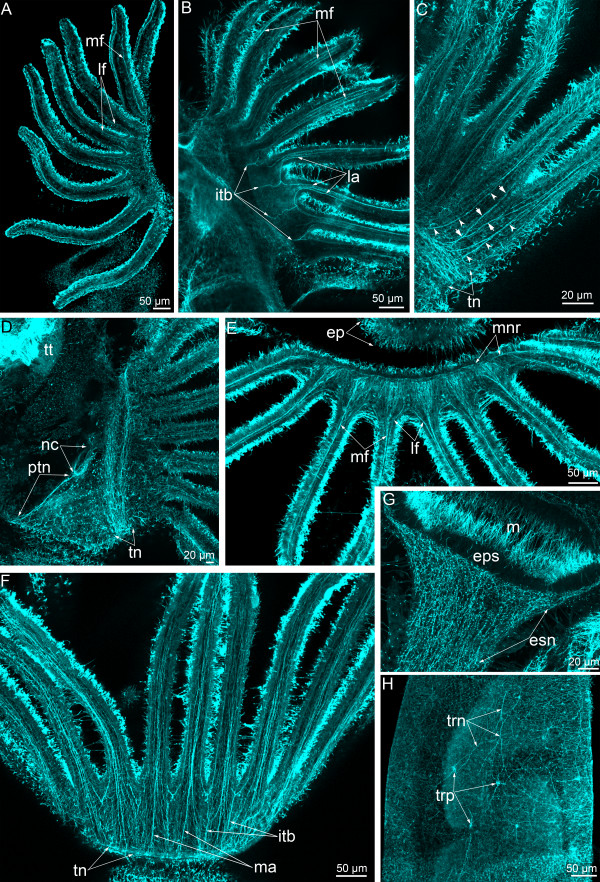
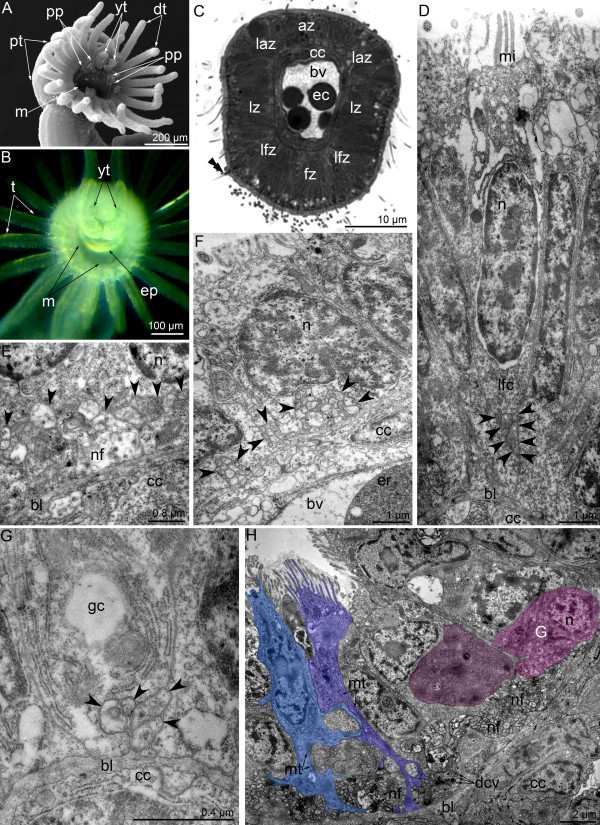
During metamorphosis, the juvenile consumes the nerve elements of the larval hood. Two dorsolateral groups of larval perikarya remain and give rise to the dorsal ganglion, which appears as the "commissural brain". The juvenile inherits the main and minor tentacular nerve rings from the larva. Although the larval tentacles are directly inherited by the juvenile in P. harmeri, the ultrastructure and location of the definitive tentacular neurite bundles change greatly. Innervation of the juvenile lophophore exhibits a regular alternation of the intertentacular and abfrontal neurite bundles. The giant nerve fiber appears at early stage of metamorphosis and passes from the right group of dorsolateral perikarya to the left side of the body.
THE METAMORPHIC REMODELING OF THE PHORONID NERVOUS SYSTEM OCCURS IN TWO DIFFERENT WAYS: with complete or incomplete destruction of organ systems. The morphology of the lophophore seems similar to those of the former members of "Lophophorata", but its innervation differs greatly. These findings support the separation of bryozoans from Lophophorata and establish a need for new data on the organization of the brachiopod nervous system. The nervous system of the phoronid juvenile is organized as an epidermal nerve plexus but exhibits a nerve center in the anterior portion of the body. The simultaneous presence of both the apical organ and anlage of the cerebral ganglion in phoronids at the larval stage, and the reduction of the apical organ during metamorphosis support the Trochea theory and allow to suggest the presence of two nervous centers in the last common ancestor of the Bilateria. Phoronids retained some plesiomorphic traits and can be regarded as one of the most primitive groups of lophotrochozoans.
神经系统的变形重塑及其在幼年动物中的组织方式可以为进化的早期步骤提供线索,并且可以作为确定大型动物群体之间关系的重要标准。翼足目的原生动物属性仍然缺乏确定的形态学和胚胎学证据。此外,翼足目动物与其他前“担轮幼虫类动物”的关系仍然不确定。解决这些冲突需要来自翼足目动物中研究较少的成员的详细信息,例如 Phoronopsis harmeri。
在变态过程中,幼虫会消耗幼虫帽的神经元素。两个背外侧的幼虫体节细胞核群保留下来,并形成背神经节,背神经节表现为“连合脑”。幼虫从幼虫那里继承了主要和次要的触手神经环。尽管幼虫的触手直接由幼虫继承,但幼体的触手神经束的超微结构和位置发生了很大变化。幼体担轮的神经支配表现为触手间和前触手神经束的有规律交替。巨大的神经纤维在变态早期出现,并从背外侧体节细胞核的右侧群穿过身体的左侧。
翼足目神经系统的变形重塑以两种不同的方式发生:系统器官的完全或不完全破坏。担轮的形态似乎与“担轮幼虫类动物”的前成员相似,但它们的神经支配却大不相同。这些发现支持了苔藓动物与担轮幼虫类动物的分离,并确立了需要关于腕足动物神经系统组织的新数据。翼足目幼虫的神经系统组织为表皮神经丛,但在身体的前部有一个神经中心。翼足目幼虫阶段既有顶器又有脑神经节原基,在变态过程中顶器减少,这支持了 Trochea 理论,并允许在两侧对称动物的最后共同祖先中存在两个神经中心。翼足目保留了一些原始特征,可以被视为担轮幼虫类动物中最原始的群体之一。