Population Biology and Conservation Biology, Department of Ecology and Genetics, Evolutionary Biology Center, Uppsala University, Norbyvägen 18D, Uppsala, SE-752 36, Sweden.
BMC Genet. 2013 Apr 24;14:29. doi: 10.1186/1471-2156-14-29.
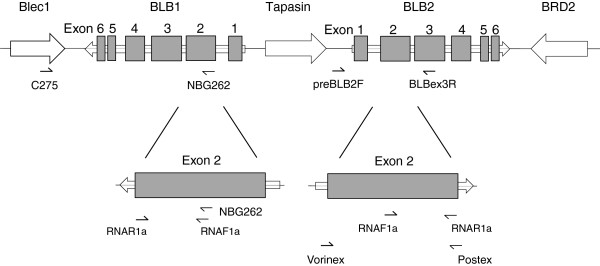
Gene duplications are frequently observed in the Major Histocompatibility Complex (MHC) of many species, and as a consequence loci belonging to the same MHC class are often too similar to tell apart. In birds, single locus genotyping of MHC genes has proven difficult due to concerted evolution homogenizing sequences at different loci. But studies on evolutionary history, mode of selection and heterozygosity correlations on the MHC cannot be performed before it is possible to analyse duplicated genes separately. In this study we investigate the architecture and evolution of the MHC class IIB genes in black grouse. We developed a sequence-based genotyping method for separate amplification of the two black grouse MHC class IIB genes BLB1 and BLB2. Based on this approach we are able to study differences in structure and selection between the two genes in black grouse and relate these results to the chicken MHC structure and organization.
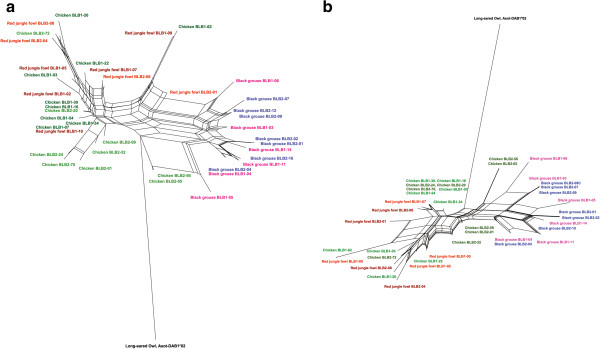
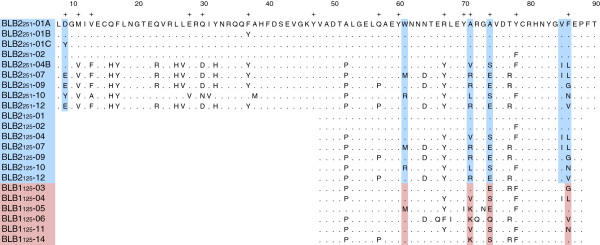
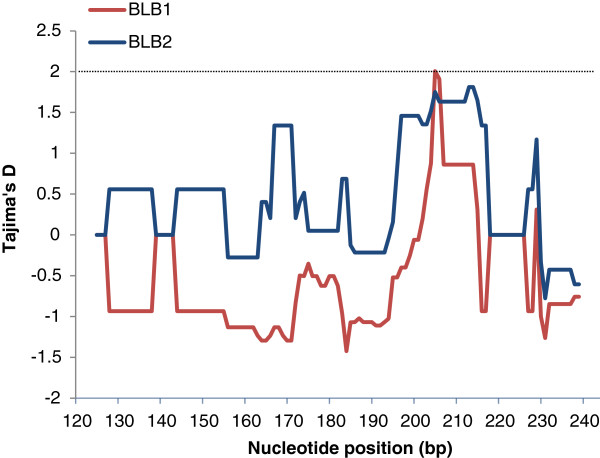
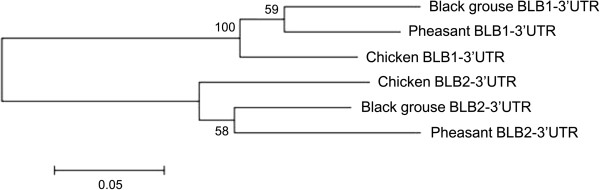
Sequences were obtained from 12 individuals and separated into alleles using the software PHASE. We compared nucleotide diversity measures and employed selection tests for BLB1 and BLB2 to explore their modes of selection. Both BLB1 and BLB2 are transcribed and display classic characteristics of balancing selection as predicted for expressed MHC class IIB genes. We found evidence for both intra- and interlocus recombination or gene conversion, as well as indication for positive but differential selection at both loci. Moreover, the two loci appear to be linked. Phylogenetic analyses revealed orthology of the black grouse MHC class IIB genes to the respective BLB loci in chicken.
The results indicate that the duplication of the BLB gene occurred before the species divergence into black grouse, chicken and pheasant. Further, we conclude that BLB1 and BLB2 in black grouse are subjected to homogenizing concerted evolution due to interlocus genetic exchange after species divergence. The loci are in linkage disequilibrium, which is in line with the theory of tightly coevolving genes within the MHC under the minimal essential MHC hypothesis. Our results support the conclusion that MHC form and function in birds derived from studies on the domesticated chicken are not artefacts of the domestication process.
在许多物种的主要组织相容性复合体(MHC)中,基因重复经常发生,因此属于同一 MHC 类别的基因座通常过于相似而无法区分。在鸟类中,由于协同进化使不同基因座的序列同质化,单基因座 MHC 基因的基因分型已被证明很困难。但是,在能够分别分析重复基因之前,无法对 MHC 的进化历史、选择模式和杂合性相关性进行研究。在这项研究中,我们调查了黑松鸡 MHC 类 IIB 基因的结构和进化。我们开发了一种基于序列的基因分型方法,用于分别扩增黑松鸡的两个 MHC 类 IIB 基因 BLB1 和 BLB2。基于这种方法,我们能够研究黑松鸡中两个基因之间的结构和选择差异,并将这些结果与鸡 MHC 的结构和组织联系起来。
从 12 个个体中获得了序列,并使用软件 PHASE 将其分离成等位基因。我们比较了核苷酸多样性度量,并对 BLB1 和 BLB2 进行了选择测试,以探索它们的选择模式。BLB1 和 BLB2 均被转录,并显示出经典的平衡选择特征,如预测的表达 MHC 类 IIB 基因。我们发现了内部和内部基因座重组或基因转换的证据,以及两个基因座都存在正选择但选择不同的证据。此外,这两个基因座似乎是连锁的。系统发育分析表明,黑松鸡 MHC 类 IIB 基因与鸡的相应 BLB 基因座具有同源性。
结果表明,BLB 基因的重复发生在物种分化为黑松鸡、鸡和雉鸡之前。此外,我们得出结论,黑松鸡中的 BLB1 和 BLB2 由于物种分化后的基因座间遗传交换而受到同质化协同进化的影响。这些基因座处于连锁不平衡状态,这与最小必需 MHC 假设下 MHC 中紧密协同进化基因的理论一致。我们的结果支持这样的结论,即鸟类的 MHC 形式和功能源于对驯化鸡的研究,而不是驯化过程的人工制品。