School of Physical and Occupational Therapy, Faculty of Medicine, McGill University, Montreal, QC, Canada.
Health Qual Life Outcomes. 2013 Apr 25;11:71. doi: 10.1186/1477-7525-11-71.
The three most widely used utility measures are the Health Utilities Index Mark 2 and 3 (HUI2 and HUI3), the EuroQol-5D (EQ-5D) and the Short-Form-6D (SF-6D). In line with guidelines for economic evaluation from agencies such as the National Institute for Health and Clinical Excellence (NICE) and the Canadian Agency for Drugs and Technologies in Health (CADTH), these measures are currently being used to evaluate the cost-effectiveness of different interventions in MS. However, the challenge of using such measures in people with a specific health condition, such as MS, is that they may not capture all of the domains that are impacted upon by the condition. If important domains are missing from the generic measures, the value derived will be higher than the real impact creating invalid comparisons across interventions and populations. Therefore, the objective of this study is to estimate the extent to which generic utility measures capture important domains that are affected by MS.
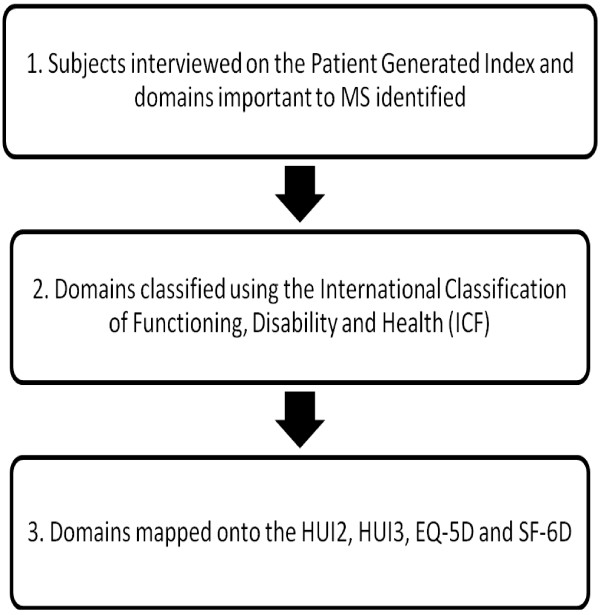
The available study population consisted of men and women who had been registered after 1994 in three participating MS clinics in Greater Montreal, Quebec, Canada. Subjects were first interviewed on an individualized measure of quality of life (QOL) called the Patient Generated Index (PGI). The domains identified with the PGI were then classified and grouped together using the World Health Organization's International Classification of Functioning, Disability and Health (ICF), and mapped onto the HUI2, HUI3, EQ-5D and SF-6D.
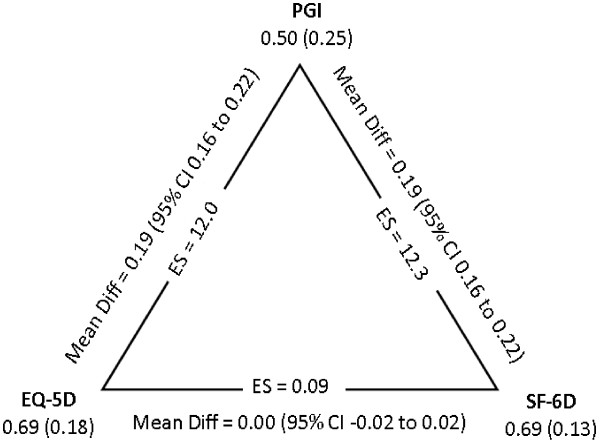
A total of 185 persons with MS were interviewed on the PGI. The sample was relatively young (mean age 43) and predominantly female. Both men and women had mild disability with a median Expanded Disability Status Scale (EDSS) score of 2. The top 10 domains that patients identified to be the most affected by their MS were, work (62%), fatigue (48%), sports (39%), social life (28%), relationships (23%), walking/mobility (22%), cognition (21%), balance (14%), housework (12%) and mood (11%). The SF-6D included the most number of domains (6 domains) important to people with MS, followed by the EQ-5D (4 domains) and the HUI2 (4 domains) and then the HUI3 (3 domains). The mean and standard deviation (SD) for the PGI, EQ-5D and the SF-6D were 0.50 (SD 0.25), 0.69 (0.18) and 0.69 (0.13), respectively. The magnitude of difference between the PGI and the generic utility measures was large and statistically significant.
Although the generic utility measures included certain items that were important to people with MS, there were several that were missing. An important consequence of this mismatch was that values of QOL derived from the PGI were importantly and significantly lower than those estimated using any of the generic utility measures. This could have a substantial impact in evaluating the effect of interventions for people with MS.
最广泛使用的三种效用衡量标准是健康效用指数 Mark 2 和 3(HUI2 和 HUI3)、欧洲五维健康量表(EQ-5D)和简短形式 6 维度(SF-6D)。符合国家卫生与临床卓越研究所(NICE)和加拿大药物和技术评估机构(CADTH)等机构的经济评估指南,这些衡量标准目前用于评估不同干预措施在多发性硬化症中的成本效益。然而,在患有特定健康状况(如多发性硬化症)的人群中使用这些衡量标准的挑战在于,它们可能无法捕捉到受病情影响的所有领域。如果通用衡量标准中缺少重要领域,则得出的价值将高于实际影响,从而在干预措施和人群之间造成无效比较。因此,本研究的目的是估计通用效用衡量标准在多大程度上可以捕捉到受多发性硬化症影响的重要领域。
可用的研究人群包括自 1994 年以来在加拿大魁北克省大蒙特利尔的三个参与多发性硬化症诊所登记的男性和女性。受试者首先接受了一项名为患者生成指数(PGI)的个性化生活质量(QOL)访谈。然后,使用世界卫生组织的国际功能、残疾和健康分类(ICF)对确定的 PGI 领域进行分类和分组,并映射到 HUI2、HUI3、EQ-5D 和 SF-6D。
共有 185 名多发性硬化症患者接受了 PGI 访谈。该样本相对年轻(平均年龄 43 岁),主要为女性。男性和女性的残疾程度都较轻,扩展残疾状况量表(EDSS)中位数为 2。患者认为最受多发性硬化症影响的前 10 个领域是工作(62%)、疲劳(48%)、运动(39%)、社会生活(28%)、人际关系(23%)、行走/移动(22%)、认知(21%)、平衡(14%)、家务(12%)和情绪(11%)。SF-6D 包括对多发性硬化症患者最重要的领域数量最多(6 个领域),其次是 EQ-5D(4 个领域)和 HUI2(4 个领域),然后是 HUI3(3 个领域)。PGI、EQ-5D 和 SF-6D 的平均值和标准差(SD)分别为 0.50(SD 0.25)、0.69(0.18)和 0.69(0.13)。PGI 和通用效用衡量标准之间的差异幅度很大且具有统计学意义。
尽管通用效用衡量标准包括对多发性硬化症患者重要的某些项目,但仍有一些项目缺失。这种不匹配的一个重要后果是,PGI 得出的生活质量价值明显低于使用任何通用效用衡量标准估计的值。这可能会对评估多发性硬化症患者干预措施的效果产生重大影响。