Centers for Disease Control and Prevention, 4770 Buford Hwy, MS K67, Atlanta, GA 30341, USA.
Prev Chronic Dis. 2013 Apr 25;10:E60. doi: 10.5888/pcd10.120316.
Public health and clinical strategies for meeting the emerging challenges of multiple chronic conditions must address the high prevalence of lifestyle-related causes. Our objective was to assess prevalence and trends in the chronic conditions that are leading causes of disease and death among adults in the United States that are amenable to preventive lifestyle interventions.
We used self-reported data from 196,240 adults aged 25 years or older who participated in the National Health Interview Surveys from 2002 to 2009. We included data on cardiovascular disease (coronary heart disease, angina pectoris, heart attack, and stroke), cancer, chronic obstructive pulmonary disease (emphysema and chronic bronchitis), diabetes, and arthritis.
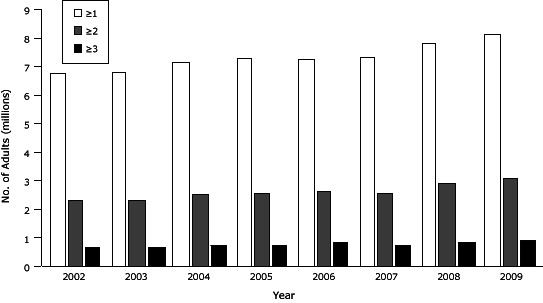
In 2002, an unadjusted 63.6% of participants did not have any of the 5 chronic conditions we assessed; 23.9% had 1, 9.0% had 2, 2.9% had 3, and 0.7% had 4 or 5. By 2009, the distribution of co-occurrence of the 5 chronic conditions had shifted subtly but significantly. From 2002 to 2009, the age-adjusted percentage with 2 or more chronic conditions increased from 12.7% to 14.7% (P < .001), and the number of adults with 2 or more conditions increased from approximately 23.4 million to 30.9 million.
The prevalence of having 1 or more or 2 or more of the leading lifestyle-related chronic conditions increased steadily from 2002 to 2009. If these increases continue, particularly among younger adults, managing patients with multiple chronic conditions in the aging population will continue to challenge public health and clinical practice.
应对多种慢性疾病带来的新挑战,公共卫生和临床策略必须解决与生活方式相关的主要病因的高患病率问题。我们的目标是评估可通过预防性生活方式干预进行治疗的美国成年人中导致疾病和死亡的主要慢性疾病的流行率和趋势。
我们使用了年龄在 25 岁及以上的 196240 名成年人自报数据,这些数据来自 2002 年至 2009 年参与国家健康访谈调查的成年人。我们纳入了心血管疾病(冠心病、心绞痛、心脏病发作和中风)、癌症、慢性阻塞性肺疾病(肺气肿和慢性支气管炎)、糖尿病和关节炎的数据。
2002 年,未经调整的 63.6%的参与者没有我们评估的 5 种慢性疾病中的任何一种;23.9%有 1 种,9.0%有 2 种,2.9%有 3 种,0.7%有 4 种或 5 种。到 2009 年,5 种慢性疾病共病的分布略有但显著改变。从 2002 年到 2009 年,年龄调整后患有 2 种或更多慢性疾病的百分比从 12.7%增加到 14.7%(P<0.001),患有 2 种或更多疾病的成年人人数从大约 2340 万增加到 3090 万。
从 2002 年到 2009 年,患有 1 种或更多或 2 种或更多主要与生活方式相关的慢性疾病的流行率稳步上升。如果这些增长持续下去,特别是在年轻成年人中,那么在人口老龄化的背景下管理患有多种慢性疾病的患者将继续给公共卫生和临床实践带来挑战。