Department of Biomedical Imaging and Radiological Sciences, National Yang Ming University, Taipei, Taiwan.
PLoS One. 2013 Apr 19;8(4):e61997. doi: 10.1371/journal.pone.0061997. Print 2013.
The accumulation of visceral adipose tissue that occurs with normal aging is associated with increased cardiovascular risks. However, the clinical significance, biological effects, and related cardiometabolic derangements of body-site specific adiposity in a relatively healthy population have not been well characterized.
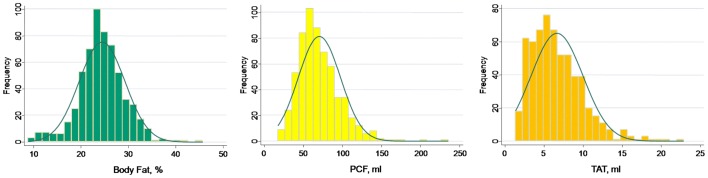
In this cross-sectional study, we consecutively enrolled 608 asymptomatic subjects (mean age: 47.3 years, 27% female) from 2050 subjects undergoing an annual health survey in Taiwan. We measured pericardial (PCF) and thoracic peri-aortic (TAT) adipose tissue volumes by 16-slice multi-detector computed tomography (MDCT) (Aquarius 3D Workstation, TeraRecon, San Mateo, CA, USA) and related these to clinical characteristics, body fat composition (Tanita 305 Corporation, Tokyo, Japan), coronary calcium score (CCS), serum insulin, high-sensitivity C-reactive protein (Hs-CRP) level and circulating leukocytes count. Metabolic risk was scored by Adult Treatment Panel III guidelines.
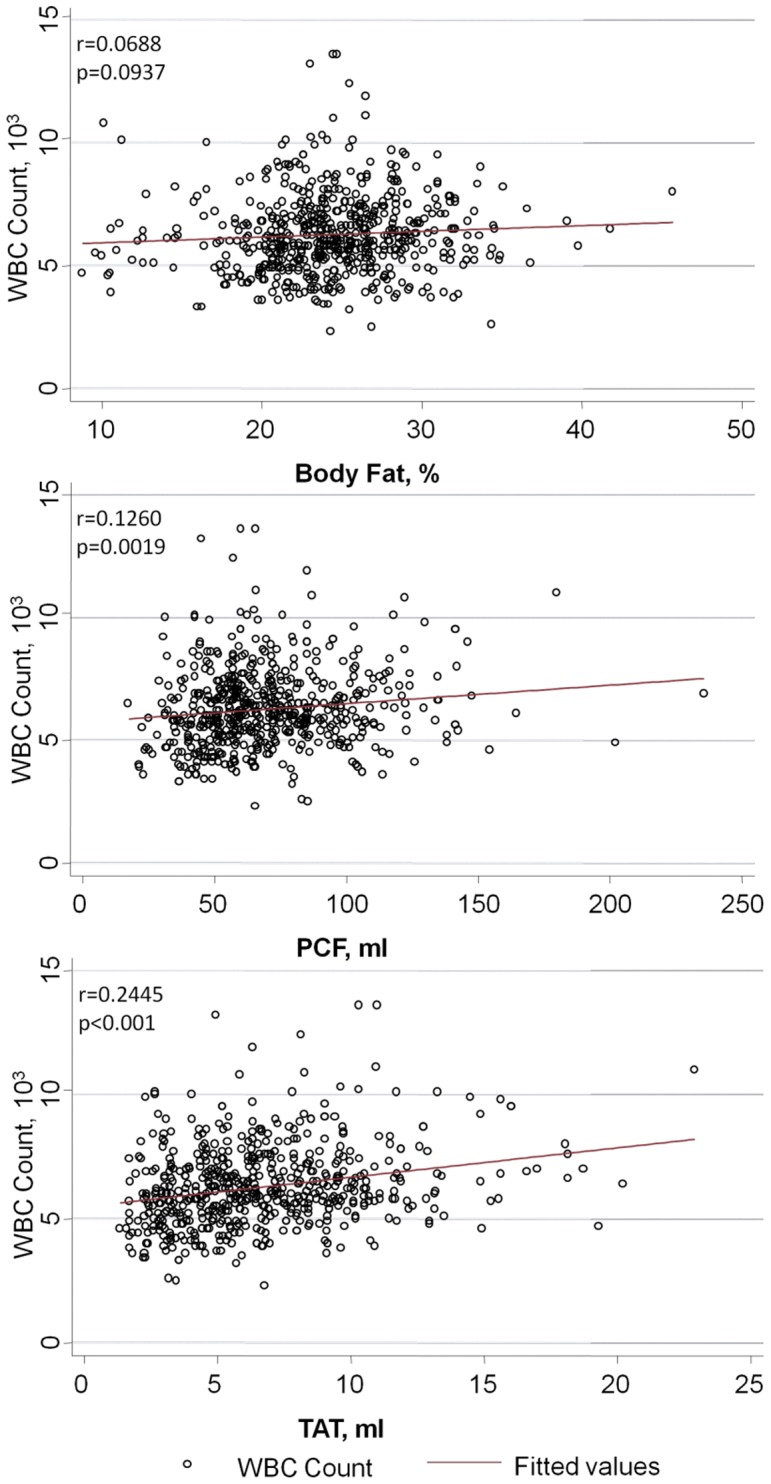
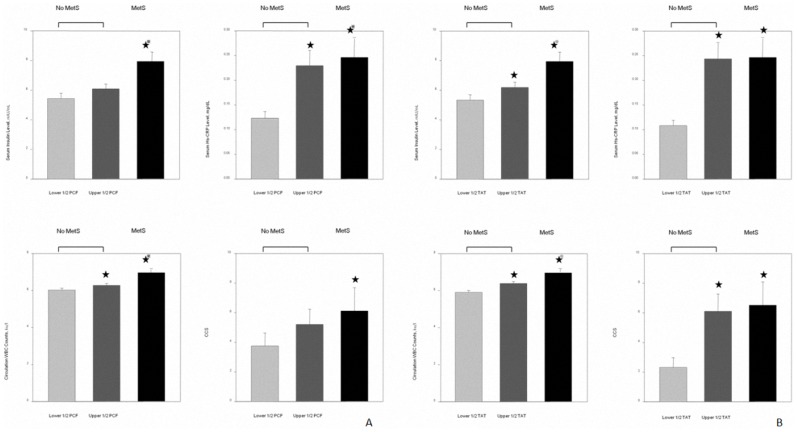
TAT, PCF, and total body fat composition all increased with aging and higher metabolic scores (all p<0.05). Only TAT, however, was associated with higher circulating leukocyte counts (ß-coef.:0.24, p<0.05), serum insulin (ß-coef.:0.17, p<0.05) and high sensitivity C-reactive protein (ß-coef.:0.24, p<0.05). These relationships persisted after adjustment in multivariable models (all p<0.05). A TAT volume of 8.29 ml yielded the largest area under the receiver operating characteristic curve (AUROC: 0.79, 95%CI: 0.74-0.83) to identify metabolic syndrome. TAT but not PCF correlated with higher coronary calcium score after adjustment for clinical variables (all p<0.05).
In our study, we observe that age-related body-site specific accumulation of adipose tissue may have distinct biological effects. Compared to other adiposity measures, peri-aortic adiposity is more tightly associated with cardiometabolic risk profiles and subclinical atherosclerosis in a relatively healthy population.
随着年龄的增长,内脏脂肪组织的积累与心血管风险的增加有关。然而,在相对健康的人群中,身体特定部位的肥胖的临床意义、生物学效应和相关的代谢紊乱尚未得到很好的描述。
在这项横断面研究中,我们连续纳入了来自台湾 2050 名接受年度健康检查的无症状受试者中的 608 名受试者(平均年龄:47.3 岁,27%为女性)。我们使用 16 层多探测器 CT(MDCT)(美国加利福尼亚州圣马特奥市 TeraRecon 公司的 Aquarius 3D 工作站)测量心外膜(PCF)和胸主动脉周围脂肪组织(TAT)体积,并将这些与临床特征、体脂组成(日本东京 Tanita 305 公司)、冠状动脉钙评分(CCS)、血清胰岛素、高敏 C 反应蛋白(Hs-CRP)水平和循环白细胞计数相关联。代谢风险按成人治疗专家组 III 指南进行评分。
TAT、PCF 和全身脂肪组成均随年龄增长和更高的代谢评分而增加(均 p<0.05)。然而,只有 TAT 与更高的循环白细胞计数(ß 系数:0.24,p<0.05)、血清胰岛素(ß 系数:0.17,p<0.05)和高敏 C 反应蛋白(ß 系数:0.24,p<0.05)相关。这些关系在多变量模型调整后仍然存在(均 p<0.05)。TAT 体积为 8.29ml 时,ROC 曲线下面积最大(AUROC:0.79,95%CI:0.74-0.83),可用于识别代谢综合征。在调整临床变量后,TAT 与更高的冠状动脉钙评分相关,而 PCF 则不相关(均 p<0.05)。
在我们的研究中,我们观察到与年龄相关的身体特定部位的脂肪组织积累可能具有不同的生物学效应。与其他肥胖测量指标相比,主动脉周围脂肪组织与相对健康人群的代谢风险特征和亚临床动脉粥样硬化的相关性更强。