Department of Physics and Astronomy and BioMaPS Institute for Quantitative Biology, Rutgers University, Piscataway, NJ 08854, USA.
BMC Genomics. 2013 Apr 26;14:284. doi: 10.1186/1471-2164-14-284.
Eukaryotic chromatin architecture is affected by intrinsic histone-DNA sequence preferences, steric exclusion between nucleosome particles, formation of higher-order structures, and in vivo activity of chromatin remodeling enzymes.
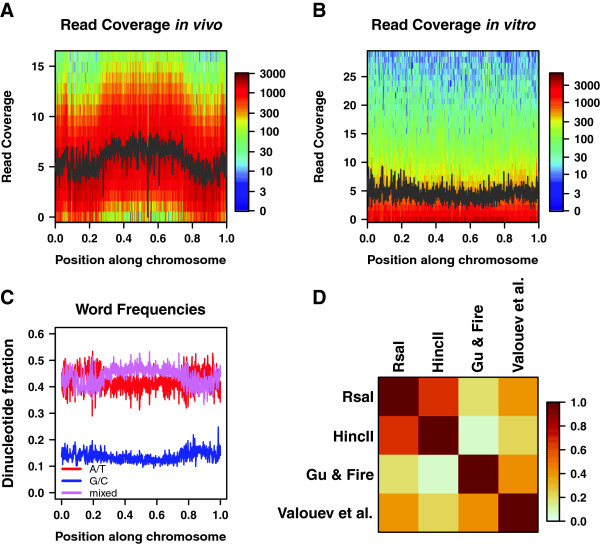
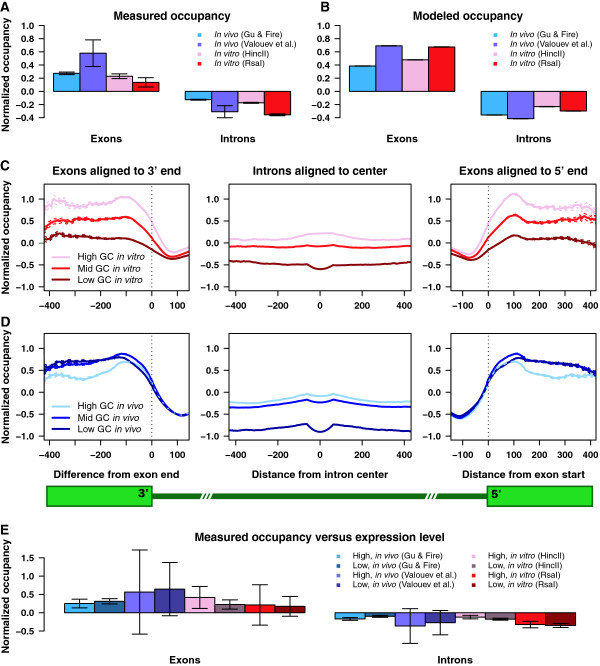
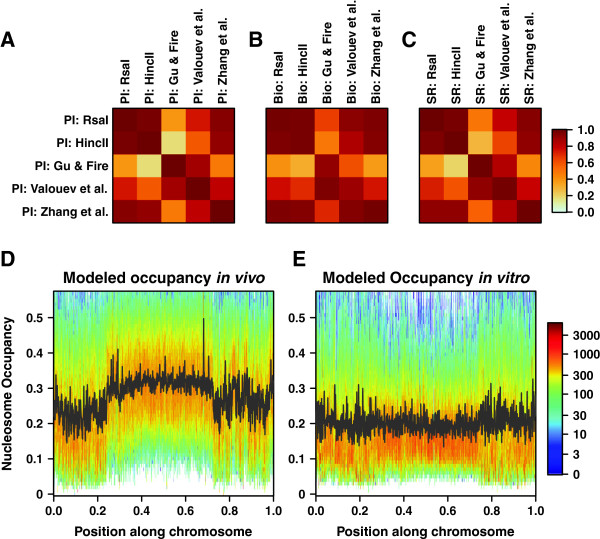
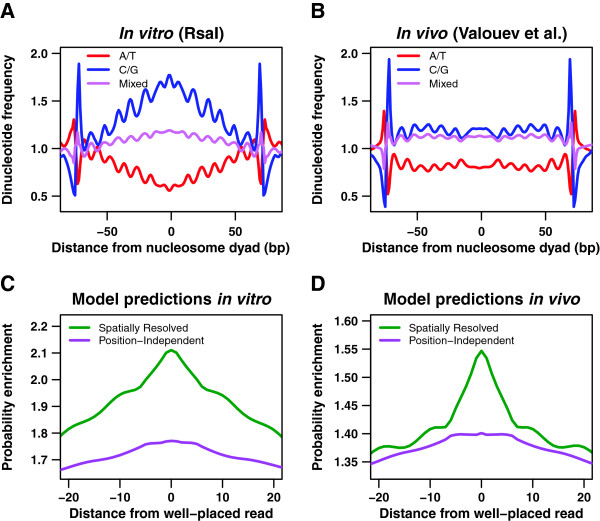
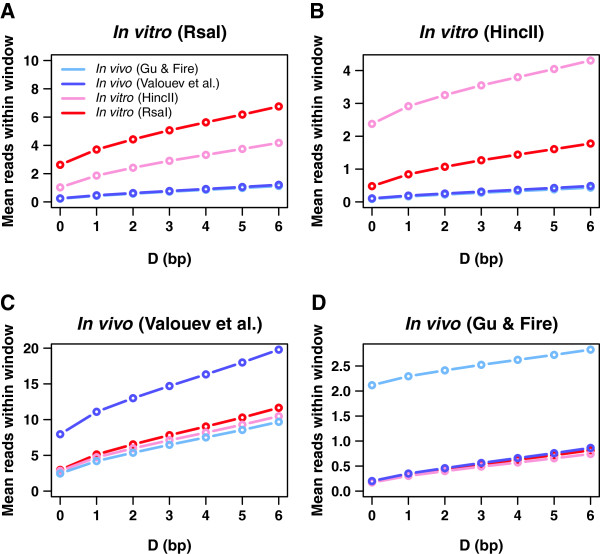
To disentangle sequence-dependent nucleosome positioning from the other factors, we have created two high-throughput maps of nucleosomes assembled in vitro on genomic DNA from the nematode worm Caenorhabditis elegans. A comparison of in vitro nucleosome positions with those observed in a mixed-stage, mixed-tissue population of C. elegans cells reveals that in vivo sequence preferences are modified on the genomic scale. Indeed, G/C dinucleotides are predicted to be most favorable for nucleosome formation in vitro but not in vivo. Nucleosome sequence read coverage in vivo is distinctly lower in chromosome arms than in central regions; the observed changes in apparent nucleosome sequence specificity, likely due to genome-wide chromatin remodeler activity, contribute to the formation of these megabase-scale chromatin domains. We also observe that the majority of well-positioned in vivo nucleosomes do not occupy thermodynamically favorable sequences observed in vitro. Finally, we find that exons are intrinsically more amenable to nucleosome formation compared to introns. Nucleosome occupancy of introns and exons consistently increases with G/C content in vitro but not in vivo, in agreement with our observation that G/C dinucleotide enrichment does not strongly promote in vivo nucleosome formation.
Our findings highlight the importance of both sequence specificity and active nucleosome repositioning in creating large-scale chromatin domains, and the antagonistic roles of intrinsic sequence preferences and chromatin remodelers in C. elegans.Sequence read data has been deposited into Sequence Read Archive (http://www.ncbi.nlm.nih.gov/sra; accession number SRA050182). Additional data, software and computational predictions are available on the Nucleosome Explorer website (http://nucleosome.rutgers.edu).
真核染色质结构受固有组蛋白-DNA 序列偏好、核小体颗粒之间的空间排斥、高级结构的形成以及染色质重塑酶的体内活性的影响。
为了将依赖于序列的核小体定位与其他因素分开,我们创建了两个基于线虫秀丽隐杆线虫基因组 DNA 的体外组装核小体的高通量图谱。将体外核小体位置与在混合阶段、混合组织的秀丽隐杆线虫细胞群体中观察到的位置进行比较,结果表明体内序列偏好在基因组尺度上发生了改变。事实上,在体外,G/C 二核苷酸最有利于核小体形成,但在体内则不然。体内核小体序列覆盖率在染色体臂中明显低于中央区域;观察到的表观核小体序列特异性变化,可能是由于全基因组染色质重塑剂的活性,有助于形成这些兆碱基规模的染色质域。我们还观察到,大多数定位良好的体内核小体并不占据体外观察到的热力学有利序列。最后,我们发现外显子比内含子更适合核小体形成。体外,无论是核小体在内含子还是外显子上的占有率都随 G/C 含量的增加而增加,但在体内则不然,这与我们的观察结果一致,即 G/C 二核苷酸富集并不能强烈促进体内核小体形成。
我们的研究结果强调了序列特异性和活跃的核小体重定位在创建大规模染色质域中的重要性,以及内在序列偏好和染色质重塑剂在秀丽隐杆线虫中的拮抗作用。序列读取数据已被存入序列读取档案(http://www.ncbi.nlm.nih.gov/sra; 访问号 SRA050182)。更多的数据、软件和计算预测可在核小体探索者网站(http://nucleosome.rutgers.edu)上获得。