Chereji Răzvan V, Morozov Alexandre V
Department of Physics and Astronomy, Rutgers University, Piscataway, NJ 08854-8019, USA.
J Stat Phys. 2011 Jul 1;144(2):379-404. doi: 10.1007/s10955-011-0214-y.
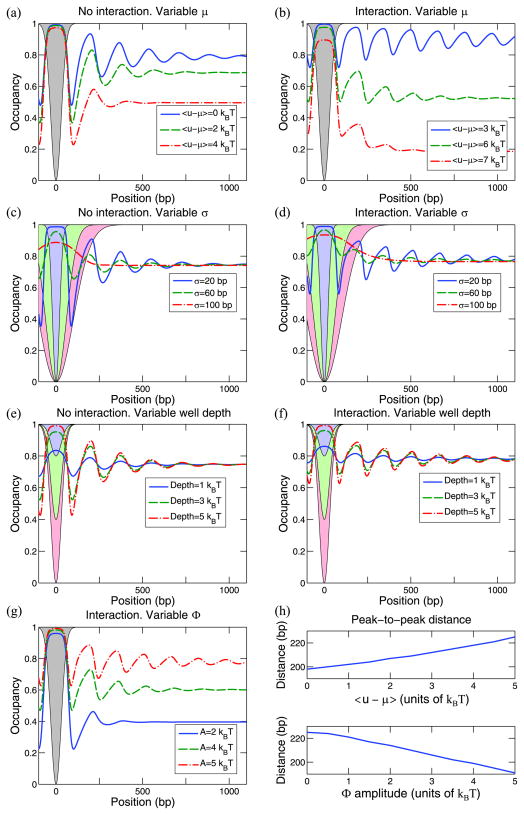
Eukaryotic DNA is packaged into chromatin: one-dimensional arrays of nucleosomes separated by stretches of linker DNA are folded into 30-nm chromatin fibers which in turn form higher-order structures (Felsenfeld and Groudine in Nature 421:448, 2003). Each nucleosome, the fundamental unit of chromatin, has 147 base pairs (bp) of DNA wrapped around a histone octamer (Richmond and Davey in Nature 423:145, 2003). In order to describe how chromatin fiber formation affects nucleosome positioning and energetics, we have developed a thermodynamic model of finite-size particles with effective nearest-neighbor interactions and arbitrary DNA-binding energies. We show that both one-and two-body interactions can be extracted from one-particle density profiles based on high-throughput maps of in vitro or in vivo nucleosome positions. Although a simpler approach that neglects two-body interactions (even if they are in fact present in the system) can be used to predict sequence determinants of nucleosome positions, the full theory is required to disentangle one- and two-body effects. Finally, we construct a minimal model in which nucleosomes are positioned primarily by steric exclusion and two-body interactions rather than intrinsic histone-DNA sequence preferences. The model reproduces nucleosome occupancy patterns observed over transcribed regions in living cells.
真核生物的DNA被包装成染色质:由连接DNA片段隔开的核小体一维阵列折叠成30纳米的染色质纤维,进而形成更高阶的结构(费尔森菲尔德和格鲁丁,《自然》421:448,2003年)。每个核小体作为染色质的基本单位,有147个碱基对(bp)的DNA缠绕在一个组蛋白八聚体周围(里士满和戴维,《自然》423:145,2003年)。为了描述染色质纤维形成如何影响核小体定位和能量学,我们开发了一个有限尺寸颗粒的热力学模型,该模型具有有效的近邻相互作用和任意的DNA结合能。我们表明,单粒子相互作用和两体相互作用都可以从基于体外或体内核小体位置高通量图谱的单粒子密度分布中提取出来。虽然一种忽略两体相互作用的更简单方法(即使它们实际上存在于系统中)可用于预测核小体位置的序列决定因素,但需要完整的理论来区分单粒子和两体效应。最后,我们构建了一个最小模型,其中核小体主要通过空间排斥和两体相互作用而非内在的组蛋白-DNA序列偏好来定位。该模型再现了活细胞中转录区域观察到的核小体占据模式。