Department of Neurobiology, Northwestern University, Evanston, Illinois 60208, USA.
Nature. 2013 May 23;497(7450):486-9. doi: 10.1038/nature12114. Epub 2013 Apr 28.
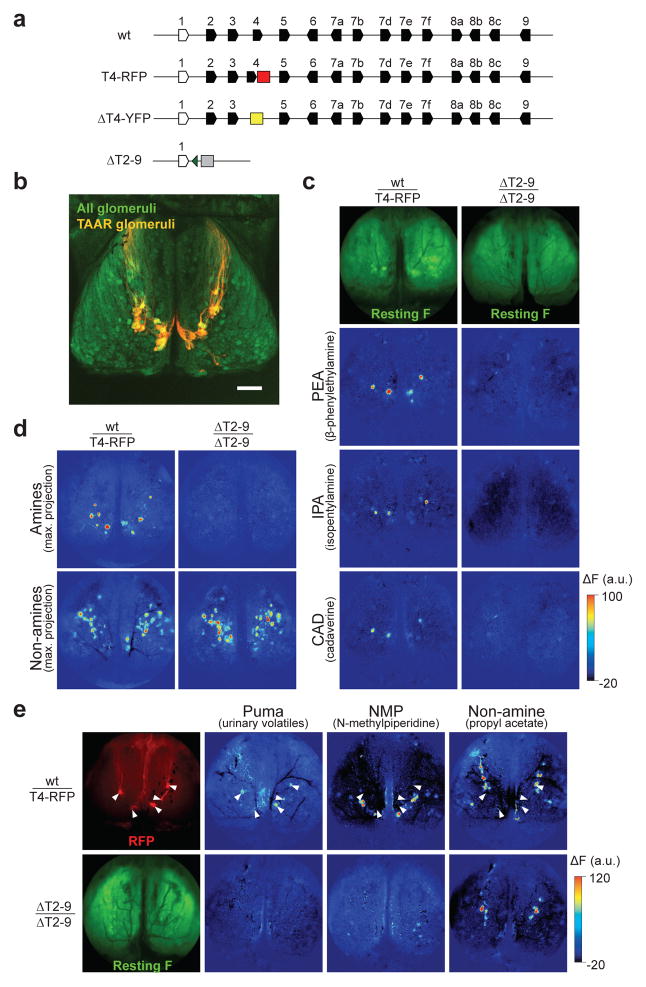
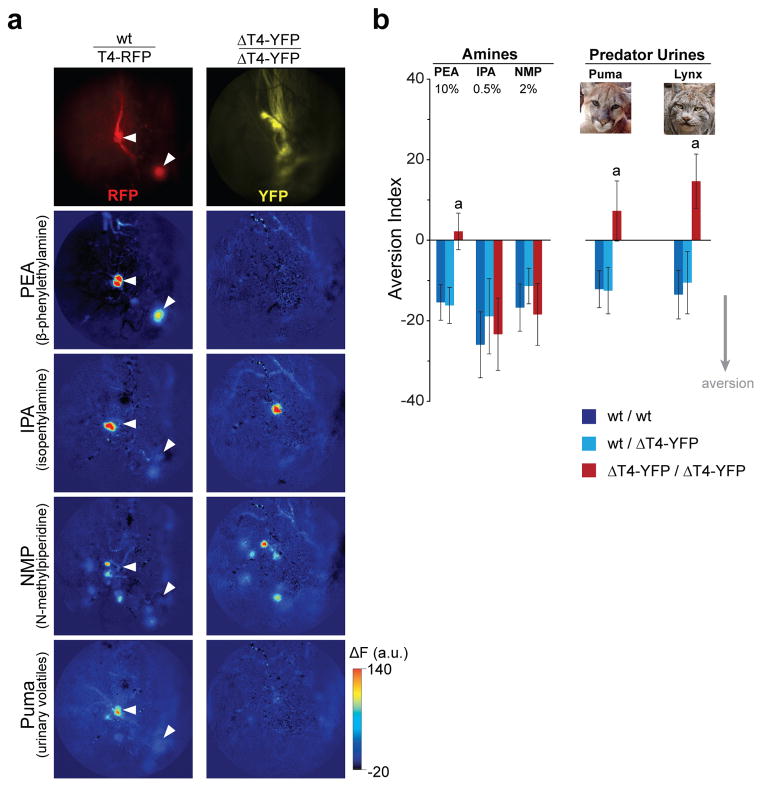
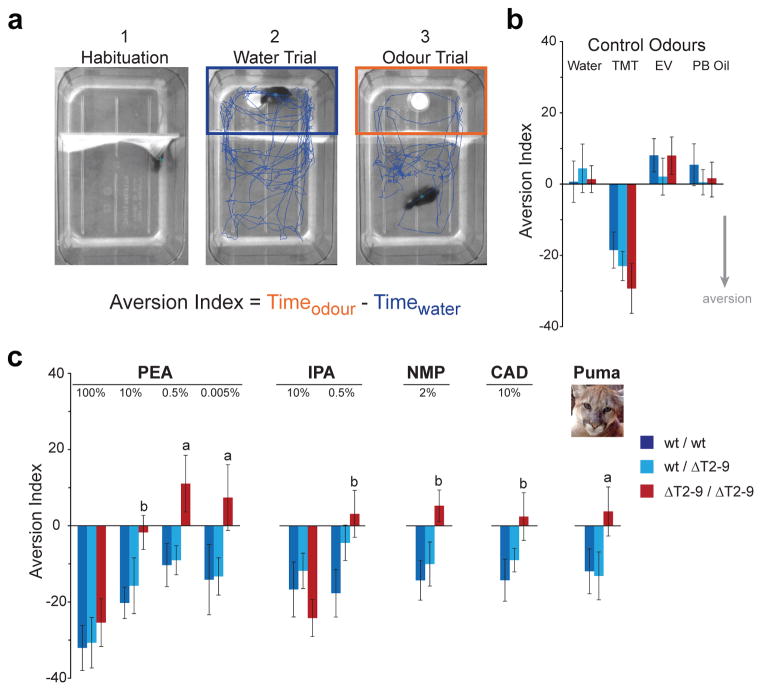
Many species are critically dependent on olfaction for survival. In the main olfactory system of mammals, odours are detected by sensory neurons that express a large repertoire of canonical odorant receptors and a much smaller repertoire of trace amine-associated receptors (TAARs). Odours are encoded in a combinatorial fashion across glomeruli in the main olfactory bulb, with each glomerulus corresponding to a specific receptor. The degree to which individual receptor genes contribute to odour perception is unclear. Here we show that genetic deletion of the olfactory Taar gene family, or even a single Taar gene (Taar4), eliminates the aversion that mice display to low concentrations of volatile amines and to the odour of predator urine. Our findings identify a role for the TAARs in olfaction, namely, in the high-sensitivity detection of innately aversive odours. In addition, our data reveal that aversive amines are represented in a non-redundant fashion, and that individual main olfactory receptor genes can contribute substantially to odour perception.
许多物种在生存上严重依赖嗅觉。在哺乳动物的主要嗅觉系统中,气味是由表达大量经典气味受体和少量痕量胺相关受体 (TAARs) 的感觉神经元检测到的。气味在嗅球的神经球中以组合的方式进行编码,每个神经球对应于特定的受体。个体受体基因对气味感知的贡献程度尚不清楚。在这里,我们表明,嗅觉 Taar 基因家族的遗传缺失,甚至单个 Taar 基因(Taar4)的缺失,都会消除老鼠对低浓度挥发性胺和捕食者尿液气味的厌恶。我们的研究结果确定了 TAARs 在嗅觉中的作用,即在高灵敏度检测先天厌恶的气味。此外,我们的数据表明,厌恶的胺以非冗余的方式表示,并且单个主要嗅觉受体基因可以对气味感知做出重要贡献。