Department of Molecular Biophysics and Biochemistry, Yale University School of Medicine, New Haven, Connecticut, USA.
Nat Struct Mol Biol. 2013 Jun;20(6):662-70. doi: 10.1038/nsmb.2564. Epub 2013 Apr 28.
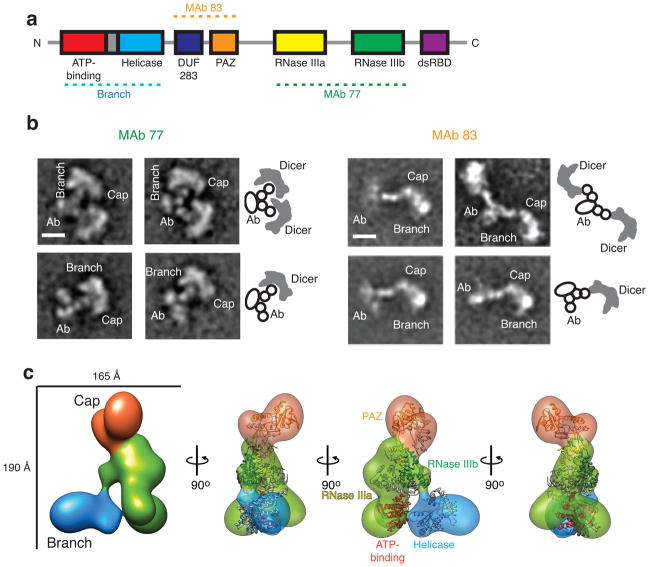
Dicer has a central role in RNA-interference pathways by cleaving double-stranded RNAs (dsRNAs) to produce small regulatory RNAs. Human Dicer can process long double-stranded and hairpin precursor RNAs to yield short interfering RNAs (siRNAs) and microRNAs (miRNAs), respectively. Previous studies have shown that pre-miRNAs are cleaved more rapidly than pre-siRNAs in vitro and are the predominant natural Dicer substrates. We have used EM and single-particle analysis of Dicer-RNA complexes to gain insight into the structural basis for human Dicer's substrate preference. Our studies show that Dicer traps pre-siRNAs in a nonproductive conformation, whereas interactions of Dicer with pre-miRNAs and dsRNA-binding proteins induce structural changes in the enzyme that enable productive substrate recognition in the central catalytic channel. These findings implicate RNA structure and cofactors in determining substrate recognition and processing efficiency by human Dicer.
Dicer 在 RNA 干扰途径中具有核心作用,通过切割双链 RNA (dsRNA) 产生小的调节 RNA。人 Dicer 可以处理长的双链和发夹前体 RNA,分别产生短干扰 RNA (siRNA) 和 microRNAs (miRNA)。先前的研究表明,在体外,pre-miRNA 的切割速度快于 pre-siRNA,并且是主要的天然 Dicer 底物。我们使用 EM 和 Dicer-RNA 复合物的单颗粒分析来深入了解人 Dicer 底物偏好的结构基础。我们的研究表明,Dicer 将 pre-siRNA 捕获在非生产性构象中,而 Dicer 与 pre-miRNA 和 dsRNA 结合蛋白的相互作用诱导酶的结构变化,从而使中央催化通道中的生产性底物识别成为可能。这些发现表明 RNA 结构和辅助因子在决定人 Dicer 的底物识别和加工效率中起作用。